Best overall portable satellite internet terminal in 2026: Starlink Mini. Best for a staffed field camp: Starlink Standard. Best for essential communication where broadband is unnecessary: Iridium GO! exec. Best for a dedicated BGAN field connection: Hughes 9202 BGAN.
- Starlink Mini is the best portable satellite internet terminal for teams that need broadband and move between sites.
- Starlink Standard suits a field camp with room and power for a larger setup; Iridium GO! exec suits essential communication, not broadband.
- Choose Hughes 9202 BGAN when a dedicated BGAN connection matters more than broadband speed.
Why this matters
A portable terminal solves the link between your location and a satellite network. It does not, by itself, connect every responder, vehicle, or building at the site. HeliosNet develops decentralized mesh, LTE, and satellite communication network infrastructure; that makes site-wide connectivity a separate planning decision from the terminal you carry.
The first question is what must work when the terrestrial connection fails. Video calls and shared work files point toward satellite broadband. Short operational messages and essential applications call for a different kind of device. A field camp also has different space and power constraints from someone carrying equipment between locations. Pick the communication task first, then the terminal.
In 2026, portable still does not mean usable from any spot. Satellite links depend on a suitable view of the sky, compatible service, power, and a setup you can deploy at the site. A terminal that fits your bag but cannot serve your actual workflow is the wrong purchase.
What makes the best portable satellite internet terminal
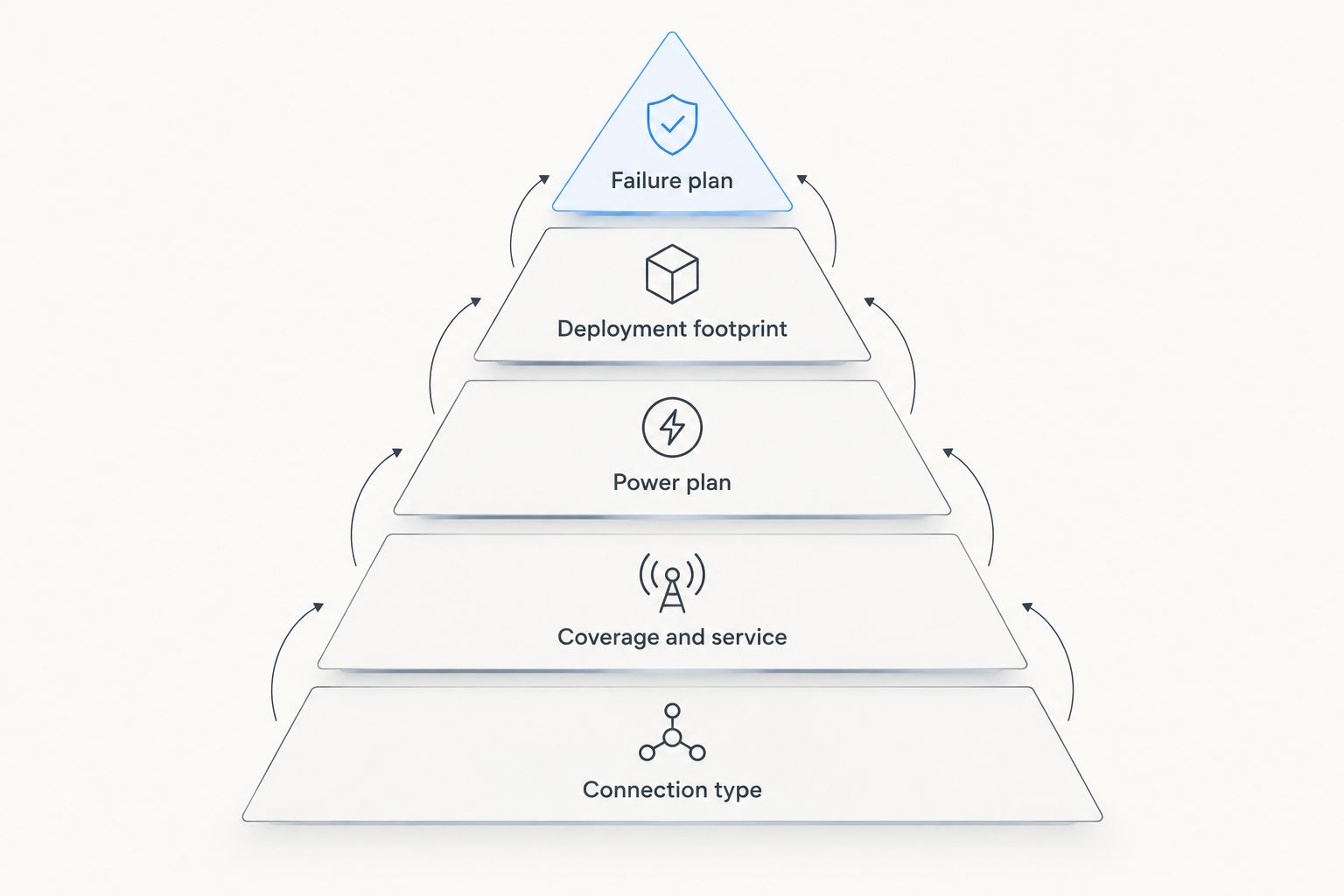
Use these criteria before comparing model names:
- Connection type: Decide whether you need general internet access, essential app connectivity, or a dedicated BGAN connection. These are not interchangeable workloads.
- Deployment footprint: Account for the terminal, its mounting position, cables, power source, and the space needed for a clear sky view.
- Power plan: Check the device's current power requirements against what you can supply throughout an outage or field deployment.
- Coverage and service: Confirm the current coverage map and service terms for the places you will operate. Hardware alone does not establish service.
- User load: Identify what each person needs to do. One operator sending a report is a different requirement from a camp sharing a connection.
- Failure plan: Decide how users communicate if the terminal loses sky visibility or power. A second path or local network needs its own design.
The best portable satellite internet terminal is the one that supports the required work at the deployment site, not the one with the broadest category label. Apply the same test to a planned deployment and to an emergency kit.
Portable satellite terminals at a glance
| Terminal | Best for | Standout feature | Key limitation |
|---|---|---|---|
| Starlink Mini | Broadband while moving between sites | Compact satellite broadband terminal | Needs power and a suitable sky view; confirm the service arrangement |
| Starlink Standard | Broadband at a staffed field camp | Larger terminal setup suited to a staging location | Less convenient to carry and set up frequently |
| Iridium GO! exec | Essential communication through supported apps | Portable connectivity built around Iridium's satellite network | Not a substitute for unrestricted broadband |
| Hughes 9202 BGAN | A dedicated BGAN field connection | Portable terminal for Inmarsat BGAN service | A poor fit when the main task is heavy broadband use |
These are different answers to different operating conditions. The table is not a claim that every terminal supports the same applications, coverage, or number of users. Check those requirements against current device documentation and the service you intend to use before committing a team to one option.
1. Starlink Mini: best portable satellite internet terminal for moving teams
Starlink Mini is the default choice when you need general internet access and expect to move between sites. Its compact form makes more sense for a small mobile team than a larger camp-oriented setup. You still need to position it for satellite reception and provide power wherever the team stops.
Starlink Mini is best for mobile teams that need portable satellite broadband rather than an app-limited communication device. That is the decisive difference between it and Iridium GO! exec. It also explains why Mini ranks above Standard for a person who must pack, carry, and redeploy the terminal regularly.
Starlink Mini pros:
- Supports a general broadband use case rather than only selected communication apps.
- Fits a move-and-redeploy workflow better than a larger terminal setup.
- Makes sense when the satellite link is the team's primary internet path at each stop.
Starlink Mini cons:
- A poor sky view can prevent the setup from serving the intended location.
- Power and service eligibility still need to be checked for each deployment pattern.
- The terminal alone does not provide a site-wide mesh or LTE network.
Best for: Small teams that need internet access across changing field locations. Verdict: Buy when portability and general internet use are both firm requirements; hold if the work can be handled through essential-message applications instead.
2. Starlink Standard: best satellite terminal for a staffed field camp
Starlink Standard belongs on this list for deployments that relocate but operate from a staffed staging point once set up. A camp has room to plan terminal placement, cable routing, and power distribution. Those conditions make a larger setup more reasonable than they would be for an individual carrying everything between stops.
Choose Standard for the location, not because its name suggests a universal upgrade. A field camp can still fail to connect if its terminal has a poor view of the sky. The crew also needs to confirm that its intended service arrangement covers how and where the equipment will be used.
Starlink Standard pros:
- Suits a planned, staffed broadband deployment.
- Gives a team a clear focal point for arranging the satellite connection at camp.
- Makes sense when setup is less frequent than day-to-day use at one location.
Starlink Standard cons:
- Less convenient than Mini for frequent packing and redeployment.
- Requires a deliberate plan for placement, power, and local distribution.
- Does not remove the need to check current service terms for the deployment.
Best for: Field camps where staff can establish and maintain a broadband setup. Verdict: Buy for a planned staging location; skip it as the default if one person must carry and reposition the connection repeatedly.
3. Iridium GO! exec: best for essential communication
Iridium GO! exec serves a narrower job than the Starlink terminals: keeping supported communication and application workflows available over the Iridium satellite network. Treat it as a way to carry out defined tasks, not as an automatic replacement for a conventional internet connection. Test the exact applications your team depends on before making it the emergency path.
Iridium's constellation has 66 satellites in its operational network. That network design matters to buyers who must consider where their teams operate, but constellation size does not tell you whether a particular app will work. Document the workflow first: who sends what, through which application, and under which conditions.
Iridium GO! exec pros:
- Fits teams with a short list of essential communication tasks.
- Offers a distinct option when general broadband is not the requirement.
- Encourages an operational plan built around supported applications.
Iridium GO! exec cons:
- Not the right pick for teams expecting unrestricted broadband behavior.
- Application support must be verified against the team's actual workflow.
- Users still need a workable position for satellite communication.
Best for: Field operators whose priority is supported messaging and essential applications. Verdict: Buy for a verified, limited workflow; skip it for a team whose core work requires general broadband.
4. Hughes 9202 BGAN: best for a dedicated BGAN field connection
Hughes 9202 BGAN is a portable terminal for the Inmarsat BGAN service. It fits a field operation that has already decided BGAN supports its applications and operating locations. It is not the default choice for a group expecting the same heavy internet use it would put on a broadband camp connection.
Network architecture explains part of that distinction. Low Earth orbit is generally defined as extending to about 2,000 km above Earth, while a geostationary satellite orbits about 35,786 km above the equator. That distance difference affects signal travel time, but it does not settle a buying decision by itself. Coverage, application requirements, and the available service still come first.
Hughes 9202 BGAN pros:
- Provides a defined portable-terminal option for a BGAN deployment.
- Fits an organization with an established BGAN communication plan.
- Makes the service choice explicit before teams deploy.
Hughes 9202 BGAN cons:
- Not the best default for heavy, general broadband use.
- Requires confirmation that BGAN service fits each operating location.
- A terminal does not solve local distribution to other users or devices.
Best for: Teams specifying a BGAN field connection for known tasks. Verdict: Buy when BGAN is an established requirement; skip it if the requirement is simply portable general-purpose internet.
How these terminals were ranked
This ranking weighs the connection task, carrying burden, setup needs, and fit for the named user. It does not rank equipment by an unverified speed claim or assume that a satellite service works at every site. In 2026, Starlink Mini wins the general portable-broadband slot because the question is how to take an internet connection between locations. Starlink Standard moves up when the deployment is a staffed camp; Iridium GO! exec and Hughes 9202 BGAN belong to narrower communication plans.
The ranking also separates a satellite uplink from the network behind it. HeliosNet satellite-network infrastructure addresses mesh, LTE, and satellite communication at the network level, while this list compares individual terminals by field use. A buyer planning responder or enterprise connectivity should specify both layers rather than assume the terminal covers every user on site.
Which portable satellite terminal should you choose?
Choose Starlink Mini if you need one default portable satellite broadband terminal in 2026. Choose Starlink Standard if your team will establish a staffed camp and leave the setup in place during operations. Choose Iridium GO! exec when supported essential communication matters more than general internet access. Choose Hughes 9202 BGAN when your field plan specifically calls for BGAN.
Before purchasing, write down the operating locations, the applications that must work, who needs access, and the power available at each site. Then verify the current service terms and hardware requirements against that list. If several people or vehicles need access, plan the local network separately from the satellite link.
For organizations designing that wider connection, HeliosNet develops decentralized mesh, LTE, and satellite communication network infrastructure and offers the DeadZone Wireless hardware line. That stated scope does not make DeadZone Wireless a ranked standalone terminal here. HeliosNet is best considered alongside the terminal decision when the problem includes network reach across a site, not just a satellite connection at one point.
FAQ
What is the best portable satellite internet terminal in 2026?
Starlink Mini is the best default for portable satellite broadband in 2026. Choose it when a team needs general internet access and expects to move between locations.
Is Starlink Mini better than Starlink Standard for a field team?
Starlink Mini is the better fit for a team that carries and redeploys its terminal frequently. Starlink Standard fits a staffed field camp where the setup can remain in place during operations.
Can Iridium GO! exec replace a portable broadband terminal?
No, Iridium GO! exec is a better fit for supported essential communication workflows than for unrestricted broadband use. Confirm your required applications before assigning it an emergency role.
When should I choose a Hughes 9202 BGAN terminal?
Choose Hughes 9202 BGAN when a portable Inmarsat BGAN connection is part of your field plan. Confirm service coverage and application fit for each operating location.
Will a portable satellite terminal connect an entire field site?
A portable satellite terminal establishes a satellite connection, not a complete site-wide network. Plan local distribution separately if users across a camp, buildings, or vehicles need access.
What should an emergency team verify before deployment?
Verify service coverage, the required applications, a clear sky view, and a workable power source. Test the full communication workflow at a representative site before relying on it during an incident.
Does HeliosNet sell one of the terminals in this ranking?
This ranking does not identify a HeliosNet terminal as one of the listed models. HeliosNet develops mesh, LTE, and satellite communication network infrastructure and offers the DeadZone Wireless hardware line.
One last thing
A backup terminal needs a backup operating plan. In 2026, make the deployment check practical: name the person who sets up the terminal, the applications they must verify, the power source, and the way other users reach the connection. HeliosNet satellite-network infrastructure is relevant when that last step extends beyond one terminal position. A working satellite link is only the first part of a working field network.