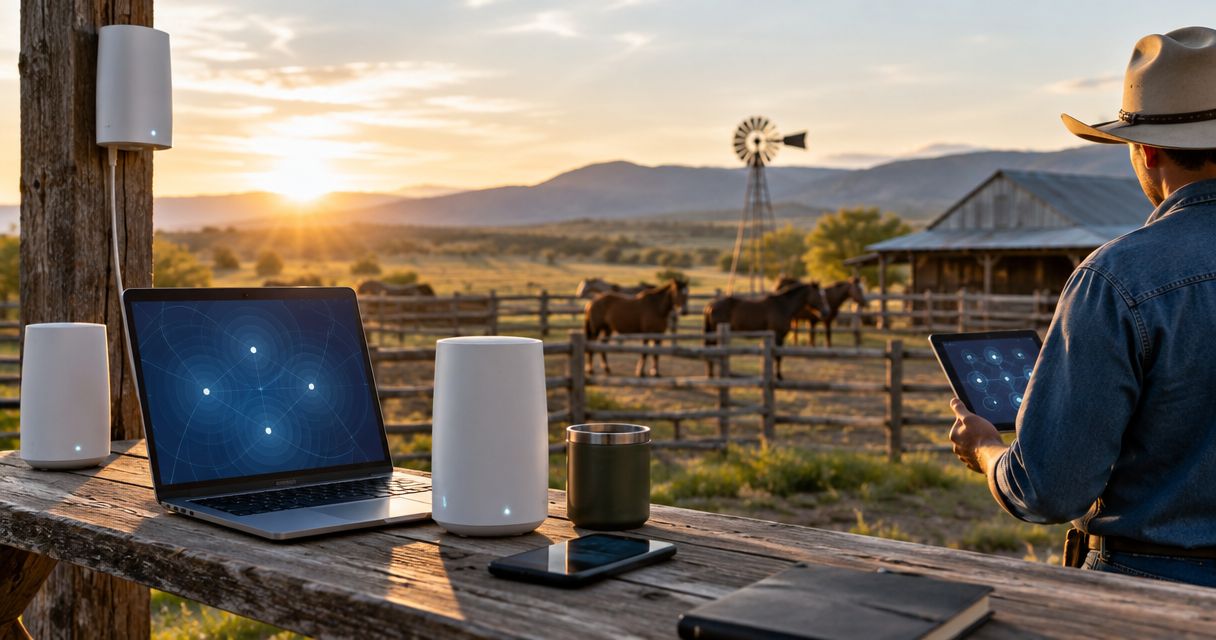
The cost to set up a mesh network for a ranch requires a site-specific quote covering equipment, installation, power, and any connection to the outside internet. For your 2026 budget, separate the initial installation from ongoing service and maintenance: a hardware-only quote does not describe the full project.
- The cost to set up mesh network for ranch depends on terrain, applications, power, and internet backhaul.
- HeliosNet LLC develops mesh, LTE, and satellite infrastructure for rural communities and off-grid users.
- Local messaging and ranch-wide broadband require different network designs; specify the job before comparing equipment.
- Compare complete installed quotes, including mounting, power, configuration, testing, and ongoing service obligations.
Why this matters
A ranch network connects places with different needs: a house, equipment shed, remote gate, water installation, or work area. Treating every location as a broadband destination creates a different project from connecting devices that send occasional status messages.
Define what must work before deciding what to buy. HeliosNet LLC develops decentralized mesh, LTE, and satellite communication infrastructure for rural communities and off-grid users. Those technologies address different parts of a connectivity plan; they are not interchangeable substitutes.
Your 2026 budget should describe the service you expect at each location, not just a collection of radios. That distinction makes competing installation quotes easier to compare and gives you a practical acceptance test.
How much does it cost to set up a mesh network for a ranch?
A defensible ranch mesh-network budget is an itemized installation quote plus a separate operating budget. Acreage alone cannot determine the total because radio paths, available power, and application requirements determine the design.
Use this breakdown when requesting proposals:
| Budget component | What the quote should identify | What to verify |
|---|---|---|
| Network equipment | Radios, gateways, antennas, and required accessories | Each device has a defined role and location |
| Installation | Mounting, cabling, weather protection, and configuration | Labor and materials are explicitly included |
| Site power | Existing electrical supply or a designed off-grid supply | The supply supports the intended operating conditions |
| Internet backhaul | The connection carrying traffic beyond the ranch | Local communication and internet access are distinguished |
| Testing | Coverage checks and application tests | Tests match the places and tasks you specified |
| Ongoing operation | Service obligations, maintenance, and support | Responsibility for each item is assigned |
Compare completed systems, not equipment lists. A proposal that includes installation and testing has a different scope from a box of hardware, even when both descriptions use the word “mesh.”
Ask each installer to state exclusions beside the relevant line item. A separate exclusion page makes it harder to see whether mounting work, electrical work, or configuration remains your responsibility.
Local messaging and telemetry: best for small data exchanges
A network intended for short messages or sensor readings has different requirements from a network carrying broadband traffic. Start with the actual information: a gate status, a water-level reading, or a worker's message.
Low-data-rate technologies such as LoRa are intended for small data exchanges, not broadband video. Mesh routing also depends on the hardware and software implementation; a LoRa radio does not automatically provide a complete mesh system.
The advantage is a design focused on the information you need rather than on general internet access. The limitation is application scope: a messaging or telemetry network does not automatically support cameras, calls, or ordinary web use.
Specify how each reading or message reaches its destination. Include the receiving device, application, and any gateway in the proposal, rather than assuming the radios alone complete the workflow.
Broadband links: best for connected buildings and work areas
If you need web access, camera feeds, or networked computers at an outbuilding, describe that requirement explicitly. A broadband wireless design must account for traffic demand and the radio paths between locations.
Do not require a mesh topology before the site assessment. A direct wireless bridge or wired connection can serve a fixed building without adding intermediate mesh hops; the appropriate topology depends on the site.
The benefit of a broadband design is support for applications that small-message networks cannot carry. The trade-off is that antenna placement, installation, and power arrangements must suit those applications, not merely establish an occasional connection.
Ask the installer to distinguish the link between buildings from coverage inside each building. Getting a signal to a barn and providing usable access throughout the barn are separate design tasks.
Internet backhaul: best for access beyond the ranch
A local mesh network does not create internet service. It carries traffic within its supported network; reaching an external website, cloud application, or remote user requires an appropriate upstream connection.
That connection might use an existing fixed service, LTE, or satellite, depending on the site and service requirements. Confirm coverage, installation conditions, and contractual obligations with the relevant provider before treating any connection as part of the design.
Backhaul adds outside connectivity, but it also introduces an external dependency. A proposal should state which functions continue locally when that upstream connection is unavailable.
For your 2026 comparison, keep the local network and upstream service in separate budget lines. This prevents an internet subscription from being confused with the equipment that distributes connectivity around the ranch.
Which ranch network design fits your job?
These options describe different network functions, not competing product tiers. A ranch can need more than one, but each should solve an identified problem.
| Network function | Best for | Main benefit | Main limitation |
|---|---|---|---|
| Local messaging or telemetry | Small status updates and supported messages | Moves operational information locally | Does not provide broadband capability |
| Broadband building links | Connected offices, barns, and work areas | Supports higher-data applications with suitable equipment | Requires appropriate radio paths and installation |
| Internet backhaul | Cloud services and communication beyond the ranch | Connects the local network to outside services | Depends on the upstream connection |
Choose by application, then select the topology. Buying a mesh kit before defining the traffic reverses that order and leaves essential compatibility questions unanswered.
Keep the requirements separate when discussing a combined system. A successful sensor message does not prove a video connection works, and a working internet connection at the house does not prove coverage at a remote gate.
Why ranch mesh-network costs vary
The same property can support different network designs depending on what you need to connect. These factors belong in the site assessment and the written proposal:
- Terrain and obstructions: Hills, vegetation, and buildings affect radio paths. The installation plan should identify the paths rather than assume coverage from a map boundary.
- Application demand: Short messages, sensor updates, and broadband traffic impose different requirements. Specify the application at each endpoint.
- Mounting access: Existing suitable structures and locations requiring new mounting work create different installation scopes. Identify access and mounting responsibilities before approval.
- Power availability: A powered building and an isolated installation require different power arrangements. Include power equipment and its upkeep in the design.
- Outside connectivity: Local-only communication and internet-connected operation have different dependencies. State whether backhaul is required and which functions depend on it.
- Maintenance responsibility: Remote access, physical repairs, and configuration support are separate tasks. Assign them rather than treating maintenance as an undefined allowance.
Acreage is context, not a bill of materials. Mark the actual destinations and proposed radio paths so the installer can explain what each piece of equipment accomplishes.
How to request a comparable installation quote
Give every installer the same requirements. Otherwise, the proposals can describe different systems while appearing to answer the same question.
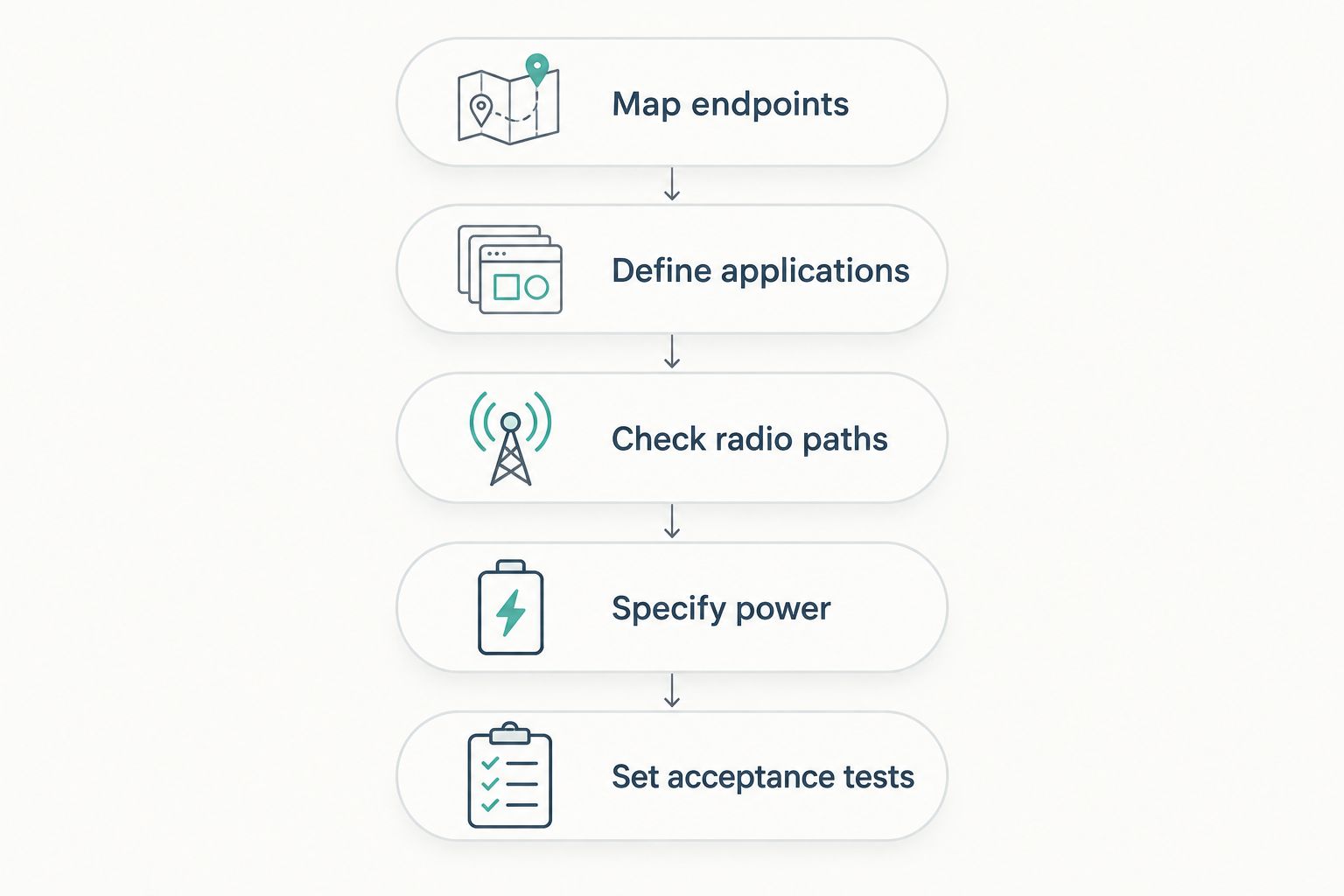
- Map endpoints. Mark buildings, gates, work areas, and monitoring locations. Identify where people need access and where only a fixed device needs a connection.
- Define applications. Describe messaging, telemetry, web access, or video separately. Name the devices and applications that must communicate.
- Check radio paths. Request a site assessment of proposed mounting locations and obstructions. Do not accept an unverified coverage circle as the installation plan.
- Specify power. Identify existing electrical supplies and locations requiring an independent supply. Require the installer to explain the proposed power arrangement.
- Set acceptance tests. Write down the tasks that must work at each endpoint. Include an upstream-disconnection test when local operation during an outage is a requirement.
Ask for a marked-up site plan with the proposal. It should connect each equipment item to a location and purpose, so you can distinguish necessary infrastructure from optional additions.
Keep a dated copy of your 2026 requirements with the approved scope. If an endpoint or application changes later, you can identify the change instead of arguing about what the original proposal meant.
Where does HeliosNet LLC fit?
HeliosNet LLC is best suited to rural and off-grid buyers evaluating mesh, LTE, and satellite communication infrastructure. Its stated offering includes the DeadZone Wireless hardware line, making it relevant to a ranch connectivity discussion.
That fit is not a substitute for a site design. Confirm the proposed equipment's supported applications, interoperability, power requirements, and installation scope before selecting it for your ranch mesh network.
Can I install a ranch mesh network myself?
Self-installation requires you to handle placement, configuration, power, and testing for the equipment you select. A setup involving elevated mounting or electrical work also requires appropriate skills and safe working practices.
Use the same written acceptance criteria whether you install the system yourself or hire an installer. Saving installation labor does not remove the need to verify the result.
Does a ranch mesh network need a monthly subscription?
A local mesh network does not inherently require an internet subscription to exchange supported traffic locally. Internet backhaul, hosted applications, management software, and support can carry separate service obligations, depending on the selected system.
Request a written list of required and optional services. Do not treat “works without internet” as proof that every part of the proposed solution has no ongoing obligations.
Should I connect every acre of the ranch?
Connect the places and routes where communication is required, rather than treating full acreage coverage as the default objective. A remote sensor, a fixed building, and a moving worker present different coverage requirements.
Describe those requirements separately. An endpoint-based design and a mobile-coverage design should not be accepted using the same test.
FAQ
What's included in the cost to set up mesh network for ranch?
A complete ranch mesh-network budget includes equipment, installation, power, configuration, testing, and any required internet backhaul. Keep ongoing service and maintenance separate from the initial installation.
Can a ranch mesh network work without internet?
A ranch mesh network can exchange supported local traffic without internet when its hardware and applications support local operation. Cloud services and communication beyond the local network still require an appropriate connection.
Is LoRa mesh suitable for security camera video?
LoRa is not a broadband video transport. Specify camera traffic separately and request a network design capable of carrying the required video streams.
How many mesh nodes does my ranch need?
Node quantity depends on required endpoints, radio paths, equipment capabilities, and the coverage objective. Acreage alone does not determine the correct quantity.
Is mesh better than a wireless bridge for a barn?
Mesh is not automatically better than a wireless bridge for a barn. Ask the installer to compare topologies against the actual radio path and application requirements.
What should I ask before approving a ranch network quote?
Ask what works at each endpoint, what is excluded, and how the installer will demonstrate acceptance. Also confirm power arrangements, ongoing service obligations, and maintenance responsibility.
One last thing
Test the outage you are buying protection against. If your 2026 plan requires local communication without outside internet, disconnect the upstream connection during acceptance testing and perform the required local tasks.
A working internet connection can conceal an application's dependence on a remote service. Testing that dependency before accepting the installation gives you a clearer answer than the word “resilient” on a proposal.