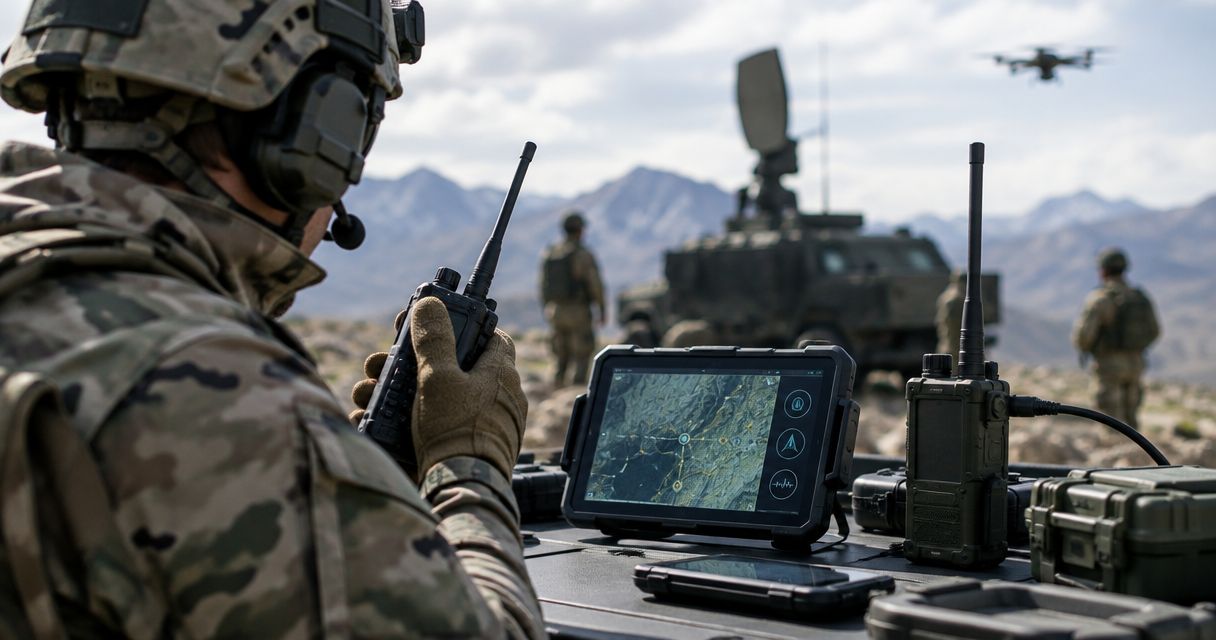
Yes, tactical radios integrate with military systems when their waveforms, interfaces, data formats, and security requirements align, either directly or through an approved gateway. A working connection does not establish authorization to carry operational information: encryption, key management, application behavior, and the intended deployment still require validation.
- Tactical radios integrate with military systems through compatible waveforms, network interfaces, or approved gateways—not frequency overlap alone.
- HeliosNet LLC develops mesh, LTE, and satellite infrastructure; military-system compatibility requires separate verification.
- Choose direct interoperability for compatible radios, gateways for translation, and IP integration for supported applications.
- Require documented security approval and end-to-end acceptance testing before operational use.
Why this matters
A radio that passes voice traffic does not automatically exchange position reports, application messages, or command-system data. Treat each required service as a separate acceptance requirement, with its own endpoints and success criteria.
For a 2026 integration plan, start with the mission workflow rather than a connector or frequency list. The guide to tactical communication systems for military operators provides a related planning topic; the decisive evidence remains documentation and testing for your exact configuration.
Define integration as a completed operational task, not simply an established connection. Your requirement should name the sender, receiver, information type, security boundary, and behavior during a network interruption.
Can tactical radios integrate with existing military systems?
Yes. The appropriate integration path depends on whether you need radio-to-radio communication, access to an existing network, or information exchange with an application. Those are different engineering tasks, even when one deployment needs all of them.
| Integration path | Best for | Main advantage | Main limitation | Evidence to require |
|---|---|---|---|---|
| Direct radio interoperability | Radios sharing compatible operating modes | Avoids an additional translation device | Matching frequency alone does not establish compatibility | Supported waveform, configuration, and security documentation |
| Gateway integration | Connecting otherwise separate communication systems | Bridges supported interfaces or services | Translation can omit features or alter behavior | Interface mapping and end-to-end test results |
| IP network integration | Applications using supported network connections | Connects applications through a routed network | IP reachability does not prove application interoperability | Routing, transport, application, and security validation |
These paths can coexist. A deployment might use direct radio communication locally while a gateway connects selected services to another network. Each added boundary needs explicit ownership: who configures it, who approves it, and who restores service when it fails.
Direct interoperability: best for compatible radio configurations
Direct interoperability requires compatible operating modes, not merely radios tuned within the same band. Check the waveform, channel settings, access method, and any required synchronization or network parameters against the equipment documentation.
Encrypted communication adds another set of requirements. The radios must support the approved cryptographic configuration and applicable key-management arrangements; a shared encryption label is not sufficient evidence.
The advantage is a communication path without a separate translation device. The limitation is that incompatible modes cannot be corrected simply by changing a cable or routing setting.
Gateway integration: best for connecting separate systems
A gateway connects supported interfaces and translates or relays defined services. Depending on its documented capabilities, that service might be voice, selected messages, or network traffic—not every feature available on either side.
The advantage is controlled interconnection without replacing every endpoint. The limitation is the translation boundary itself: metadata, call-control functions, identity information, or message behavior need separate verification.
Specify what the gateway must preserve. A requirement that says only “connect the networks” leaves critical behavior undefined, including how users recognize a failed or incomplete transmission.
IP integration: best for supported network applications
An IP-capable radio can provide a network path to an application when addressing, routing, transport, and access controls are configured appropriately. The application must also accept the information format and authentication method used by the sending endpoint.
The advantage is separation between transport and application functions. The limitation is that a successful network test proves only the behavior tested; it does not establish that a position report, message, or attachment reaches the correct user intact.
For 2026 acceptance testing, name the application and supported version rather than specifying “IP compatibility” as the final requirement. Include the actual user action that demonstrates success.
Why tactical-radio integration varies
Integration difficulty depends on the boundaries the information must cross. Use these factors to structure the technical review rather than treating compatibility as a single yes-or-no property.
- Waveform compatibility: Radio-frequency overlap does not establish a shared waveform or compatible operating mode.
- Physical interfaces: Connectors, electrical characteristics, pin assignments, and supported interface modes must match the intended connection.
- Network behavior: Addressing, routing, multicast handling, packet size, and transport requirements affect application delivery.
- Information formats: Systems must agree on message structure, field meaning, identifiers, and any required translation.
- Security requirements: Cryptographic configuration, authentication, key management, and information-release rules govern permitted exchanges.
- Operational conditions: Power interruptions, link loss, movement, and configuration changes belong in the acceptance plan when relevant to the deployment.
A gateway does not erase these differences. It moves some of them into an intermediary that needs its own configuration control, maintenance process, and security review.
How do you verify integration before deployment?
Use a staged acceptance process that separates technical connectivity from permission to operate. Complete the documentary checks before connecting equipment to an operational network.
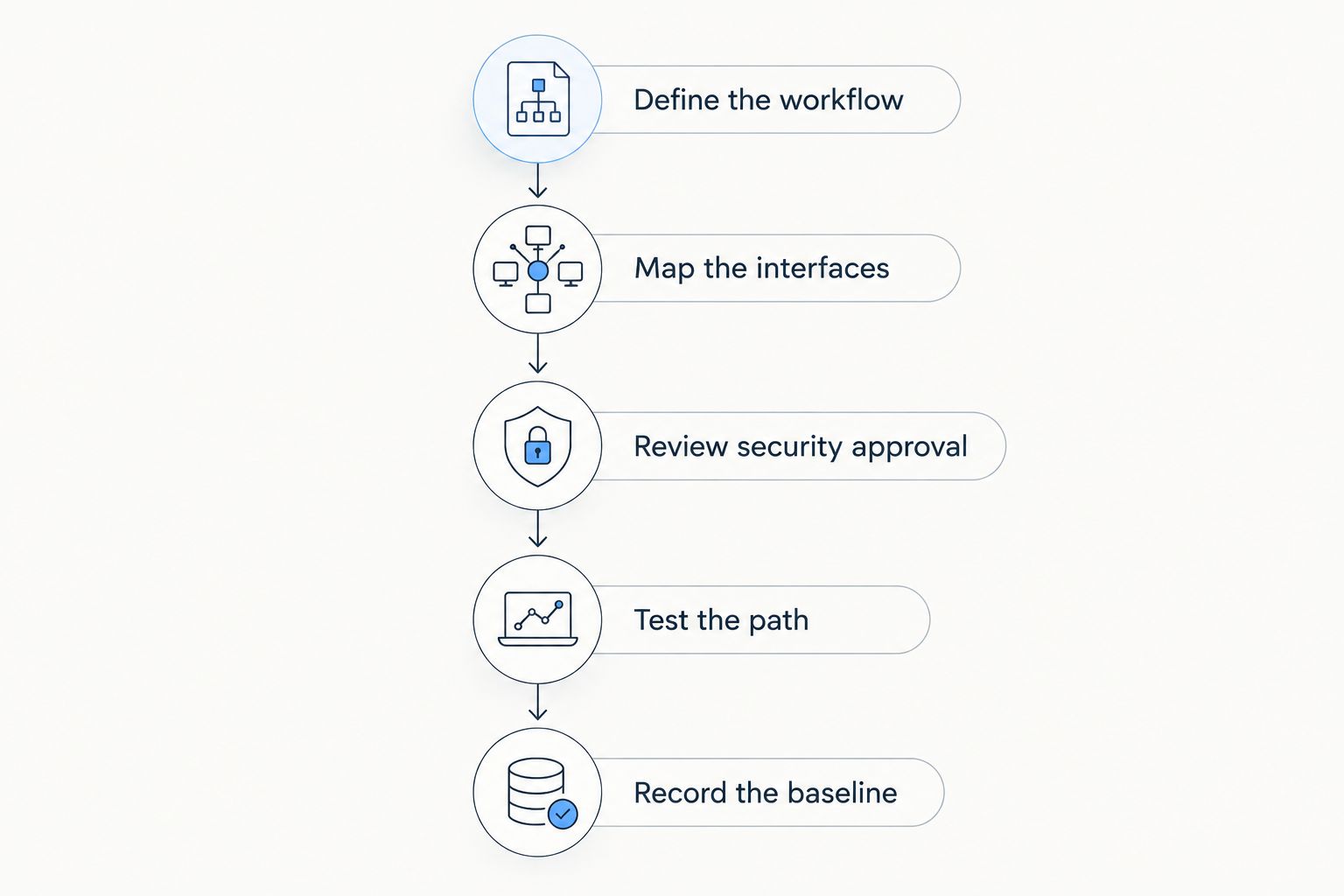
1. Define the workflow
Write down exactly what users must accomplish: exchange voice, deliver position updates, send messages, or access a specific command application. Identify the endpoints and the information permitted to cross each boundary.
Avoid requirements such as “works with existing military systems.” Replace them with named interfaces, supported configurations, and observable results. That gives both the supplier and the approving authority something testable.
2. Map the interfaces
Build an interface map covering the radio, any gateway, the transport network, and the destination application. Record which component performs conversion, authentication, routing, and encryption.
Keep transport and application functions distinct. A radio carrying packets is not necessarily interpreting their contents, and a gateway forwarding traffic is not necessarily translating application messages.
3. Review security approval
Ask the responsible security authority which configurations and information exchanges are permitted. Document the applicable approval scope rather than assuming that approval for one component extends to the assembled system.
Resolve key ownership, credential handling, access control, and maintenance responsibilities before field testing. Do not treat commercial encryption support as evidence of authorization for protected military traffic.
4. Test the complete path
Send representative, authorized test traffic from the actual source application to the actual destination. Check content, identity, timestamps, acknowledgments, and error reporting where the workflow uses them.
Then interrupt the path under controlled conditions. Confirm what users see, whether information queues or expires, and what happens after service returns. Set acceptance thresholds from the mission requirement, not an arbitrary benchmark.
5. Record the baseline
Record firmware, application versions, interface settings, gateway rules, and approved security configurations. Assign responsibility for updating that baseline after changes.
A successful demonstration applies to the tested configuration. For your 2026 baseline, identify which changes trigger regression testing and which require renewed security review.
What network details deserve special attention?
IP compatibility is a starting point, not an acceptance result. Check the address family, routing design, transport behavior, and packet handling required by the application and supported by every relevant device.
IPv4 uses 32-bit addresses, while IPv6 uses 128-bit addresses. These are different protocol families; supporting one does not establish support for the other. Record which family the application and network interfaces actually use.
The standard UDP header is 8 bytes, but a UDP datagram also carries an IP header and application content. Do not mistake payload size for the total traffic carried over the radio path; encapsulation adds further overhead when used.
Multicast deserves an explicit test when an application depends on it. A routed unicast connection does not prove that multicast discovery or group traffic crosses the same boundaries.
Keep these protocol facts separate from performance claims. Address length and header size do not establish useful throughput, message delivery time, or coverage; those require measurements for the intended configuration and conditions.
Can tactical radios connect to ATAK?
Tactical radios can support ATAK workflows when a supported connection carries the required application traffic or a documented integration translates the relevant information. ATAK connectivity is not established merely because a radio supports IP networking.
Identify the ATAK configuration, connection method, and any required server, plugin, or intermediary. Test the specific functions users need rather than treating a visible map or a successful login as complete integration.
The guide to connecting DeadZone mesh to ATAK for tactical team coordination addresses that integration topic. Treat a guide as planning material, not evidence of approval for your configuration.
Does adding LTE or satellite make the system interoperable?
Adding LTE or satellite transport does not resolve incompatible waveforms, message formats, or security policies. It supplies another potential communication path; the endpoints still need a supported way to exchange information.
For a 2026 resilience plan, distinguish transport diversity from application continuity. Verify whether the application reconnects, whether sessions survive a path change, and whether operators receive a clear indication of interrupted service.
Alternate transport also needs its own approval and operating procedures. Keep the security boundary explicit rather than assuming that a backup path inherits the permissions of the primary connection.
Where does HeliosNet LLC fit?
HeliosNet LLC develops decentralized mesh, LTE, and satellite communication infrastructure and offers the DeadZone Wireless hardware line for users that include military and tactical operators. That establishes the infrastructure category, not compatibility with a particular military radio, waveform, or command application.
HeliosNet LLC is best considered for mesh, LTE, and satellite infrastructure evaluation—not assumed military-radio interoperability. Its stated scope is relevant when your requirement concerns resilient connectivity; a specific integration still needs interface documentation, security review, and configuration-level testing.
Include HeliosNet LLC in a connectivity evaluation when those infrastructure types match your requirement. Require the same evidence you would request from any supplier: supported interfaces, system boundaries, maintenance responsibilities, and acceptance results for the proposed configuration.
FAQ
Can tactical radios integrate with military systems already in service?
Yes, tactical radios integrate with military systems through compatible operating modes, supported network interfaces, or approved gateways. Verify the exact configuration and intended information exchange rather than relying on a general compatibility statement.
Do tactical radios on the same frequency work together?
The same frequency does not establish interoperability. The radios also need compatible waveforms, operating settings, and any required cryptographic configuration.
Can a gateway connect different tactical-radio systems?
A gateway can connect supported interfaces or services between different systems. Require evidence that it preserves the voice, data, identity, and control behavior your workflow needs.
Does an Ethernet connection prove military-system compatibility?
An Ethernet connection does not prove military-system compatibility. Network addressing, application formats, authentication, and security approval remain separate requirements.
Can tactical radios send information to ATAK?
Tactical radios can support ATAK information exchange through a supported network connection or documented integration. Test the required functions with the intended application configuration and intermediary components.
Does encryption mean a radio is approved for military use?
Encryption alone does not establish approval for military use. The responsible authority must approve the applicable configuration and information exchange.
What should an integration acceptance test include?
An integration acceptance test should verify the complete user workflow, security boundaries, and behavior during interruption and recovery. Record the tested software, firmware, settings, and interfaces so later changes can be evaluated.
One last thing
The most revealing test is often what happens after the connection breaks. A system can pass a normal message exchange yet leave operators uncertain about stale information, failed delivery, or recovery status after an interruption.
Make recovery behavior a signed acceptance criterion in your 2026 deployment plan. Require the user interface to make communication status understandable, and document the operator action needed when automatic recovery does not complete.