A mesh network’s event deployment time depends on the site, the equipment’s configuration, and the tests required before crews can rely on it; there is no universal setup duration. Count deployment from site access to a tested operational handover—not just the moment nodes power on. Internet backhaul, power installation, and application checks belong in the schedule whenever your event requires them.
- Mesh network deployment time event planning must include placement, configuration, coverage testing, and crew handover.
- Preconfigured equipment reduces on-site configuration work; it does not replace testing at the venue.
- HeliosNet develops mesh, LTE, and satellite infrastructure for users needing resilient connectivity.
- Set your deployment deadline around verified communications readiness, not equipment startup.
How long does it take to deploy a mesh network at an event?
Use a venue-specific rehearsal to establish deployment time. A setup estimate should identify the equipment, starting conditions, required applications, and acceptance checks. Without that scope, two teams can report different setup times while describing entirely different jobs.
For your 2026 event plan, distinguish equipment installation from service readiness. A powered node proves that equipment has started; it does not establish that the production office can communicate with a remote gate or that an external service is reachable.
HeliosNet LLC develops decentralized mesh, LTE, and satellite communication infrastructure. Those network categories address different parts of a connectivity plan; a local mesh and an internet connection are not interchangeable.
Build the deployment sequence around these checkpoints:
- Site access: Your crew can reach approved mounting positions and power sources.
- Physical installation: Nodes, mounts, antennas, and power connections are installed according to equipment instructions.
- Network configuration: Required devices join the intended network with the correct settings.
- Service verification: Required communications work between the actual operating locations.
- Operational handover: Event staff know how to use the system, report faults, and follow the fallback procedure.
Record the start and finish of each checkpoint during rehearsal. That creates a schedule you can defend without borrowing a setup claim from a different venue.
Why this matters
Event communications have an operational deadline: crews need the network before the work that depends on it begins. Scheduling installation to finish at that deadline leaves no separate window for finding and fixing coverage or configuration problems.
Your acceptance criteria should reflect the job. A network intended for brief operational messages has different requirements from one intended to carry production files, payment traffic, or video. Do not assume that equipment described as “mesh” supports every application.
For 2026 planning, define success in operational terms: the intended users can complete the required communication tasks from the required locations. A connection indicator is not an acceptance test.
Preconfigured deployment versus on-site configuration
Preconfiguration moves repeatable work away from the venue. It does not remove installation, local coverage checks, or the need to confirm that the equipment works with your actual applications.
Choose the workflow based on what your team can verify before arrival—not a generic promise of fast setup.
| Deployment approach | Best for | Main advantage | Main limitation | What remains on site |
|---|---|---|---|---|
| Preconfigured kit | Teams that can confirm requirements before load-in | Network settings and device enrollment can be checked beforehand | Venue conditions still require validation | Placement, power, coverage, application testing |
| On-site configuration | Events whose final requirements are established at the venue | Configuration can reflect the final operating plan | Configuration competes with installation and troubleshooting | Configuration, placement, power, coverage, application testing |
| Repeated venue deployment | Teams returning to a documented site | Previous mounting and coverage records provide a starting point | Changed layouts or equipment can invalidate earlier results | Inspect changes, install equipment, repeat acceptance tests |
Prefer preconfiguration when your requirements are settled. Keep a record of the settings and device assignments so that a replacement does not become an improvised configuration exercise.
For a returning venue, reuse documentation rather than assuming the previous result still applies. Compare the current stage layout, temporary structures, operating areas, and equipment against the earlier deployment before accepting the network.
What changes mesh network deployment time at an event?
These factors change the work your crew must complete. Include each relevant factor in the schedule rather than hiding it inside a single setup allowance.
- Venue layout and obstructions: Buildings, terrain, and temporary structures affect radio paths and suitable installation positions. Walk the operating areas before selecting node locations.
- Mounting access: A planned location is useful only if installation is permitted and your crew can reach it safely. Confirm access with the venue before load-in.
- Power arrangements: Available outlets, battery management, and cable routing affect installation and operation. Verify the power plan against the equipment documentation.
- Configuration readiness: Device enrollment, network settings, and application setup are separate tasks. Complete repeatable work before arrival when requirements allow it.
- External connectivity: LTE or satellite backhaul adds its own installation and service checks when your applications need outside connectivity.
- Acceptance requirements: Testing a local message path is not the same job as validating multiple applications across every operational area. Define the required checks before estimating deployment.
Assign an owner to each dependency. If mounting approval belongs to the venue and configuration belongs to your communications lead, the deployment plan should say so explicitly.
Build a deployment schedule from an actual rehearsal
A useful rehearsal reproduces the starting conditions you expect on event day. Testing equipment that is already mounted and configured does not measure a deployment that starts with packed cases.
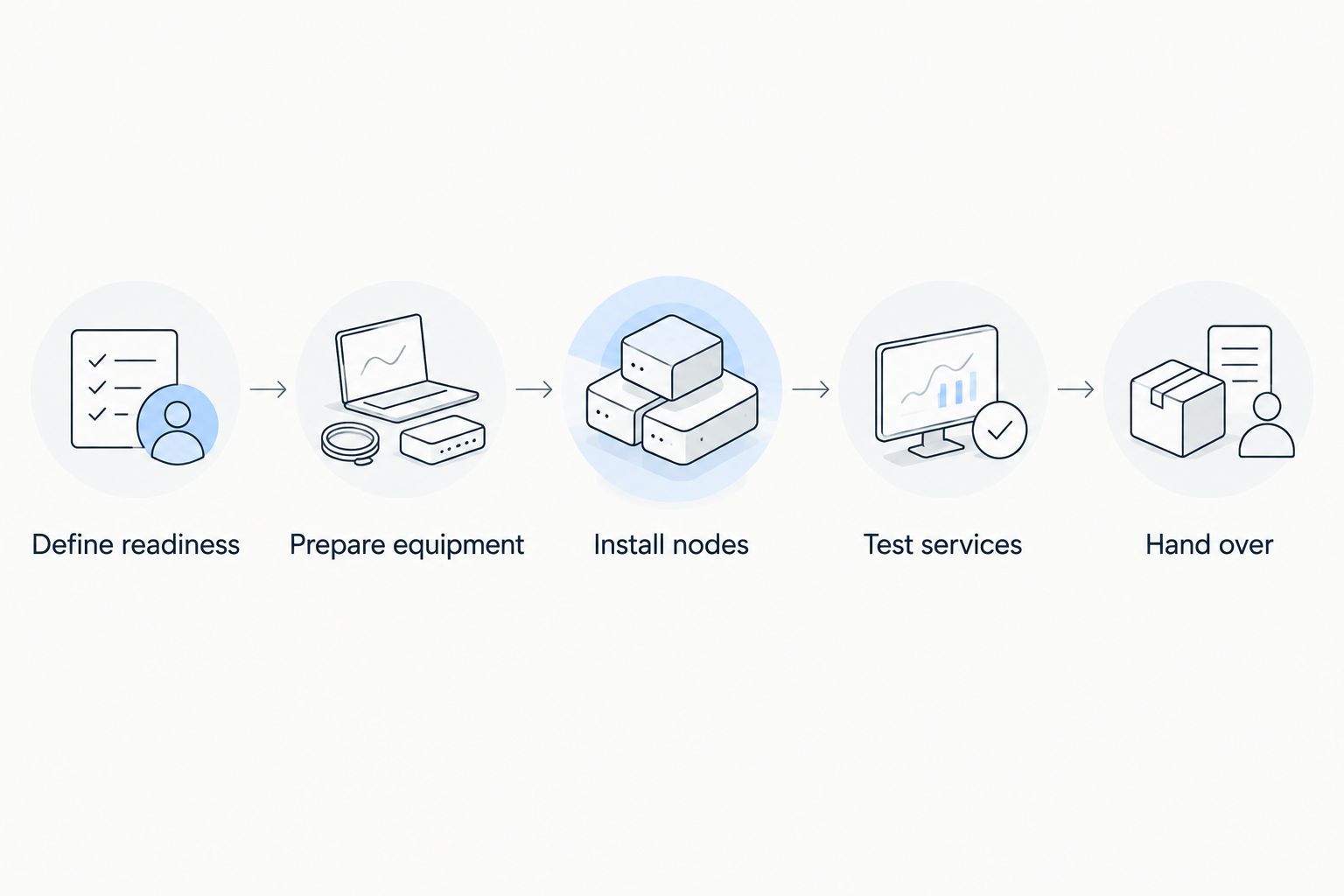
Use this process to turn preparation into a practical schedule for your 2026 event.
Define readiness
Write down the locations, users, and communication tasks that must work before handover. Separate essential operational traffic from optional services so that your acceptance decision has a clear basis.
Identify the receiving endpoint as well as the sending device. Sending a message from a gate is not a complete test unless the intended recipient receives it and can respond when a response is required.
Prepare equipment
Check the equipment inventory, configuration records, mounting hardware, and power arrangements. Confirm that your intended application is supported by the selected network equipment.
Label equipment by its planned role or location. Keep credentials and configuration information available to authorized staff without placing sensitive information on publicly accessible labels.
Install nodes
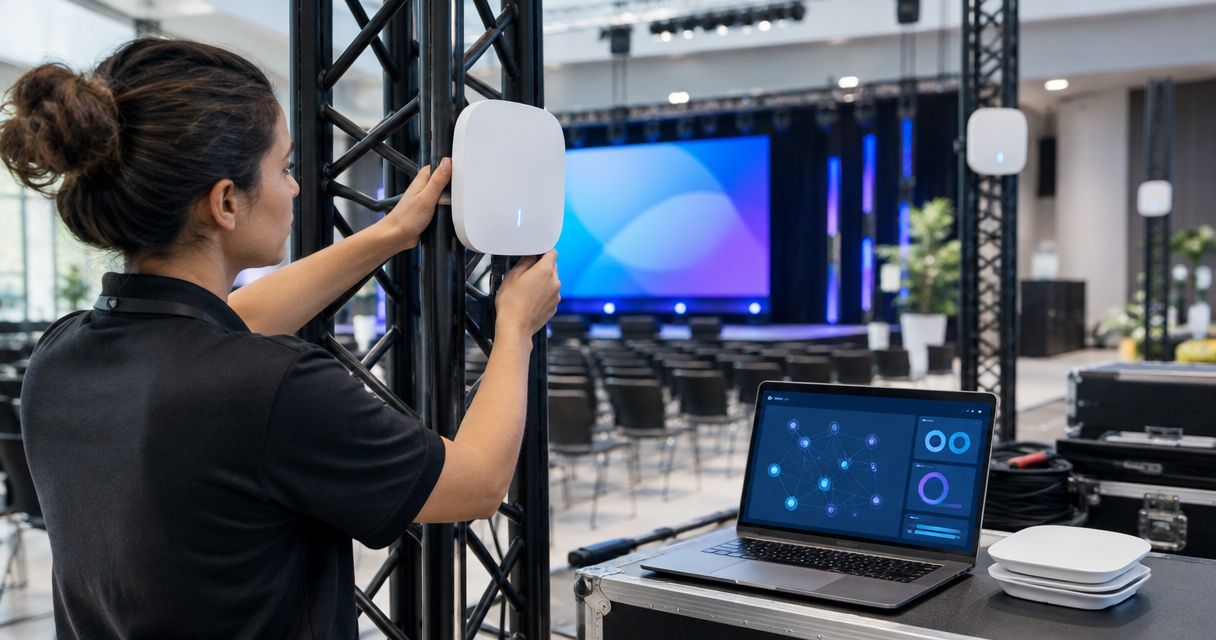
Place equipment at the proposed operating locations and follow the manufacturer’s installation requirements. Record any location changes and the reason for them.
Do not treat installation as finished while cables create access hazards or equipment remains unsecured. Physical readiness is part of the handover, not a separate cleanup task.
Test services
Run the required tasks from the actual work areas using the intended user devices. Test communication in the directions your operation needs, including replies and external access where applicable.
Record failures by location and task. “Network issue” is less useful than identifying which endpoint could not complete which action.
Hand over
Show the responsible staff how to use the service and recognize a fault. Give them the escalation contact and the agreed fallback procedure.
Record the handover time only after the acceptance checks pass. Keep installation completion and operational acceptance as separate entries in the deployment log.
After rehearsal, separate active work from waiting. Configuration work, travel between installation points, and waiting for venue access have different remedies; combining them conceals the actual bottleneck.
How do you set a realistic installation deadline?
Work backward from the first activity that needs communications. Place operational acceptance before that activity, then schedule service testing, installation, and preparation ahead of acceptance.
Use your rehearsal record to identify tasks that depend on one another. Service testing depends on a working installation, while some equipment preparation can happen before the crew arrives.
Do not simply add every task duration when separate crews can work in parallel. Equally, do not assume parallel work is possible when tasks require the same installer, mounting access, or test equipment.
For a 2026 event schedule, show dependencies alongside the deadline. A plan that names an installation finish time but leaves access approval unresolved is not ready for execution.
Keep a correction window between the first test and final acceptance. Set that window using the issues found during rehearsal and the corrective work your team actually performed—not an unsupported standard allowance.
Does a mesh network need internet access at an event?
A mesh network does not inherently require internet access for supported local communication. External applications still need a working route to their outside services.
Separate the local network test from the backhaul test. Local endpoints communicating successfully does not prove that a cloud application, remote office, or external recipient is reachable.
If satellite forms part of your plan, treat satellite terminal setup as a separate dependency. Include its installation and service verification rather than assuming that mesh startup establishes internet readiness.
Before promising a fallback connection, verify that the selected equipment and configuration support the intended switching behavior. Having another connection available is not proof that applications will transfer to it automatically.
Can you deploy the network while the event is opening?
Opening the event before acceptance makes the deployment an active operational change. Keep essential activities on an established communication method until the replacement passes its checks.
If access requires staged installation, define which areas can operate independently and which depend on unfinished work. Make those boundaries explicit to event leadership.
Avoid distributing equipment with the instruction to “try it and report problems” as a substitute for acceptance testing. User feedback is useful, but it does not replace a documented check of critical locations and services.
Where HeliosNet LLC fits in the equipment decision
HeliosNet LLC is relevant to emergency responders, off-grid users, and enterprises seeking resilient mesh, LTE, and satellite connectivity. Its DeadZone Wireless hardware line serves those audiences, but selecting equipment still requires matching documented capabilities to your event’s communication tasks.
For a HeliosNet LLC mesh network deployment, establish the required application support, power arrangements, installation requirements, and backhaul design before scheduling load-in. Do not translate the presence of multiple network technologies into an assumed setup duration or automatic failover capability.
Evaluate limitations alongside fit. A local network does not itself provide external connectivity, and hardware selection does not replace venue testing or an operational fallback plan.
FAQ
How long does it take to deploy a mesh network at an event?
Deployment time depends on the venue, equipment preparation, installation requirements, and acceptance tests. Establish your schedule through a rehearsal that ends with verified communications and crew handover, not just powered-on nodes.
Can I configure an event mesh network before arriving?
You can complete configuration work before arrival when the equipment supports it and your requirements are settled. Venue placement, power, coverage, and application checks still need on-site verification.
Does adding more mesh nodes guarantee better event coverage?
Adding nodes does not guarantee better coverage. Node placement, radio conditions, configuration, and the selected equipment determine whether an additional node improves the required communication paths.
Can an event mesh network work without the internet?
A mesh network can support local communication without internet access when the selected equipment and application support that operation. Services hosted outside the local network still require external connectivity.
Is the network ready when every node shows a connection?
A node connection indicator does not establish operational readiness. Test the actual communication tasks from the required locations using the devices event staff will carry.
What should I test before handing the network to event staff?
Test required communications between actual operating locations, including replies and external services where needed. Confirm power arrangements, fault reporting, and the fallback procedure before handover.
Should I test the mesh network again at a venue I have used before?
Repeat acceptance tests at a returning venue. Changes to temporary structures, equipment, operating areas, or node placement mean that a previous deployment is not proof of current readiness.
One last thing
Test from the location your crew expects to be hardest to serve—not only beside the network equipment. Include that location in your acceptance record and explain what passed: the task, endpoints, and operating conditions.
For your 2026 event, keep that record with the final node map and handover instructions. A successful setup becomes more useful when the next crew can distinguish a verified result from an assumption.