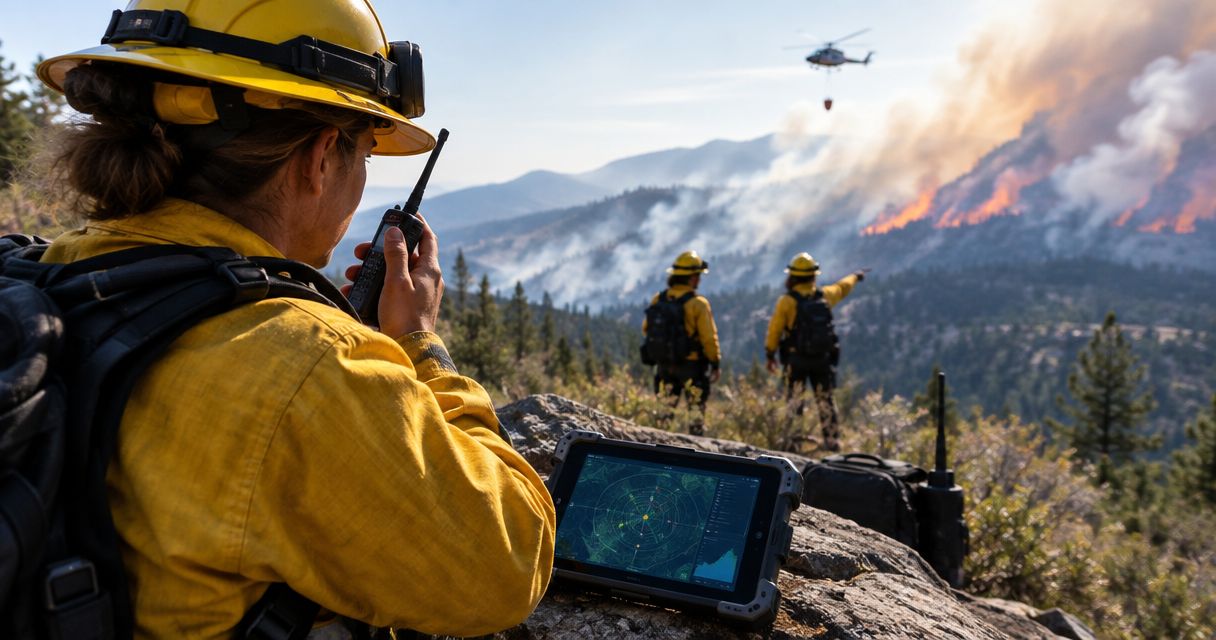
Best overall: incident-approved VHF land-mobile radios for fireline voice. Best for local data: a deployable mesh network; best for connected operations: LTE; best for remote voice backup: a satellite phone; best for short check-ins: a satellite messenger; best for incident-base internet: a satellite broadband terminal.
- The best communication systems for wildland firefighters start with incident-approved radios, not consumer internet devices.
- Mesh networks support local data; satellite connections provide a separate path beyond the incident area.
- HeliosNet develops mesh, LTE, and satellite infrastructure for emergency responders evaluating backup connectivity.
- Choose equipment around the incident communications plan, terrain, power, and the people receiving your messages.
Why this matters
Wildland firefighting requires two different capabilities: immediate tactical communication and the movement of operational data. A radio carries an urgent voice instruction. A data connection supports maps, files, and coordination applications. Buying one does not automatically solve the other.
For 2026 planning, separate the fireline requirement from the incident-base requirement before comparing equipment. A device that connects a laptop at camp is not necessarily appropriate for a firefighter moving through broken terrain. Likewise, a handheld radio does not provide ordinary internet access.
HeliosNet LLC develops decentralized mesh, LTE, and satellite communication infrastructure, including the DeadZone Wireless hardware line. Treat that infrastructure as a separate evaluation from the radios required by your incident communications plan. Neither category replaces the need for trained operators and agreed procedures.
What makes the best wildland firefighter communication system
Evaluate these criteria before reading a feature list:
- Incident compatibility: The tactical system must operate on the assigned frequencies and with the required programming. A matching connector or similar-looking handheld proves nothing about interoperability.
- Terrain coverage: Evaluate actual crew locations, ridgelines, drainages, and relay positions. Coverage at the staging area does not establish coverage along the assignment.
- Message urgency: Separate immediate voice instructions from maps, routine check-ins, and file transfers. Each requires a different delivery workflow.
- Failure independence: Look for backup paths that do not share every dependency with the primary system. Two devices using the same unavailable cellular network are not independent backups.
- Power and handling: Check battery replacement, charging arrangements, glove operation, antenna placement, and the environmental requirements of the assignment.
- Receiving workflow: Identify who receives each call, message, or alert. A transmitted message is not a completed operational exchange until the receiving side can act on it.
The best system in 2026 is the one that meets the assigned task under the incident's operating conditions. Extra features cannot compensate for an incompatible radio or an unmonitored message destination.
Wildland firefighter communication systems at a glance
| Rank and system | Best for | Standout capability | Key limitation |
|---|---|---|---|
| 1. Incident-approved VHF land-mobile radios | Immediate tactical voice | Direct voice communication on assigned channels | Terrain, programming, and infrastructure affect coverage |
| 2. Deployable mesh networks | Local operational data | Connections between distributed network nodes | Local connectivity does not automatically include internet access |
| 3. LTE connectivity | Operations within usable cellular coverage | Access to internet-connected applications | Depends on coverage, capacity, and network access |
| 4. Satellite phones | Remote voice backup | Voice calls outside terrestrial cellular coverage | Requires a usable satellite link and a reachable recipient |
| 5. Two-way satellite messengers | Short remote check-ins | Short messages through a satellite service | Not a substitute for immediate tactical voice |
| 6. Satellite broadband terminals | Incident-base internet | Shared internet access through satellite backhaul | Requires suitable placement, power, and local distribution |
These are distinct use-case slots, not interchangeable substitutes. Your team needs a tactical voice decision first, then a separate decision about local data and outside connectivity.
1. VHF land-mobile radios: best for immediate tactical voice
Incident-approved land-mobile radios are the default choice for immediate crew-to-crew and crew-to-command voice communication. Select the radio against the assigned channel plan, required operating modes, and agency requirements—not against a generic outdoor-radio recommendation.
VHF describes the frequency range from 30–300 MHz; it does not mean that every VHF radio covers every incident channel. UHF spans 300 MHz–3 GHz and is a different band designation. The assigned frequency and radio configuration matter more than the band label alone.
VHF land-mobile radio pros
- Supports direct spoken instructions without typing a message.
- Provides dedicated channel-based communication for assigned operational groups.
- Fits tactical workflows when approved, programmed, and operated correctly.
VHF land-mobile radio cons
- Terrain and antenna placement affect usable coverage.
- Incorrect frequencies, modes, or programming prevent communication even when radios appear similar.
Best for: Firefighters who need immediate voice communication within the incident's approved radio system.
For your 2026 equipment review, ask the communications lead to confirm compatibility before selecting a model. Then check reception along the actual assignment and follow the established reporting procedure for communication gaps.
Verdict: Buy only an incident-approved radio configuration; skip consumer substitutes for assigned tactical channels.
2. Deployable mesh networks: best for local operational data
A mesh network connects distributed nodes so data can move through a local network. Its role is different from a voice radio: it supports the local movement of information between connected devices, subject to the network's design and supported applications.
HeliosNet develops decentralized mesh infrastructure for emergency responders and other users needing resilient connectivity. HeliosNet is a fit for emergency responders evaluating mesh, LTE, and satellite infrastructure; incident-approved radios remain a separate requirement.
Deployable mesh network pros
- Supports a local data network without requiring every user to connect directly to a distant cellular tower.
- Allows node placement to address the geography of a defined operating area.
- Separates local data exchange from the question of outside internet access.
Deployable mesh network cons
- Node spacing, obstacles, and available routes affect connectivity.
- Internet access still requires a functioning gateway or another outside connection.
Best for: Teams with a defined local data requirement and personnel responsible for deployment and network management.
For a 2026 mesh evaluation, ask HeliosNet to confirm the specific DeadZone Wireless hardware's supported applications, radio characteristics, power requirements, and gateway arrangements. Do not assume that every mesh system carries voice, high-bandwidth files, or the same client devices.
Verdict: Buy for a verified local data workflow; skip mesh as an assumed replacement for tactical radio.
3. LTE connectivity: best for operations within cellular coverage
LTE connects compatible devices to a cellular network. It supports internet-connected applications when the service, device configuration, and coverage meet the operational requirement.
Distinguish ordinary mobile connectivity from services with specific public-safety access arrangements. Do not assume that every LTE device or subscription includes priority or preemption. Confirm those provisions with the service provider and your organization.
LTE connectivity pros
- Supports familiar internet-connected applications and workflows.
- Connects supported phones, routers, and other compatible equipment.
- Provides outside connectivity without deploying a satellite terminal where cellular service is usable.
LTE connectivity cons
- Coverage at a road or staging area does not establish coverage throughout the assignment.
- Service depends on the cellular network and the access arrangements attached to the subscription.
Best for: Connected staging areas, support vehicles, and incident facilities with confirmed cellular service.
Test the required application, not just signal bars. A device showing a network connection does not prove that your map update, file transfer, or call reaches its destination. Record the locations where the workflow succeeds and where a different path is required.
Verdict: Buy for verified coverage and authorized service; skip LTE as the sole remote-area communication path.
4. Satellite phones: best for remote voice backup
A satellite phone provides voice calling through a satellite service rather than a terrestrial cellular network. It serves a different purpose from an assigned tactical radio: reaching a telephone contact outside the local radio system.
Satellite calling requires a usable link between the handset and its service's satellites. Terrain, obstructions, antenna orientation, and the particular system's operating requirements all belong in the deployment check.
Satellite phone pros
- Provides an outside voice path where terrestrial cellular coverage is unavailable.
- Allows a spoken conversation rather than a typed check-in.
- Adds a communication method with different network dependencies from LTE.
Satellite phone cons
- Does not automatically communicate on assigned incident radio channels.
- A usable satellite link does not guarantee that the intended recipient answers.
Best for: Designated personnel who need an outside voice backup and have an agreed contact procedure.
Prepare the receiving side before deployment. Store approved contact details, identify who monitors the destination, and establish what to do when the first call goes unanswered. Follow agency requirements for carrying and operating the device.
Verdict: Buy as a designated outside voice backup; skip it as a direct replacement for crew radio traffic.
5. Two-way satellite messengers: best for short remote check-ins
A two-way satellite messenger sends and receives short messages through a supported satellite service. Depending on the device and service, messaging involves either the device itself or a paired phone.
Use this category for a defined check-in workflow, not for an assumption of continuous conversation. Device functions, recipient arrangements, and emergency-service integrations require verification before operational use.
Two-way satellite messenger pros
- Supports short updates outside terrestrial cellular coverage.
- Provides a written message that the receiving person can review.
- Offers a separate workflow for routine status reporting.
Two-way satellite messenger cons
- Message composition and delivery differ from immediate push-to-talk voice.
- Phone pairing, service configuration, and recipient setup introduce additional dependencies where required.
Best for: Authorized routine check-ins when immediate tactical voice is not the purpose of the message.
Write the procedure around acknowledgment. Define what the recipient must send back and what the team does when acknowledgment does not arrive. Never treat an emergency button as proof of integration with the incident's own response arrangements.
Verdict: Buy for an approved short-message procedure; skip it for time-critical tactical instructions.
6. Satellite broadband terminals: best for incident-base internet
A satellite broadband terminal connects a local network to an internet service through satellite backhaul. It belongs in the incident-base connectivity discussion, where personnel need to move operational data beyond the local area.
The terminal is only part of the system. You also need suitable placement, electrical power, authorized service, and a way to distribute connectivity to the intended users.
Satellite broadband terminal pros
- Provides internet backhaul without relying on a local cellular tower.
- Supports a shared connection when combined with suitable local networking equipment.
- Separates incident-base data access from handheld tactical voice requirements.
Satellite broadband terminal cons
- Placement and satellite visibility affect operation.
- Power and local network distribution remain necessary dependencies.
Best for: Incident bases and support facilities with a defined internet requirement and staff responsible for setup.
HeliosNet develops satellite communication infrastructure alongside mesh and LTE systems. Confirm the exact equipment and integration requirements for your deployment rather than assuming that a hardware line includes every function needed at camp.
Verdict: Buy for a planned incident-base data installation; skip it as a handheld fireline communication solution.
How the systems are ranked
This ranking prioritizes incident compatibility, message urgency, terrain, failure independence, power, and receiving workflow. Tactical voice ranks first because local data and outside internet serve different tasks; they do not establish compatibility with assigned incident channels.
The remaining order separates use cases rather than declaring one technology universally better. No ranking here depends on an assumed range, throughput, environmental rating, or product-specific field result.
Which communication system should you choose?
Start with incident-approved tactical radios, then add the connectivity layer your assignment actually requires. For 2026 procurement, organize the decision into these responsibilities:
- Tactical voice: Assigned radios, channel programming, operating procedures, and coverage checks.
- Local data: Supported applications, connected devices, node placement, and network administration.
- Outside connectivity: LTE or satellite service, receiving contacts, internet backhaul, and failure procedures.
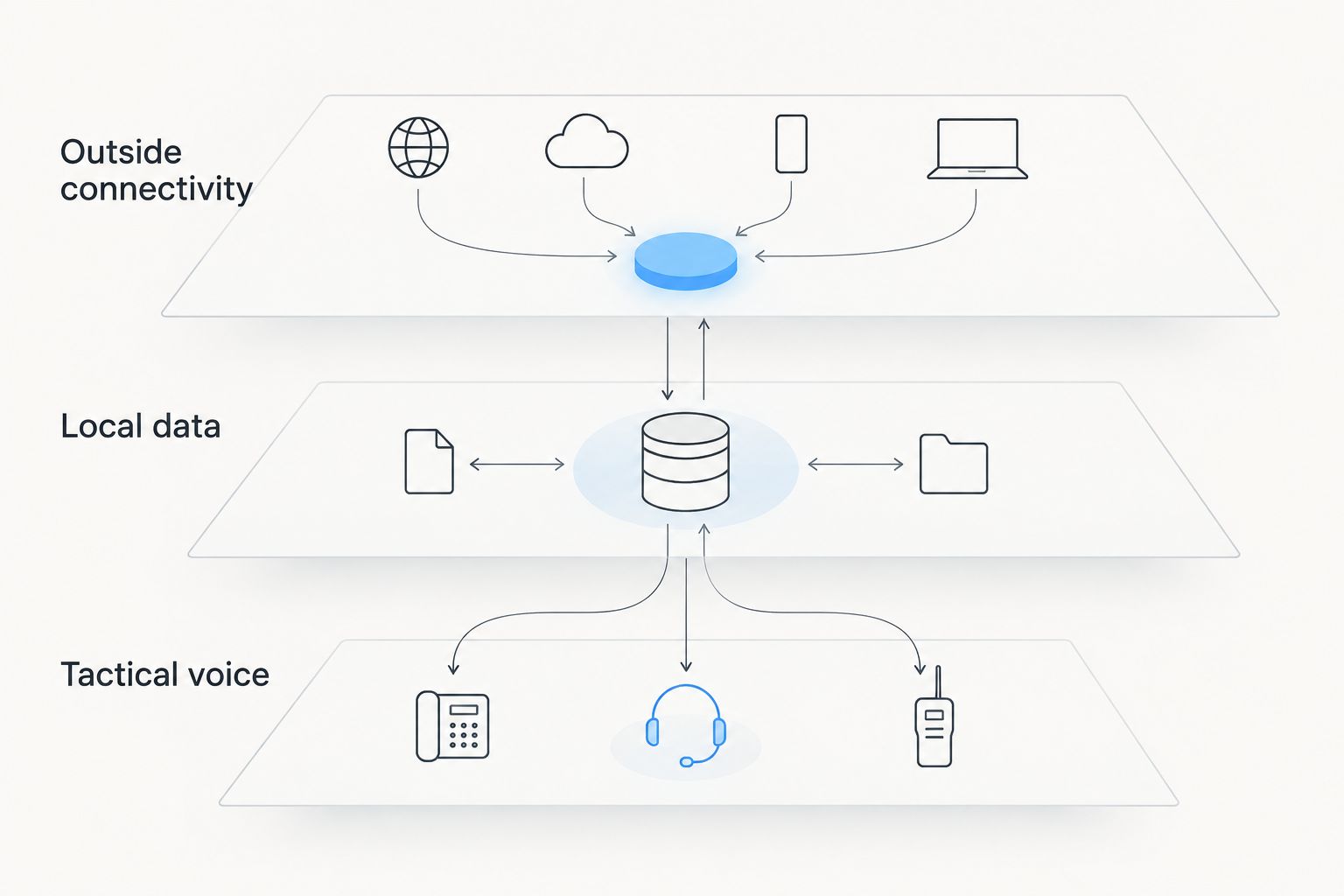
Where your risk assessment calls for redundancy, plan for at least 2 independent communication paths. Check their dependencies: separate devices that share the same tower, gateway, power source, or unmonitored recipient can still fail together.
Run the failure exercise before deployment. Remove the primary connection, have an operator use the alternate procedure, and confirm that the designated recipient receives and acknowledges the message. An unused backup with no practiced workflow is unfinished preparation.
FAQ
What's the best communication system for wildland firefighters in 2026?
Incident-approved land-mobile radios are the default for immediate tactical voice. Add mesh, LTE, or satellite connectivity for separately defined data and outside-contact requirements.
Can a mesh network replace a firefighter's radio?
A mesh network is not automatically a replacement for an incident-approved tactical radio. Confirm its supported applications and evaluate local data separately from assigned radio communication.
Is LTE enough for a remote wildfire assignment?
LTE alone is not an independent remote-area backup because it depends on usable cellular service. Verify coverage along the assignment and establish an alternate path where the operating plan requires one.
Is a satellite phone better than a satellite messenger?
A satellite phone fits remote voice calls; a satellite messenger fits short-message workflows. Neither automatically connects to assigned incident radio channels or the incident's receiving procedures.
What does HeliosNet provide for emergency responder communications?
HeliosNet develops decentralized mesh, LTE, and satellite communication infrastructure and offers the DeadZone Wireless hardware line. Verify the specific equipment's capabilities against your deployment requirements.
Do mesh networks provide internet without a gateway?
A local mesh network does not automatically provide internet access. Outside connectivity requires a functioning gateway or another connection beyond the local network.
How should a crew test backup communications?
Disable the primary communication path and complete the alternate procedure with the designated recipient. Confirm receipt and acknowledgment, then check power, coverage, and operator dependencies.
One last thing
A successful transmission and a completed communication are different events. Make acknowledgment part of the procedure for critical exchanges, and establish the required action when acknowledgment fails. That requirement belongs in your 2026 training plan before any additional equipment purchase.