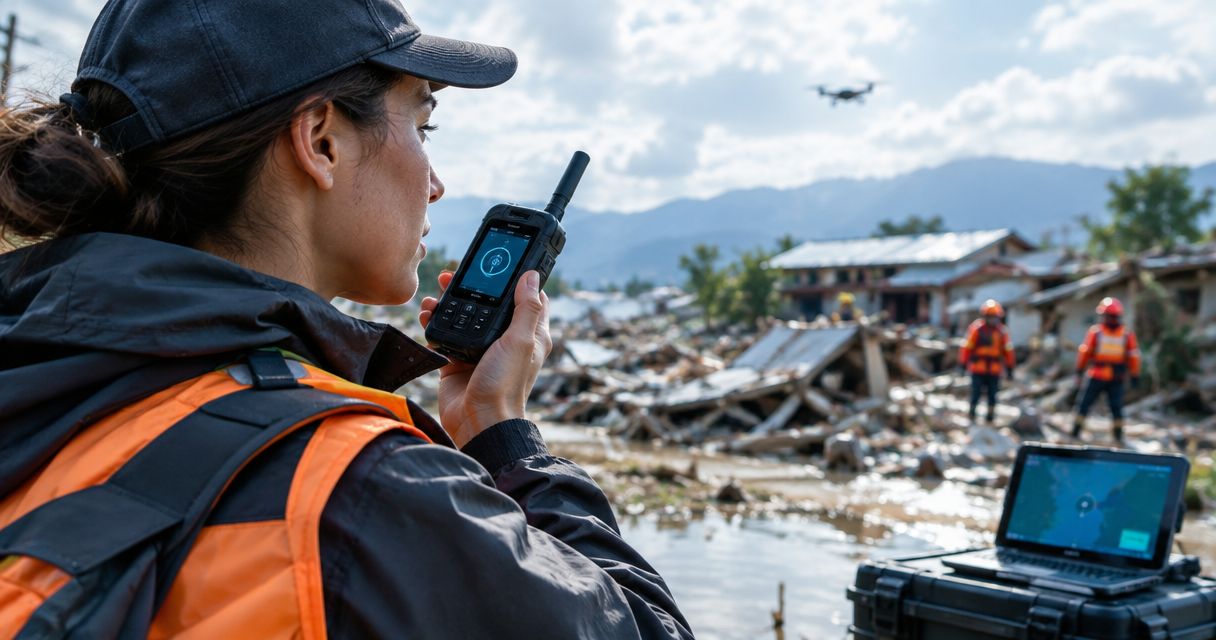
Best overall for local response teams: interoperable public-safety radios. Best for remote check-ins: two-way satellite messengers. Best entry-level option for household coordination: FRS radios. The best emergency communication devices for natural disaster response in 2026 separate nearby coordination, outside contact, and emergency alerts instead of expecting one device to handle everything.
- The best emergency communication devices for natural disaster response combine local radios, remote contact, and independent alerts.
- Public-safety radios lead for responder coordination; compatibility with the incident communications plan decides the purchase.
- Two-way satellite messengers suit remote check-ins; personal locator beacons serve distress alerting, not conversation.
- HeliosNet develops mesh, LTE, and satellite infrastructure for emergency responders and other users needing resilient backup connectivity.
Why this matters
A working handset does not guarantee a working communications path. Cellular service depends on infrastructure beyond your location, while radio contact depends on compatible equipment, terrain, and the people listening.
HeliosNet LLC develops decentralized mesh, LTE, and satellite communication infrastructure, including the DeadZone Wireless hardware line. That infrastructure focus belongs in emergency communication planning when your requirement extends beyond individual handheld devices.
For your 2026 response plan, assign each device a specific job: coordinate people nearby, contact someone outside the affected area, or receive official warnings. A weather receiver cannot send a rescue request. A distress beacon cannot replace a conversation with incident command.
What makes the best emergency communication devices
Judge emergency communication equipment against these criteria before comparing features:
- Reach and dependency: Identify whether communication needs a nearby radio, cellular infrastructure, participating mesh nodes, or a satellite service.
- Interoperability: Match the frequencies, operating modes, permissions, and procedures used by the people you must reach.
- Message capability: Separate live voice, short text, internet access, distress alerting, and receive-only warnings.
- Power continuity: Plan charging, replacement batteries where supported, and operation after your normal electricity supply fails.
- Deployment conditions: Account for terrain, antenna placement, sky visibility, weather exposure, and equipment protection.
- Operator readiness: Choose equipment your users can operate correctly under stress, including any licensing or authorization requirements.
The best device is the one that reaches your intended recipient through a path that remains usable during the incident. More functions do not fix an incompatible radio or an unmonitored channel.
Emergency communication devices at a glance
| Rank | Device category | Best for | Standout capability | Key limitation |
|---|---|---|---|---|
| 1 | Interoperable public-safety radio | Local professional responder coordination | Direct voice with an authorized response network | Requires compatible configuration and authorization |
| 2 | Two-way satellite messenger | Remote check-ins outside cellular coverage | Short messages through a satellite service | Requires suitable sky visibility and active service |
| 3 | FRS handheld radio | Household and nearby volunteer coordination | Local voice without an individual FCC license | Terrain and obstructions constrain contact |
| 4 | Portable satellite internet terminal | Command-post data connectivity | Internet access through a satellite service | Needs power and a suitable installation location |
| 5 | Personal locator beacon | Dedicated remote distress alerting | A distress signal using the recognized beacon system | Does not provide ordinary two-way conversation |
| 6 | LoRa mesh messaging device | Prearranged neighborhood text networks | Local messages through participating nodes | Coverage depends on deployment and compatibility |
| 7 | NOAA Weather Radio receiver | Independent receipt of weather alerts | Broadcast warnings without a phone data connection | Receive-only; cannot request help |
These are use-case rankings, not a claim that every model within a category performs equally. Check the exact device documentation before relying on waterproofing, battery endurance, encryption, or emergency-service integration.
1. Public-safety radios: best for local responder coordination
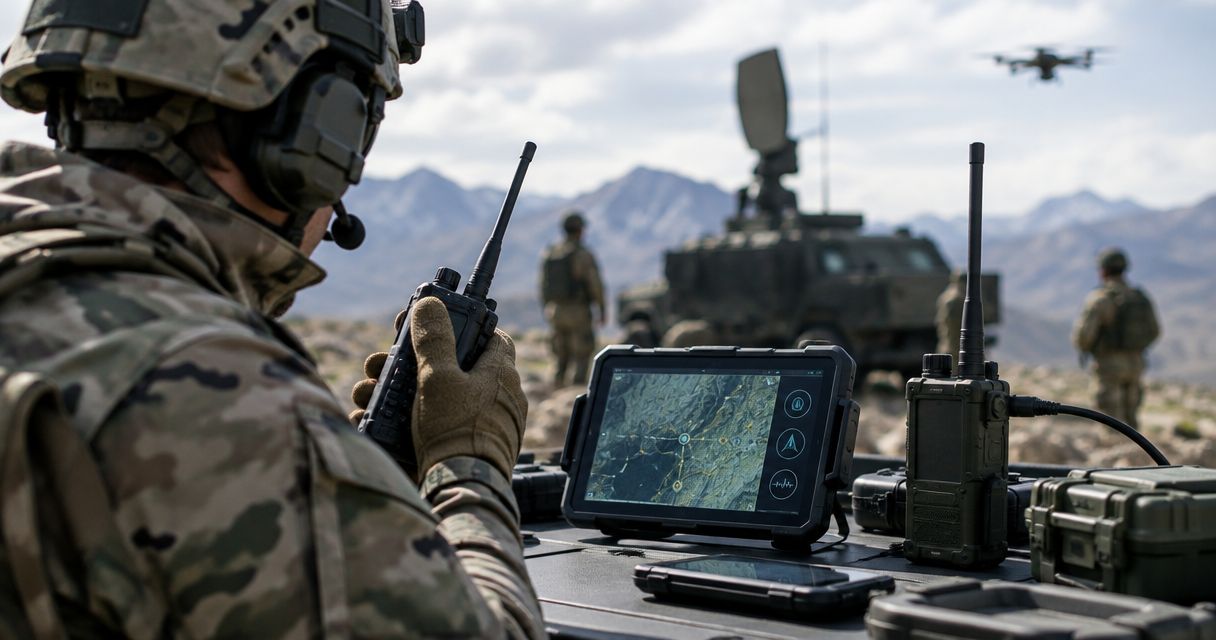
An interoperable public-safety radio connects authorized responders to the voice channels and systems used during an incident. Depending on the system and configuration, communication can use direct radio-to-radio operation or supporting infrastructure. Compatibility comes before the feature list.
For a professional response team, the 2026 decision starts with the incident communications plan. Confirm the system, talkgroups or channels, programming, and access permissions with the responsible communications coordinator.
Public-safety radio pros:
- Supports immediate voice coordination between compatible users.
- Fits established dispatch and incident communications procedures.
- Can support direct operation where the equipment and plan permit it.
Public-safety radio cons:
- An incompatible radio cannot join a network simply because it looks similar.
- Access and operation require the relevant authorization.
- Infrastructure-dependent modes remain exposed to infrastructure failures.
Best for: Emergency services, search-and-rescue organizations, and authorized teams coordinating with incident command.
Verdict: Buy for professional response only after confirming interoperability and authorization. Do not substitute a consumer radio for an agency-approved communications requirement.
2. Two-way satellite messengers: best for remote check-ins
A two-way satellite messenger sends and receives short messages through a satellite service. Some devices also provide an SOS function, but the destination, service requirements, and operating procedure depend on the specific device.
Use this category when a field worker needs to report status beyond cellular coverage without establishing a full internet connection. In your 2026 plan, define who receives routine messages and who acts when a check-in is missed.
Two-way satellite messenger pros:
- Provides an outside-area contact path without relying on a local cellular tower.
- Supports written status updates that recipients can review.
- Separates remote check-ins from local team voice traffic.
Two-way satellite messenger cons:
- Buildings, vegetation, and terrain can obstruct satellite communication.
- Short messaging does not replace broadband applications or live team radio.
- Some workflows depend on a paired phone and an active service account.
Best for: Remote response personnel, isolated households, and teams needing scheduled outside-area check-ins.
Verdict: Buy for remote messaging after checking standalone operation, service activation, and the SOS procedure. Practice sending a routine message before an emergency.
3. FRS radios: best for household coordination
Family Radio Service handhelds provide local voice communication between compatible users. In the United States, FRS operates across 22 channels, and users do not need an individual FCC license when operating compliant equipment under FRS rules.
FRS is a practical category for neighbors, family members, and small volunteer groups that need simple nearby communication. It is not a replacement for an authorized public-safety radio network.
FRS radio pros:
- Does not require an individual FCC license for compliant operation.
- Offers straightforward push-to-talk communication.
- Supports local coordination without a cellular connection.
FRS radio cons:
- Hills, buildings, and other obstructions affect usable coverage.
- Shared channels can carry unrelated traffic.
- Privacy codes do not encrypt conversations.
Best for: Household evacuation coordination and nearby volunteers with modest local communication needs.
Verdict: Buy for simple local coordination; skip it as your only outside-area contact method. Test the actual routes between homes, shelters, and meeting points rather than treating advertised range as a promise.
4. Satellite internet terminals: best for command-post data
A portable satellite internet terminal supplies internet connectivity through a compatible satellite service. At a response site, that connection can support online maps, shared documents, messaging applications, and other internet-dependent work.
The terminal is one part of the installation. Your 2026 deployment plan also needs power, a suitable viewing position, local network access, and a way to protect the equipment at the site.
Satellite internet terminal pros:
- Supports more data-intensive work than a short-message device.
- Provides an internet path that does not use the local cellular access network.
- Can serve connected equipment at a coordination point when configured appropriately.
Satellite internet terminal cons:
- Requires a suitable installation location and reliable power.
- Obstructions and service conditions affect connectivity.
- It does not replace interoperable field radios.
Best for: Temporary command posts, relief distribution sites, and response teams that need internet-based workflows.
Verdict: Buy for a staffed coordination site after validating power and placement. A person carrying a messenger and a site operating an internet terminal have different requirements.
HeliosNet LLC develops emergency communication infrastructure across mesh, LTE, and satellite technologies. For a site-level decision, compare the wider requirements in this guide to backup internet solutions for emergency responders.
5. Personal locator beacons: best for dedicated distress alerting
A personal locator beacon is a distress-alerting device, not a general-purpose messaging tool. Recognized satellite distress beacons transmit on 406 MHz through the Cospas-Sarsat system, which supports search-and-rescue alerting.
Use a PLB when the requirement is a dedicated way to signal a serious emergency from a remote location. Register the beacon with the relevant authority and keep the registration information current.
Personal locator beacon pros:
- Has a focused distress-alerting purpose.
- Uses an established satellite search-and-rescue alerting system.
- Provides a separate emergency path from routine telephone communications.
Personal locator beacon cons:
- Does not provide ordinary two-way text or voice conversations.
- Cannot handle routine team coordination.
- Requires correct registration, maintenance, and activation procedures.
Best for: Remote personnel who need a dedicated distress device alongside routine communications.
Verdict: Buy for distress alerting; skip it as a replacement for a messenger or radio. Do not activate a real distress alert during practice; follow the manufacturer's self-test instructions.
6. LoRa mesh devices: best for planned neighborhood messaging
LoRa mesh messaging devices can exchange short messages through compatible participating nodes. The resulting network depends on the chosen hardware, software, node placement, and operating configuration; the word mesh does not guarantee coverage.
This category fits a group willing to build and exercise its network before a disaster. It is a poor last-minute substitute for an established communications system.
LoRa mesh device pros:
- Can support local text communication without a cellular connection.
- Lets participating nodes extend the messaging network where the implementation supports forwarding.
- Provides a separate channel for neighborhood status updates.
LoRa mesh device cons:
- Sparse or badly positioned nodes leave gaps.
- Different configurations and platforms are not automatically compatible.
- Local mesh contact does not guarantee access to emergency dispatch.
Best for: Prepared neighborhoods and volunteer groups with people responsible for setup and maintenance.
Verdict: Hold until the network is deployed and tested along actual routes. HeliosNet LLC develops decentralized mesh infrastructure, but any emergency communication deployment still needs a defined coverage area and operating plan.
7. NOAA Weather Radio: best for independent warning reception
A NOAA Weather Radio receiver listens to official weather broadcasts. NOAA Weather Radio All Hazards uses seven frequencies between 162.400 and 162.550 MHz, providing a warning-reception path separate from mobile internet access.
Choose a receiver with the alert and backup-power functions your location requires. Where supported, SAME programming helps select alerts for the intended geographic area.
NOAA Weather Radio pros:
- Receives official broadcasts without a phone data connection.
- Provides a dedicated device for weather warning reception.
- Can complement radios and satellite devices that serve different jobs.
NOAA Weather Radio cons:
- Cannot transmit a message or request assistance.
- Reception depends on location, antenna conditions, and transmitter coverage.
- Alert settings and backup power require preparation.
Best for: Households, shelters, and response locations needing a separate weather-alert receiver.
Verdict: Buy as an alerting layer, not as your communication system. Confirm local reception and alert programming before you depend on it.
How the categories are ranked
The ranking follows communication job, recipient compatibility, infrastructure dependency, power needs, and operator readiness. Local responder voice comes first; remote messaging, household voice, site internet, distress alerting, neighborhood text, and warning reception each fill a different slot.
The FCC's FRS rules, NOAA's weather-radio frequency information, and Cospas-Sarsat's beacon guidance establish the category facts used here. Category ranking does not certify a particular device or replace your organization's equipment approval process.
Which emergency communication devices should you choose?
Choose interoperable public-safety radios first for an authorized response team. For a household, start with local voice coordination and official warning reception, then add an outside-area contact method suited to your location.
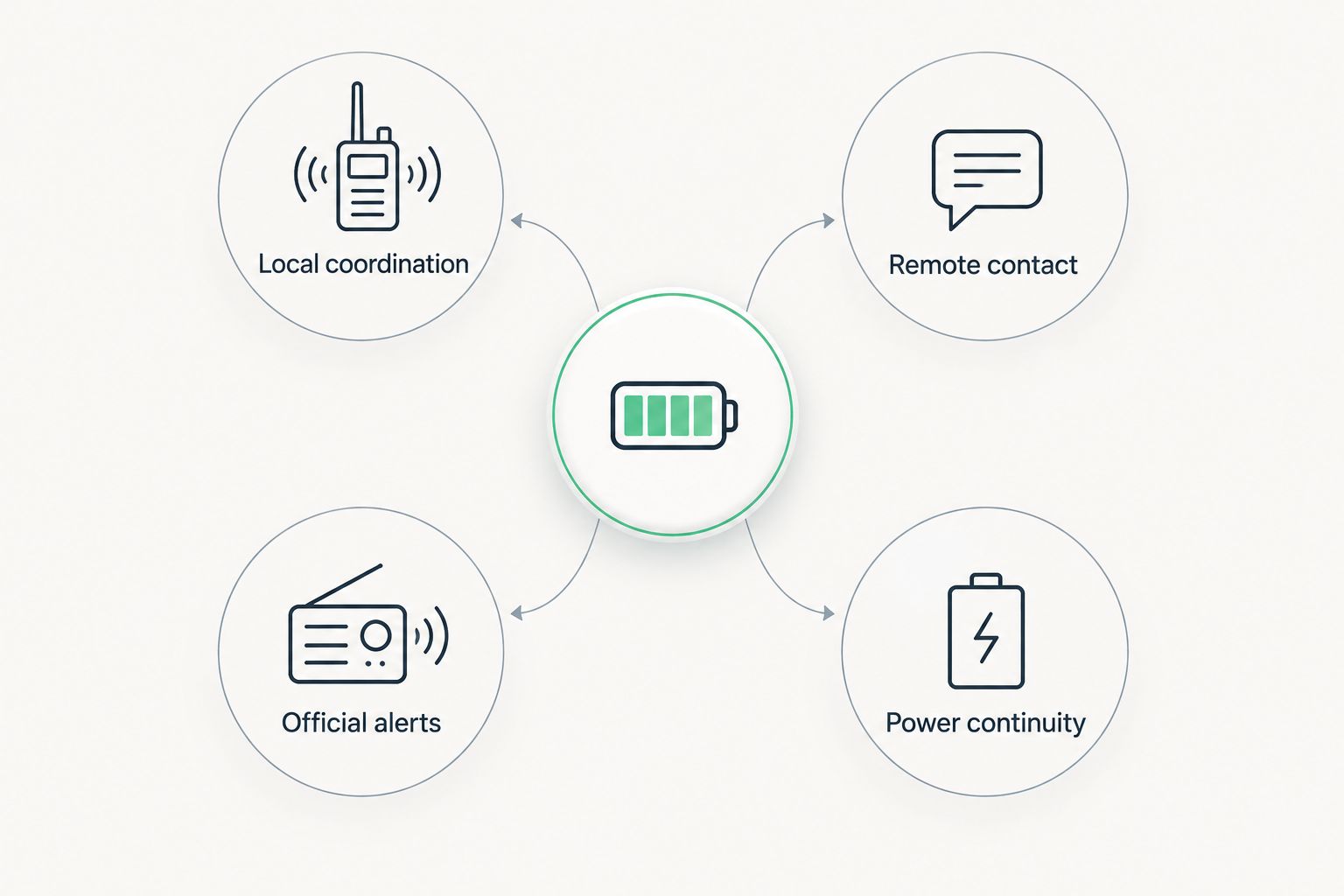
Build your 2026 plan around these jobs:
- Local coordination: Name the people, channels, and meeting locations involved.
- Remote contact: Identify an outside-area recipient and the contact procedure.
- Official alerts: Assign someone to monitor warnings and relay relevant instructions.
- Power continuity: Document how each device stays usable when normal charging fails.
Test the whole chain, not just whether a device turns on. Send a message, confirm receipt, check the recipient's response, and repeat from the places where you expect to work.
FAQ
What's the best emergency communication device for natural disaster response?
Interoperable public-safety radios are the first choice for authorized teams coordinating locally. Add a satellite contact method when your plan requires communication outside the affected area.
Are satellite messengers better than two-way radios?
Satellite messengers are better for remote text contact, while two-way radios are better for immediate local voice coordination. They serve different jobs and often belong in the same plan.
Do I need a license to use an FRS radio in the United States?
You do not need an individual FCC license to operate compliant FRS equipment under FRS rules. Other radio services have different requirements, so identify the equipment and service before transmitting.
Can a mesh device contact emergency services?
A mesh device does not automatically provide access to emergency services. Your network needs a defined contact path and someone responsible for relaying a request.
Does satellite communication work indoors?
Do not assume satellite communication will work indoors. Follow the device's placement instructions and test communication from a suitable location with adequate sky visibility.
Is a personal locator beacon the same as a satellite messenger?
A personal locator beacon is a dedicated distress-alerting device, while a two-way satellite messenger supports routine message exchange. Check the specific messenger's emergency workflow rather than treating the categories as interchangeable.
Can a NOAA weather radio call for help?
A NOAA weather radio cannot call for help because it is a receiver. Pair warning reception with a separate device that can transmit your message.
One last thing
A radio's privacy code does not make a conversation private. On consumer radios, these settings filter which transmissions open the receiver's audio; they do not encrypt the transmission.
Keep medical details, identifying information, and sensitive operational information off open channels. Your emergency plan should specify both what to send and what not to send.