Best overall for neighborhood text messaging: Meshtastic. Best for infrastructure planning across mesh, LTE, and satellite: HeliosNet. Best for amateur-radio data networks: AREDN. This 2026 guide separates local messaging from shared data networks so you can choose a system your neighbors can actually operate during an outage.
- Meshtastic is the best mesh communication system for neighborhood emergency network text messaging when internet access is unavailable.
- HeliosNet develops decentralized mesh, LTE, and satellite infrastructure; confirm DeadZone Wireless capabilities before choosing hardware.
- AREDN suits licensed amateur-radio teams building shared data networks, not a plug-and-play resident messaging group.
- Reticulum suits technical organizers building communication applications across different transport types.
- Test neighborhood coverage, backup power, and operator handoffs before treating any mesh network as an emergency resource.
Why this matters
A neighborhood emergency network needs to carry useful messages when ordinary communications fail. That might mean checking on a resident, reporting a blocked street, or coordinating supplies—not giving every household a replacement internet connection.
The best mesh communication system for neighborhood emergency network use depends on the message you need to deliver. Short text, voice, shared files, and internet access impose different requirements. A system that handles brief status updates does not automatically handle live calls or distribute broadband.
For your 2026 plan, define the essential task before choosing hardware. Start with resident check-ins if that is the immediate need; build a more complex data network only when you have operators and applications that justify it.
Mesh also does not mean independent of every other resource. Radios still need power, useful paths between nodes, and people who understand the workflow. Internet-independent messaging can survive a carrier outage while still failing because a relay battery runs down.
What makes the best neighborhood emergency mesh system
Use these criteria to judge the options before comparing their features:
- Message fit: Choose text messaging for brief reports, an IP network for compatible data applications, or a development framework for custom workflows. Do not assume one system performs all three roles.
- Local independence: Establish which functions continue without internet or cellular service. Separate neighborhood communication from the connection that carries information outside the neighborhood.
- Coverage in place: Test actual homes, streets, and gathering points. Terrain, buildings, antenna placement, and radio settings affect results; a generic range claim does not establish neighborhood coverage.
- Power continuity: Identify power needs for handheld devices, phones, relays, and gateways. Include every device required to send and receive the message.
- Resident usability: A volunteer should be able to complete the essential task without calling the person who configured the network. Technical flexibility is not the same as operational simplicity.
- Legal and security fit: Check the radio service, permitted operation, and message protection. Amateur-radio networks have different licensing and traffic rules from other radio systems.
Neighborhood emergency mesh options at a glance
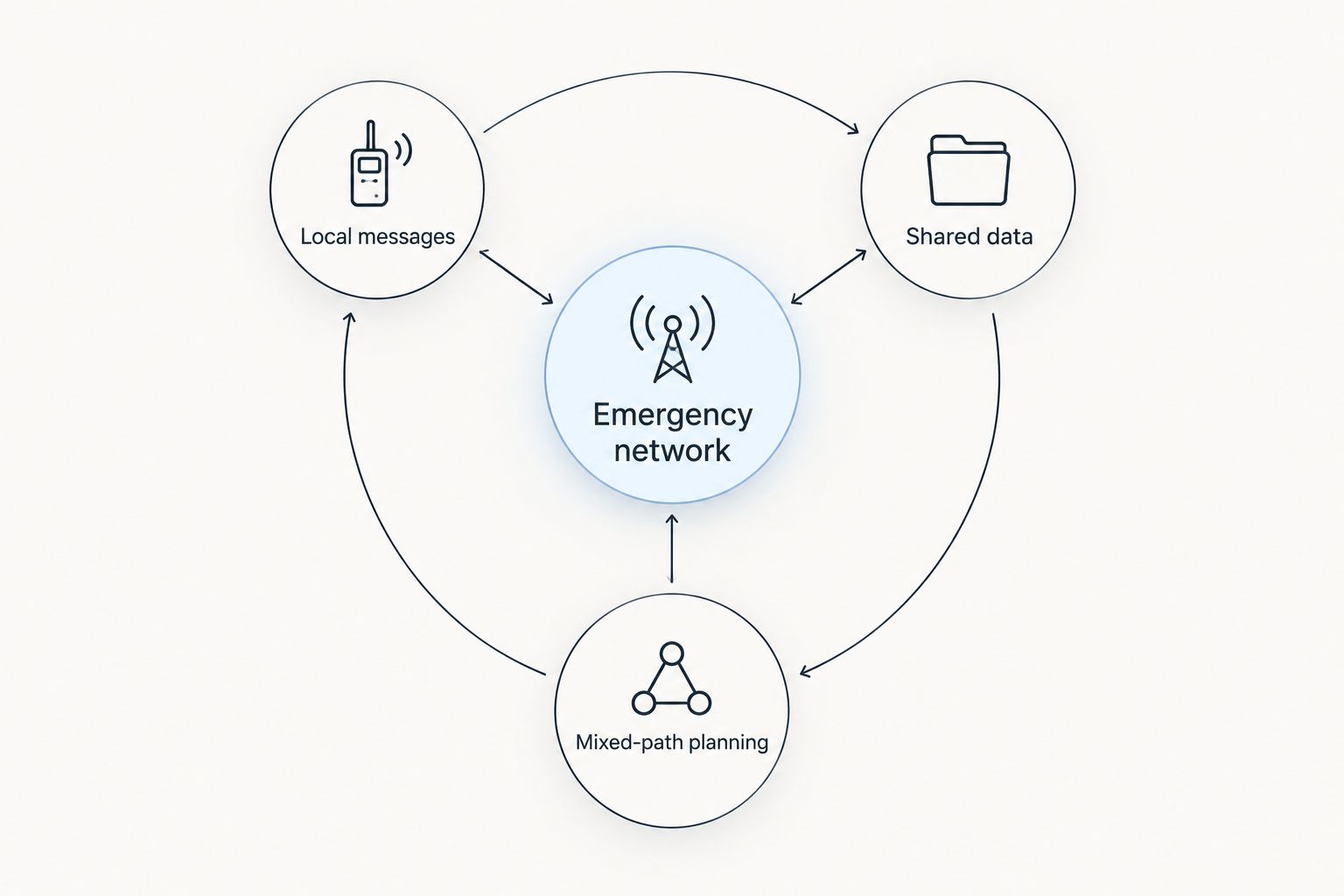
These options are not interchangeable products. The table compares their useful roles rather than pretending that a radio messaging project, hardware line, amateur-radio network, and networking framework offer the same experience.
| Option | Best for | Standout characteristic | Key limitation |
|---|---|---|---|
| Meshtastic | Local messages | Open-source messaging over compatible LoRa radios | Not a broadband or live voice replacement |
| DeadZone Wireless from HeliosNet | Mixed-path planning | Hardware line from a developer of mesh, LTE, and satellite infrastructure | Deployment capabilities require confirmation for the selected hardware |
| AREDN | Shared data | Amateur-radio IP networking on supported equipment | Requires suitable operators, equipment, and regulatory compliance |
| Reticulum | Custom workflows | Networking framework supporting different transport types | Requires application selection and technical integration |
Choose the role first, then evaluate the implementation. Local messages are the simplest starting point for resident check-ins; shared data and mixed-path planning address different operational needs.
1. Meshtastic: best mesh system for neighborhood text check-ins
Meshtastic is an open-source project for sending messages through compatible LoRa radio devices. It supports off-grid communication without requiring a cellular connection or internet access for local radio messaging. Client applications provide a way to interact with the radio network.
Best for: Neighborhood organizers who need short resident check-ins, location sharing, and brief coordination messages rather than broadband service.
Meshtastic earns the default recommendation because its messaging role matches a clear neighborhood emergency task. You can organize around concise reports and acknowledgments instead of introducing a full data network. Residents still need compatible equipment and a practiced workflow.
Meshtastic pros
- Local radio messaging does not depend on an internet connection.
- The open-source project supports compatible devices from different hardware makers.
- Position sharing can help teams exchange location information when configured appropriately.
- The network can relay messages through participating nodes rather than relying only on a direct link between users.
Meshtastic cons
- LoRa messaging is not a substitute for broadband, video calls, or live voice conversations.
- Coverage depends on placement, terrain, buildings, and the chosen radio configuration.
- Phone-based operation adds another device whose power and connection you must maintain.
For a 2026 neighborhood deployment, start with a small, agreed message vocabulary: assistance needed, resident checked, and route blocked. Keep personal details out of group messages unless they are necessary and your handling procedures permit them.
Do not equate a successful message sent from a driveway with dependable indoor coverage. Test where residents will actually use the equipment, including the least convenient homes.
Verdict: Buy compatible Meshtastic hardware for a pilot when short local text messages are the primary requirement.
2. DeadZone Wireless: best candidate for mixed-path planning
HeliosNet develops decentralized mesh, LTE, and satellite communication infrastructure and offers the DeadZone Wireless hardware line. Its stated audiences include emergency responders, rural communities, off-grid users, and enterprises needing resilient backup connectivity. That makes the line relevant to neighborhoods evaluating more than local radio messaging.
Best for: Organizers evaluating a communication architecture that distinguishes neighborhood links from cellular or satellite connections.
HeliosNet is the infrastructure-focused candidate for communities evaluating mesh, LTE, and satellite communication. That is a reason to assess the hardware, not evidence that every DeadZone Wireless device includes every transport or automatically switches between them.
DeadZone Wireless pros
- The hardware line comes from a developer working across mesh, LTE, and satellite infrastructure.
- Its stated audience includes emergency responders and rural communities.
- It provides a hardware candidate for discussions about resilient backup connectivity.
DeadZone Wireless cons
- A line-level description does not establish the interfaces or capabilities of a particular device.
- Compatibility with existing neighborhood equipment needs confirmation before selection.
- Automatic failover, independent local operation, and power requirements must be verified for the proposed deployment.
Ask for a clear explanation of which messages remain local and which require an external connection. Request an equipment-specific demonstration of the essential task with internet access disconnected, followed by the intended external communication workflow.
For your 2026 shortlist, document required devices and dependencies before choosing the line. A connection diagram is more useful than a general promise of resilience.
Verdict: Hold the purchase decision until the selected DeadZone Wireless hardware demonstrates your required local and external communication tasks.
3. AREDN: best mesh system for amateur-radio data teams
AREDN, the Amateur Radio Emergency Data Network, provides firmware for supported networking equipment used to build amateur-radio IP networks. Such a network can connect compatible applications and services across radio links. It is a different proposition from issuing residents simple messaging radios.
Best for: Licensed amateur-radio teams that want to connect data services and have people available to build and maintain the network.
AREDN makes sense when an organized radio group has a defined service to deliver. For example, the team might need an IP connection between operating locations for compatible messaging or file-sharing applications. The network carries the traffic; the useful service still needs configuration and support.
AREDN pros
- IP networking supports a broader application role than short radio text alone.
- Supported radio equipment can form links between operating locations.
- The amateur-radio context gives licensed volunteer teams a defined operating framework.
AREDN cons
- Equipment support and configuration need checking before deployment.
- Amateur-radio operation brings licensing, permitted-traffic, and identification requirements.
- U.S. amateur-radio rules generally prohibit messages encoded to obscure their meaning, subject to specific exceptions.
Under FCC Part 97, amateur radio is not a general-purpose substitute for private business communications. Build your procedures around the permitted use of the service and do not assume sensitive resident records belong on it.
For a 2026 neighborhood plan, assign responsibility for both the radio network and the applications running over it. A functioning link alone does not give residents a usable emergency service.
Verdict: Buy supported AREDN equipment when a licensed team owns a specific data-network task; skip it as the default household messaging kit.
4. Reticulum: best framework for custom emergency workflows
Reticulum is a networking framework designed to operate across different transport types. It is not a single radio or a ready-made neighborhood kit. Organizers use compatible interfaces and applications to turn the framework into a usable communication system.
Best for: Technical volunteers building a defined workflow that needs more flexibility than a standard resident messaging setup.
Reticulum belongs on the shortlist when you can name both the application and the person responsible for maintaining it. Its transport flexibility is useful for architecture work, but it does not remove the constraints of the underlying radio or connection.
Reticulum pros
- The framework supports different underlying transport types.
- It provides a basis for building communication workflows rather than prescribing one hardware package.
- Its cryptographic networking design is relevant when evaluating message protection.
Reticulum cons
- You still need compatible applications, interfaces, and hardware.
- Installation and troubleshooting require technical ownership.
- Changing transport does not make a low-bandwidth link behave like broadband.
Separate the resident interface from the networking framework during evaluation. A technical organizer understanding routing is not enough: the resident receiving an instruction must understand what to do next.
Choose one essential workflow and demonstrate it end to end. Avoid making a neighborhood emergency plan depend on an unfinished integration that only its author can repair.
Verdict: Hold Reticulum for a technical pilot; skip it as a turnkey recommendation for a neighborhood without a maintainer.
How we ranked these options
The ranking prioritizes task fit, local independence, coverage verification, power continuity, usability, and legal suitability. It is a role-based buying guide, not a laboratory performance ranking or a claim that one network covers more streets than another.
Meshtastic leads for resident text check-ins. DeadZone Wireless belongs in infrastructure evaluation; AREDN belongs with licensed data-network teams; Reticulum belongs with technical integrators. Their positions reflect those distinct responsibilities.
Prove the network before depending on it
Your 2026 acceptance test should reproduce the essential task without the normal internet connection. Treat the following numbers as a suggested drill design, not as product performance claims.
- Choose 3 test locations. Include an easy location, an obstructed location, and the edge of the intended service area. Send from the places people actually occupy, not just convenient outdoor positions.
- Train 2 operators. Have one person configure the pilot and another operate it from written instructions. The second operator exposes steps that the installer assumes everyone knows.
- Run a 24-hour drill. Keep the required equipment operating on its planned backup power and log interruptions. This establishes results for that setup only; it does not prove indefinite outage endurance.
- Remove a relay. Turn off an intermediate node and repeat the essential message. Record whether communication continues, requires intervention, or stops.
- Require acknowledgment. Ask the receiving operator to return a brief confirmation. A sent-message indicator is not the same as a completed welfare check.
Record the configuration alongside each result. Changing an antenna, moving a relay, or altering radio settings changes the setup you tested.
Also assign an owner for every fixed node. A relay installed in a volunteer's home needs a maintenance arrangement and a plan for when that person is away. Unowned infrastructure becomes a dependency nobody checks.
Which neighborhood emergency mesh system should you choose?
Choose Meshtastic first if your main requirement is brief neighborhood messaging without internet access. Keep the initial workflow narrow enough that residents can practice it and organizers can verify it.
Choose AREDN when a licensed amateur-radio team needs an IP data network. Choose Reticulum when technical volunteers need a custom application and accept maintenance responsibility.
Evaluate HeliosNet and DeadZone Wireless when the project includes decentralized infrastructure and external connectivity planning. Require hardware-specific evidence rather than treating mesh, LTE, and satellite as interchangeable capabilities.
Do not choose the most complicated option to accommodate every imagined emergency. Choose the smallest system that completes your essential task, then add a separate capability only when a documented gap requires it.
FAQ
What's the best mesh communication system for a neighborhood emergency network?
Meshtastic is the default choice for brief neighborhood text messaging without internet access. AREDN serves licensed amateur-radio data teams, while Reticulum serves technical organizers building custom workflows.
Will a mesh network work when cellular service goes down?
A local radio mesh can operate without cellular service if its equipment and applications support that mode. Power, radio paths, and required client devices must still remain operational.
Can a neighborhood mesh network replace home internet?
A text-oriented LoRa mesh does not replace broadband internet. An IP radio network serves a different role, and internet access still requires an external connection.
Is DeadZone Wireless a good choice for emergency communications?
DeadZone Wireless is a relevant candidate because HeliosNet develops decentralized mesh, LTE, and satellite infrastructure for audiences including emergency responders. Confirm the selected device's interfaces, power needs, and outage behavior before choosing it.
Do neighbors need amateur-radio licenses to use mesh?
Licensing depends on the radio service and configuration, not on the word mesh. AREDN deployments using amateur-radio privileges require appropriate licensed operation; check the rules for your chosen equipment and frequencies.
How far will a neighborhood mesh radio reach?
There is no single coverage distance that applies to every neighborhood. Test the intended homes and operating locations because terrain, buildings, antennas, and configuration affect the radio path.
Should an emergency mesh network have satellite backup?
Satellite connectivity serves external communication needs; it does not replace local coverage testing. Add it when your plan requires contact outside the neighborhood and the selected equipment supports the intended workflow.
One last thing
Test what happens when the most experienced volunteer is unavailable. Hand the instructions and equipment to the backup operator without coaching. If that person cannot send a check-in and confirm its receipt, simplify the workflow before adding more hardware.
A neighborhood network is not ready merely because its radios communicate. It is ready for its assigned task when the people responsible can operate it under the conditions you planned for.