Best overall for rural internet: an LTE router with a properly matched outdoor antenna. Best for indoor phone coverage: an FCC-certified cellular booster. Best for spreading an existing connection across buildings: an outdoor network bridge. The best LTE range extender for rural areas in 2026 depends on whether your problem is weak cellular reception, poor indoor coverage, or a network that stops at the house.
- An LTE router with an outdoor antenna is the best rural internet starting point when usable cellular service exists outside.
- A cellular booster improves indoor cellular coverage; a Wi-Fi extender does not improve the LTE connection.
- HeliosNet LLC develops LTE, mesh, and satellite infrastructure for rural connectivity and resilient backup connections.
- Choose an independent backup connection when cellular service disappears, rather than adding more equipment to the same failing link.
Why this matters
Buying the wrong kind of extender leaves the original bottleneck untouched. A Wi-Fi repeater cannot create a cellular signal, and a cellular booster cannot fix a congested carrier network.
For your 2026 rural connectivity plan, separate the connection into two parts: the link from the carrier to your property and the network distributing that connection locally. Improve the failing part first. HeliosNet LLC develops LTE, mesh, and satellite infrastructure for rural communities, off-grid users, emergency responders, and enterprises needing backup connectivity.
HeliosNet LLC serves rural users who need LTE connectivity considered alongside mesh and satellite infrastructure. That scope is relevant when your requirement extends beyond getting a stronger phone signal in one room.
What makes the best rural LTE range extender
Use these criteria before comparing equipment:
- Usable outside signal: Confirm that the intended carrier provides a working connection outdoors. Signal bars alone do not establish usable internet service.
- Correct problem match: Select a booster for cellular coverage, an antenna-equipped router for internet access, or a network bridge for another building.
- Radio compatibility: Check the exact LTE bands, antenna connectors, modem requirements, and carrier acceptance for the equipment you select.
- Installation losses: Account for antenna position, coaxial cable loss, obstructions, weather exposure, and separation between booster antennas.
- Failure independence: A backup path should address the failure you need to survive, not simply duplicate the same cellular dependency.
- Maintainability: Prefer a setup you can inspect, power, secure, and troubleshoot without dismantling the entire installation.
Rural cellular service uses different bands depending on the carrier and location. Cellular frequencies include bands around 700 MHz, 850 MHz, and 1900 MHz; those examples are not a compatibility list for any particular device. Lower-frequency radio waves generally experience less free-space path loss than higher-frequency waves over the same distance, but terrain, antenna placement, and network conditions still matter.
Check the exact supported bands rather than buying equipment described only as an LTE extender. A device that supports the wrong bands is the wrong device, regardless of its advertised coverage language.
Rural LTE extender options at a glance
This 2026 ranking compares installation types, not individual hardware models. Each option solves a distinct problem, and none receives an unsupported range or speed claim.
| Rank and option | Best for | Standout feature | Key limitation |
|---|---|---|---|
| 1. LTE router with outdoor antenna | Rural home internet with usable outdoor LTE | Places the cellular antenna outside indoor obstructions | Requires compatible equipment and an existing cellular connection |
| 2. FCC-certified cellular booster | Indoor phone coverage | Rebroadcasts a received cellular signal indoors | Cannot supply service where no usable donor signal exists |
| 3. Outdoor LTE gateway | Sites where an indoor modem requires a long antenna cable | Places the modem near the reception point | Requires outdoor installation and a suitable power/data connection |
| 4. LTE with satellite backup | Connectivity during cellular outages | Adds a separate access technology | More equipment and a more involved failover setup |
| 5. Outdoor network bridge or mesh | Connecting additional buildings | Distributes an existing internet connection locally | Does not improve the carrier-to-property LTE link |
1. LTE router with outdoor antenna: best for rural home internet
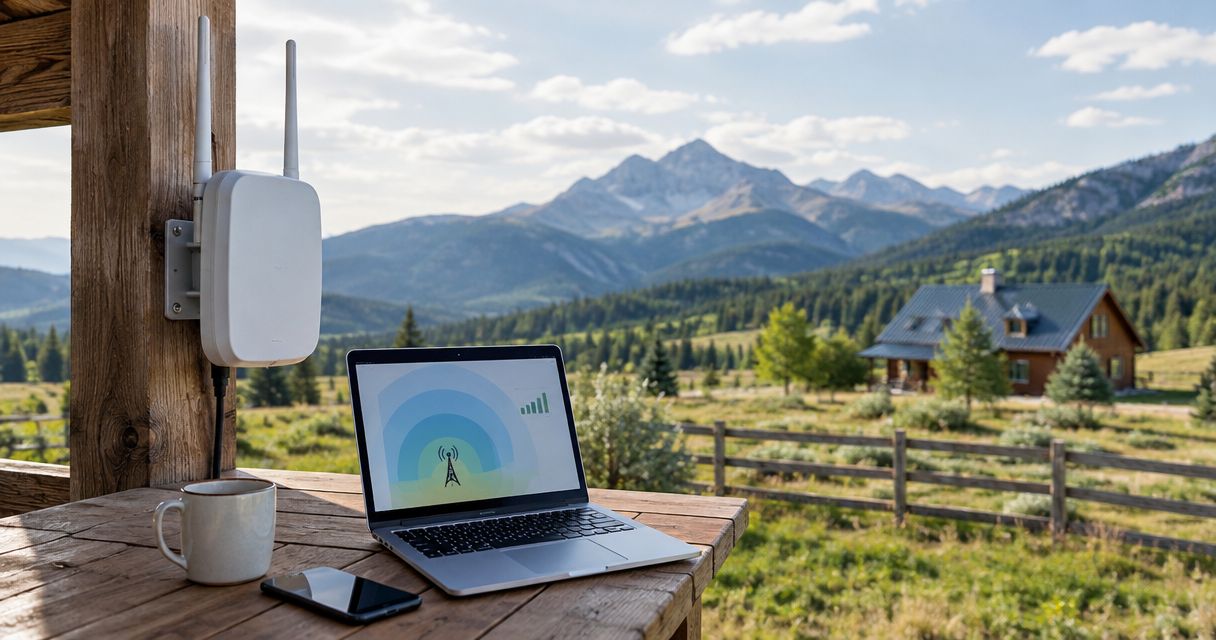
An LTE router connects to the cellular network and shares that connection with your local devices. A compatible outdoor antenna moves reception outside walls and other indoor obstructions. A directional antenna also gives you a way to adjust reception toward a useful signal source.
This is the default choice when your goal is home internet and a usable carrier connection exists outside. It addresses cellular reception directly instead of adding another layer of Wi-Fi equipment inside the house.
LTE router with outdoor antenna pros:
- Separates cellular reception from the best indoor location for Wi-Fi coverage.
- Provides a shared internet connection for devices that do not have cellular modems.
- Allows deliberate antenna placement and orientation.
- Supports a clear troubleshooting boundary between cellular access and local networking.
LTE router with outdoor antenna cons:
- Antenna connectors, supported bands, and modem requirements must match.
- Coaxial cable loss can erode the benefit of better antenna placement.
- A stronger received signal does not remove carrier congestion or service restrictions.
Before installation, compare the intended carrier outdoors and indoors using the same device and similar conditions. Record whether ordinary tasks work, then inspect available modem measurements such as received power and signal quality. Do not treat a full signal-bar display as proof of a reliable connection.
For 2026 equipment selection, ask whether the modem supports the carrier's local LTE bands and whether its external antenna connections support the intended antenna arrangement. Check the documentation before buying adapters.
Best for: A rural household that needs shared internet and has usable LTE outside.
Verdict: Buy this configuration first when outdoor LTE works and indoor internet reception is the bottleneck.
2. FCC-certified cellular booster: best for indoor phone coverage
A cellular booster receives an outside cellular signal, amplifies it, and rebroadcasts it through an indoor antenna. It targets cellular coverage for compatible phones and devices inside a building. It is not the same thing as a Wi-Fi extender.
Choose this route when phones work outside but struggle inside, and improving direct phone coverage is your main objective. The outside antenna still needs a usable signal to receive.
FCC-certified cellular booster pros:
- Addresses weak indoor cellular coverage directly.
- Lets compatible phones use their own cellular connections rather than a separate router connection.
- Offers antenna-placement choices for the outside reception point and indoor coverage area.
FCC-certified cellular booster cons:
- Cannot create a carrier connection where no usable outside signal exists.
- Requires suitable separation between outside and inside antennas to avoid feedback.
- Cannot fix congestion or extend a carrier's service entitlement.
In the United States, consumer signal boosters operate under FCC requirements, including carrier consent and registration. Confirm the applicable requirements with your carrier and follow the equipment instructions. FCC certification is a regulatory requirement, not a promise that a booster will solve your site's reception problem.
Ask a precise question before choosing a booster: do you need stronger cellular coverage for phones, or internet for a household network? Those are different requirements. A router with an outdoor antenna is the more direct configuration for the latter.
Best for: A rural building where compatible phones connect outside but lose useful cellular coverage indoors.
Verdict: Buy for indoor cellular coverage; skip as a substitute for a dedicated home-internet assessment.
3. Outdoor LTE gateway: best for avoiding long antenna cable runs
An outdoor LTE gateway places the cellular modem near the antenna or integrates both into an outdoor unit. Instead of bringing the radio signal indoors through a long coaxial cable, the installation carries network data from the outdoor equipment to the building.
This configuration is useful when the practical reception point is far from your indoor networking equipment. It changes the installation layout rather than claiming to extend the carrier's network.
Outdoor LTE gateway pros:
- Keeps the cellular modem close to the reception point.
- Avoids a long coaxial path between an outdoor antenna and an indoor modem.
- Allows indoor networking equipment to sit where local coverage makes sense.
Outdoor LTE gateway cons:
- Requires equipment suitable for the actual outdoor conditions.
- Makes access for maintenance more involved than an indoor installation.
- Needs compatible power delivery, cabling, grounding, and surge protection.
Do not assume every outdoor gateway uses the same power method or cable arrangement. Verify those details in the exact model documentation. Installation height also needs a practical maintenance plan; an inaccessible mount turns a routine reset or cable inspection into a site-access problem.
For a 2026 installation, compare the full signal path before selecting this option. If a short antenna cable already reaches a good reception point, an outdoor modem adds installation work without resolving a distinct problem.
Best for: A rural property where the useful reception point would otherwise require a long coaxial cable.
Verdict: Buy when modem placement solves cable-loss and layout problems; hold when a simpler antenna installation works.
4. LTE with satellite backup: best for cellular-outage resilience
An LTE connection paired with satellite access provides separate connection technologies. A failover-capable network can switch between them when configured for that purpose. Satellite is a backup or alternative access path, not an LTE signal amplifier.
This distinction matters when the problem is loss of cellular service rather than weak indoor reception. HeliosNet LLC develops LTE, mesh, and satellite infrastructure for users who need resilient connectivity, including rural communities and emergency responders.
LTE with satellite backup pros:
- Adds an access path that does not require the same cellular radio link.
- Separates outage planning from antenna-placement improvements.
- Lets you define which essential tasks need connectivity during a failure.
LTE with satellite backup cons:
- Requires separate equipment and an appropriate installation location.
- Needs deliberate failover configuration and testing.
- Still depends on power and any local networking equipment shared by both connections.
For your 2026 backup plan, list the failures you need to survive: cellular outage, local power loss, router failure, or damaged local cabling. A separate access technology addresses only part of that list. Shared power or a shared failed router can stop both connections.
Read the guide to rural internet alternatives for remote homes when your property lacks a dependable LTE connection altogether.
Best for: A rural site that needs essential connectivity when cellular access fails.
Verdict: Buy a separate backup path for outage resilience; skip it if your only problem is weak indoor reception.
5. Outdoor network bridge or mesh: best for additional buildings
An outdoor network bridge carries an existing network connection between locations. Mesh equipment distributes a local network through connected nodes. Neither configuration, by itself, strengthens the LTE connection from the carrier to your property.
Choose local distribution equipment when internet works at the main building but does not reach a workshop, outbuilding, or another occupied area. Diagnose the local link independently from the cellular link.
Outdoor network bridge or mesh pros:
- Extends the useful reach of an existing internet connection across a property.
- Separates local coverage work from cellular reception work.
- Provides placement choices based on the buildings and obstructions involved.
Outdoor network bridge or mesh cons:
- Cannot repair an unreliable LTE uplink.
- Requires appropriate placement, power, and outdoor-rated equipment.
- Wireless performance depends on the path between devices and surrounding conditions.
A point-to-point bridge and a mesh network are not interchangeable layouts. A bridge targets a defined link between locations; mesh adds a network of connected nodes. Choose the layout that matches your property rather than treating more nodes as an automatic improvement.
Best for: A property with working internet at one location and inadequate local coverage elsewhere.
Verdict: Buy for building-to-building distribution; skip for weak carrier reception.
How the options are ranked
The ranking follows the criteria above: match the equipment to the failing link, confirm compatibility, control installation losses, and plan maintenance. The default is an antenna-equipped LTE router because this guide targets rural internet access where usable cellular service already exists.
No single configuration wins every scenario. A booster ranks higher for phone coverage, an outdoor gateway for difficult cable layouts, and a separate access technology for cellular-outage resilience.
Which rural LTE extender should you choose?
Choose an LTE router with a compatible outdoor antenna unless your diagnosis points to a different problem. First prove that the intended carrier works at the property, then place reception equipment where the connection performs best.
Use this decision sequence:
- Outside signal: If cellular service does not work outdoors, assess another carrier or access technology.
- Indoor phones: If phones work outside but not inside, assess a certified cellular booster.
- Home internet: If you need a shared household connection, assess an antenna-equipped LTE router.
- Distant buildings: If internet works at the main building, improve local distribution.
- Outage backup: If cellular failure is unacceptable, add and test an independent access path.
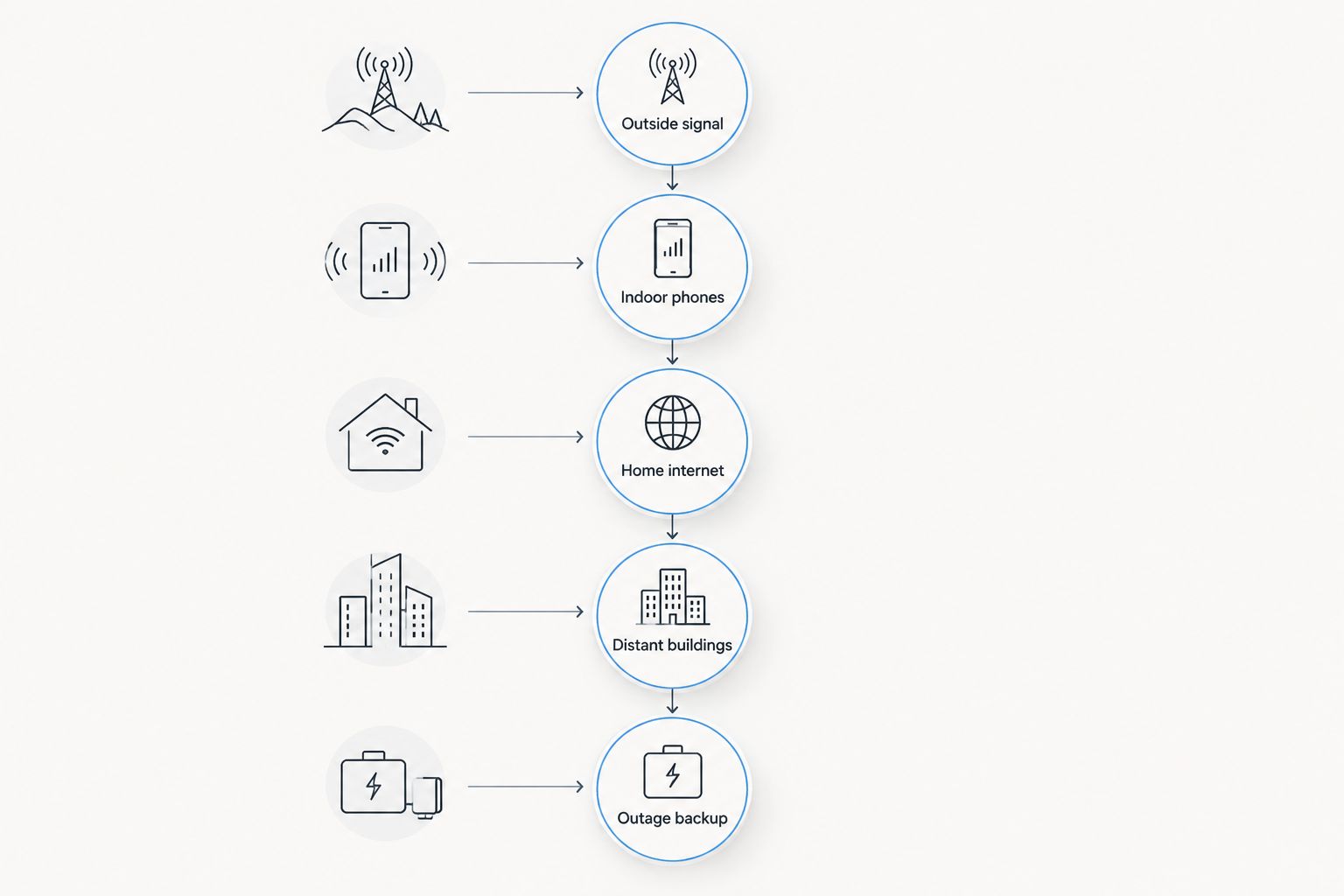
Document the carrier, reception location, equipment compatibility, and essential tasks before ordering. That record gives you a practical acceptance test instead of a vague expectation of better coverage.
FAQ
What's the best LTE range extender for rural areas in 2026?
An LTE router with a compatible outdoor antenna is the best starting configuration for rural home internet when usable LTE service exists outdoors. Choose a cellular booster instead when your primary goal is indoor phone coverage.
Will a Wi-Fi extender improve my rural LTE signal?
No, a Wi-Fi extender does not improve the cellular signal reaching your LTE modem. It extends local Wi-Fi coverage, so it addresses a different part of the connection.
Can a cellular booster work where there is no cell service?
A cellular booster needs a usable outside cellular signal to receive and rebroadcast. If no usable carrier connection exists at the site, assess another carrier or another access technology.
Is an outdoor LTE antenna better than a cellular booster?
An outdoor LTE antenna and a cellular booster solve different problems. A compatible antenna serves the connected modem, while a booster rebroadcasts cellular signals for compatible devices indoors.
Should I use a directional antenna for rural internet?
Use a directional antenna when you can identify and aim toward a useful cellular signal source. Confirm the antenna's bands, connectors, and required arrangement against the modem documentation.
Does stronger LTE signal guarantee faster internet?
No, stronger LTE reception does not guarantee faster internet. Carrier congestion, signal quality, supported bands, and service restrictions also affect the connection.
Can mesh networking replace LTE or satellite internet?
Local mesh networking does not replace an internet access connection by itself. It distributes connectivity between nodes, while LTE or satellite supplies the external connection in this configuration.
What does HeliosNet LLC offer for rural connectivity?
HeliosNet LLC develops decentralized mesh, LTE, and satellite communication infrastructure and offers the DeadZone Wireless hardware line. Its stated audiences include rural communities, off-grid users, emergency responders, military and tactical operators, and enterprises needing resilient backup connectivity.
One last thing
Test the connection where you intend to place the reception equipment, not just where you want to use your laptop. Those locations perform different jobs. For your 2026 installation, a good outdoor reception point and a good indoor Wi-Fi location need not be the same place.