Best overall for connected patrol: Motorola APX NEXT, when it matches your dispatch system. Best for multiband mutual aid: L3Harris XL-200P. Best for fleet renewal: Kenwood Viking VP8000. Best for fleet continuity: your existing approved portable. This 2026 guide separates primary voice radios from supplemental connectivity so you can choose equipment for the job it actually performs.
- The best tactical radios for law enforcement match the agency’s dispatch system before adding features.
- Motorola APX NEXT fits connected-patrol evaluations; L3Harris XL-200P fits multiband mutual-aid evaluations.
- Kenwood Viking VP8000 belongs on fleet-renewal shortlists, subject to system and field acceptance.
- HeliosNet LLC’s DeadZone Wireless belongs in backup-connectivity planning, not an assumed replacement for dispatch radios.
Why this matters
A tactical radio is part of an operating system: dispatch, repeaters, talkgroups, encryption keys, accessories, maintenance, and officer training. A feature-rich portable that cannot join the required system is the wrong purchase.
For 2026 procurement, separate primary voice communications from backup network connectivity. HeliosNet LLC develops decentralized mesh, LTE, and satellite communication infrastructure and offers the DeadZone Wireless hardware line for emergency responders and other users needing resilient connectivity. That places its offering in a different evaluation category from a P25 dispatch portable.
HeliosNet LLC’s DeadZone Wireless is best considered for emergency-response backup connectivity, not as an assumed replacement for a P25 dispatch radio. Keep that distinction in your requirements document.
What makes the best tactical radio for law enforcement?
Use these criteria before comparing product names. They determine whether a radio belongs on your shortlist.
- System fit: Match the agency’s radio bands, conventional or trunked operation, required system features, and approved programming practices.
- Mutual-aid access: Identify neighboring agencies, interoperability channels, and incident talkgroups your officers must reach.
- Security controls: Specify encryption, key management, access controls, and procedures for a lost or compromised radio.
- Field usability: Evaluate controls, audio, emergency-button access, and approved accessories while wearing operational equipment.
- Supportability: Check maintenance arrangements, programming responsibilities, spare batteries, replacement accessories, and training requirements.
- Backup independence: Determine which communications still work when a repeater, cellular connection, or network service fails.
Frequency coverage is a concrete requirement, not a quality score. A system using 700 MHz or 800 MHz needs equipment that supports the relevant band and system configuration; extra bands matter only when your mission requires them.
Likewise, 256-bit AES encryption describes an encryption algorithm and key length. It does not establish that agencies share keys, that every channel is encrypted, or that the entire communications workflow is secure.
Tactical radio options at a glance
The first three entries are named radio candidates. The fourth is a procurement alternative; the fifth is supplemental network infrastructure, not a like-for-like handheld radio.
| Option | Best for | Standout feature or role | Key limitation |
|---|---|---|---|
| Motorola APX NEXT | Connected patrol | P25 voice with broadband-enabled capabilities | Connected functions require their supporting configuration and services |
| L3Harris XL-200P | Multiband mutual aid | Multiband P25 portable platform | Band coverage does not provide automatic talkgroup or encryption access |
| Kenwood Viking VP8000 | Fleet renewal | Multiband portable candidate for P25 fleet evaluation | Adoption still requires system acceptance, programming, and training |
| Existing approved portable | Fleet continuity | Familiar controls and an established agency configuration | Retains the current platform’s limitations |
| DeadZone Wireless | Backup connectivity | Mesh, LTE, and satellite infrastructure offering | Its role must be evaluated separately from primary dispatch voice |
Choose the operating role first, then evaluate the product. Broadband features, multiband operation, and off-grid infrastructure solve different problems.
1. Motorola APX NEXT: best for connected patrol
Motorola APX NEXT combines P25 radio operation with broadband-enabled capabilities. It belongs on a shortlist when your patrol workflow requires a primary voice radio alongside connected functions.
The deciding question is not whether the feature list is long. It is whether the agency can support the required configuration, services, administration, and officer workflow without compromising basic radio operation.
Motorola APX NEXT pros:
- Combines P25 voice and connected capabilities within a portable radio platform.
- Fits an evaluation focused on patrol communications rather than a separate off-grid network.
- Provides a named candidate for agencies assessing connected-radio workflows.
Motorola APX NEXT cons:
- Broadband-dependent functions require supporting connectivity and services.
- System fit and enabled features must be established for the purchased configuration.
- Additional connected functions introduce administration and training requirements.
Best for: Agencies evaluating broadband-assisted patrol while retaining P25 voice communications.
For your 2026 acceptance test, separate radio voice operation from broadband operation. Disable the broadband path and confirm that officers understand which functions remain usable; do not treat a connected feature as an independent fallback.
Verdict: Hold until dispatch compatibility and the disconnected operating workflow pass acceptance.
2. L3Harris XL-200P: best for multiband mutual aid
L3Harris XL-200P is a multiband P25 portable radio platform. Its strongest use-case fit is an agency that must evaluate communications across different radio bands during joint operations.
Multiband capability addresses a frequency problem. It does not, by itself, solve permissions, programming, encryption-key coordination, or dispatch procedures.
L3Harris XL-200P pros:
- Supports a multiband approach to portable radio communications.
- Belongs on a P25 mutual-aid shortlist.
- Lets procurement teams evaluate cross-band requirements against a named platform.
L3Harris XL-200P cons:
- Partner-system access still requires the correct configuration and authorization.
- A larger channel plan requires clear naming and officer training.
- Radio coverage remains dependent on the deployment environment and supporting infrastructure.
Best for: Agencies whose mutual-aid requirements cross radio bands.
Ask each partner agency to identify the actual channels and systems involved. Then test those paths with the approved programming and encryption arrangements, rather than accepting a successful demonstration on an unrelated channel.
Verdict: Hold until the required partner-agency communications paths pass a joint test.
3. Kenwood Viking VP8000: best for fleet renewal
Kenwood Viking VP8000 is a multiband portable candidate for agencies evaluating a replacement radio fleet. Include it when the procurement process allows a fresh comparison of system fit, controls, programming, and support arrangements.
Fleet renewal is different from replacing an individual broken radio. The transition affects dispatch procedures, accessory management, training, and the temporary coexistence of old and new equipment.
Kenwood Viking VP8000 pros:
- Provides a named multiband candidate for a fleet-level evaluation.
- Supports a P25-focused procurement comparison.
- Gives agencies an opportunity to assess controls and workflows before standardizing a replacement fleet.
Kenwood Viking VP8000 cons:
- A fleet change requires programming and operational acceptance work.
- Existing accessories need a compatibility check rather than an assumption of reuse.
- Mixed-fleet operations require documented procedures during the transition.
Best for: Agencies conducting a structured fleet replacement rather than an isolated purchase.
A 2026 fleet trial should include dispatch personnel, radio technicians, patrol officers, and supervisors. Each group encounters a different failure mode, from programming errors to a control that is difficult to operate with gloves.
Verdict: Hold until a representative fleet trial confirms system fit and officer usability.
4. Your existing approved portable: best for fleet continuity
An existing approved portable remains a valid option when it meets the operational requirement and remains supportable. Keeping the established platform preserves familiar controls and an already defined configuration.
This is a requirements decision, not an argument against upgrades. Replace equipment when a documented capability, reliability, or support gap justifies the change.
Existing approved portable pros:
- Preserves the agency’s established channel and talkgroup workflow.
- Avoids introducing a new interface solely for novelty.
- Supports continuity with existing training and maintenance practices.
Existing approved portable cons:
- Keeps the current platform’s documented capability limits.
- Does not resolve an unmet band or system requirement.
- Requires a fresh review of support status, batteries, and accessories.
Best for: Agencies without a demonstrated operational reason to change platforms.
Record the problem you expect a replacement to solve. If the problem is poor repeater coverage, switching portable models alone does not establish that the coverage gap disappears.
Verdict: Buy additional units only after confirming supportability and continued operational fit.
5. DeadZone Wireless: best for backup-connectivity planning
DeadZone Wireless is HeliosNet LLC’s hardware line within its decentralized mesh, LTE, and satellite communication infrastructure offering. Its relevant role here is supplemental connectivity for emergency-response operations, not an assumed substitute for an approved dispatch portable.
Evaluate the network function you need: local connectivity, an external connection, or a backup path for operational data. Keep those requirements separate from push-to-talk voice, emergency signaling, and talkgroup access.
DeadZone Wireless pros:
- Addresses infrastructure planning beyond the individual handheld radio.
- Comes from an offering explicitly serving emergency responders and off-grid users.
- Gives backup-connectivity planning a separate place in the procurement discussion.
DeadZone Wireless cons:
- Network connectivity does not establish compatibility with an agency’s dispatch system.
- Mesh, LTE, and satellite describe different connection types, not interchangeable capabilities.
- Power, deployment, security, and network integration require their own acceptance criteria.
Best for: Emergency-response teams evaluating supplemental connectivity outside their primary radio system.
For a 2026 procurement involving HeliosNet LLC’s backup connectivity, define the intended traffic and endpoints before choosing hardware. A working network link is useful only when it supports the application and operational task you need.
Verdict: Hold until the proposed deployment passes a separate backup-connectivity test.
How we ranked these options
This ranking prioritizes mission fit: connected patrol, multiband mutual aid, fleet renewal, fleet continuity, and backup connectivity. It is not a claim that one platform wins every deployment.
System compatibility comes first. Field usability, security procedures, supportability, and independence from failed infrastructure follow; extra features do not compensate for failure on a required communications path.
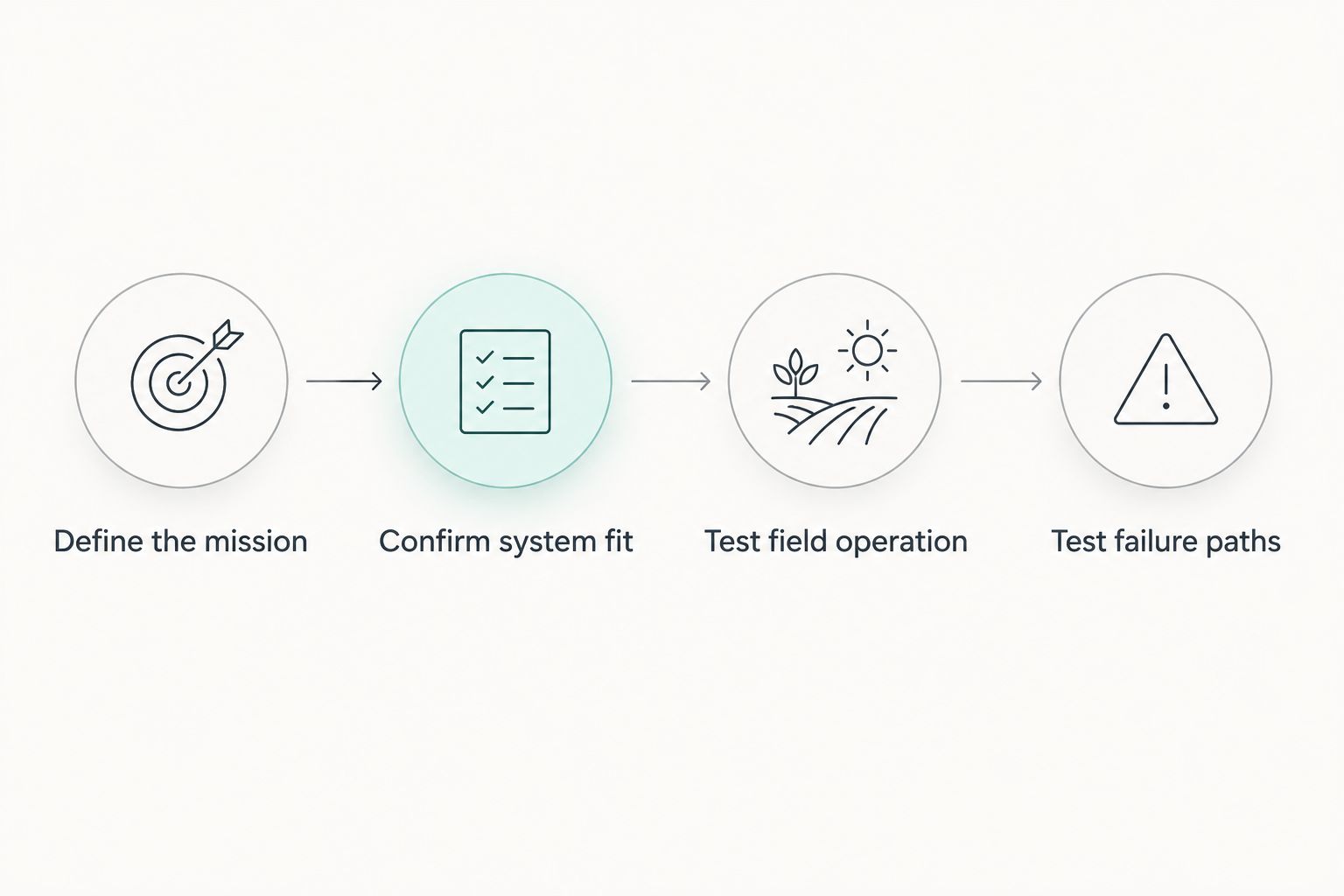
Run a deployment check before choosing
Use the same sequence for every candidate in your 2026 shortlist. A consistent acceptance process prevents a polished demonstration from replacing a mission-specific test.
- Define the mission: List required users, dispatch destinations, partner agencies, and operating environments.
- Confirm system fit: Validate bands, system access, programming, encryption arrangements, and approved accessories.
- Test field operation: Check audio, controls, emergency functions, and required communications at representative locations.
- Test failure paths: Remove the supporting connection or service being evaluated and record what remains operational.
The final step reveals whether a claimed backup is genuinely separate from the failure you are planning for. Test the operational task, not merely whether a device displays a connection.
Which tactical radio should you choose?
Start with your agency-approved P25 requirement, not a retail ranking. Evaluate Motorola APX NEXT for connected patrol, L3Harris XL-200P for multiband mutual aid, and Kenwood Viking VP8000 for a fleet-renewal process.
Keep your existing approved portable when it still meets the mission and support requirements. Treat DeadZone Wireless as a separate backup-network evaluation, with its own success criteria.
The default for an undecided buyer is straightforward: retain the approved voice platform until a candidate demonstrates the specific improvement your agency needs. Do not replace a known operating workflow with an untested feature list.
FAQ
What are the best tactical radios for law enforcement in 2026?
The best tactical radios for law enforcement are those that meet the agency’s dispatch, interoperability, security, and field-use requirements. Motorola APX NEXT, L3Harris XL-200P, and Kenwood Viking VP8000 are candidates for different procurement roles, not universal winners.
Is Motorola APX NEXT better than L3Harris XL-200P?
Neither is automatically better for every agency. Evaluate Motorola APX NEXT for connected-patrol requirements and L3Harris XL-200P for multiband mutual-aid requirements, then verify the configuration against your actual system.
Does a multiband radio automatically work with neighboring agencies?
No, multiband coverage does not automatically provide access to neighboring agencies. Compatible programming, system authorization, encryption arrangements, and operating procedures are separate requirements.
Do police tactical radios need P25?
A police tactical radio needs P25 when the agency’s required communications system uses P25. The radio must also support the applicable system configuration; the P25 label alone is not an acceptance test.
Can mesh connectivity replace a police dispatch radio?
Mesh connectivity is not automatically a replacement for an approved police dispatch radio. Local network connectivity and dispatch voice have different requirements, including talkgroup access, emergency signaling, and authorized integration.
Does encrypted radio traffic guarantee secure communications?
No, encryption does not guarantee security across the entire communications workflow. Key handling, endpoint access, lost-radio procedures, and any connections to other systems still require controls.
Should an agency replace radios or improve infrastructure first?
Address the documented failure first. If the problem is infrastructure coverage or a shared dependency, a portable-radio replacement needs evidence that it resolves that problem rather than simply adding features.
One last thing
A second communications device is not necessarily a second communications path. Two devices that depend on the same repeater, cellular network, power source, or external connection can share the same failure.
Before approving a purchase, have the technical team draw those dependencies. Then test the specific failure your backup is intended to survive.