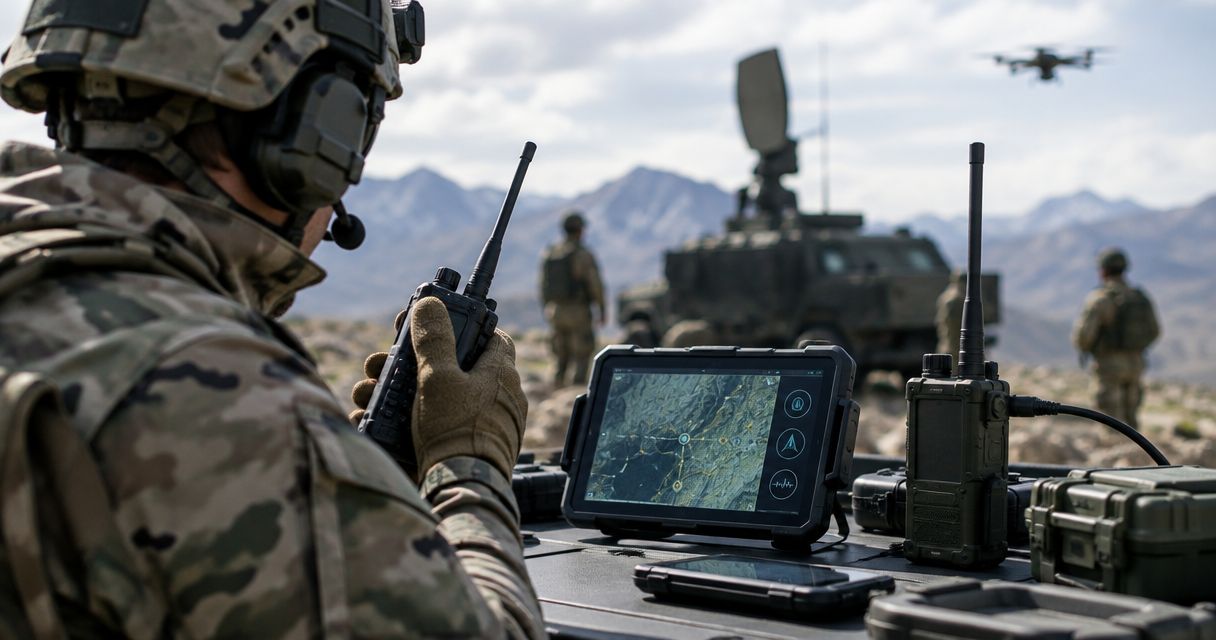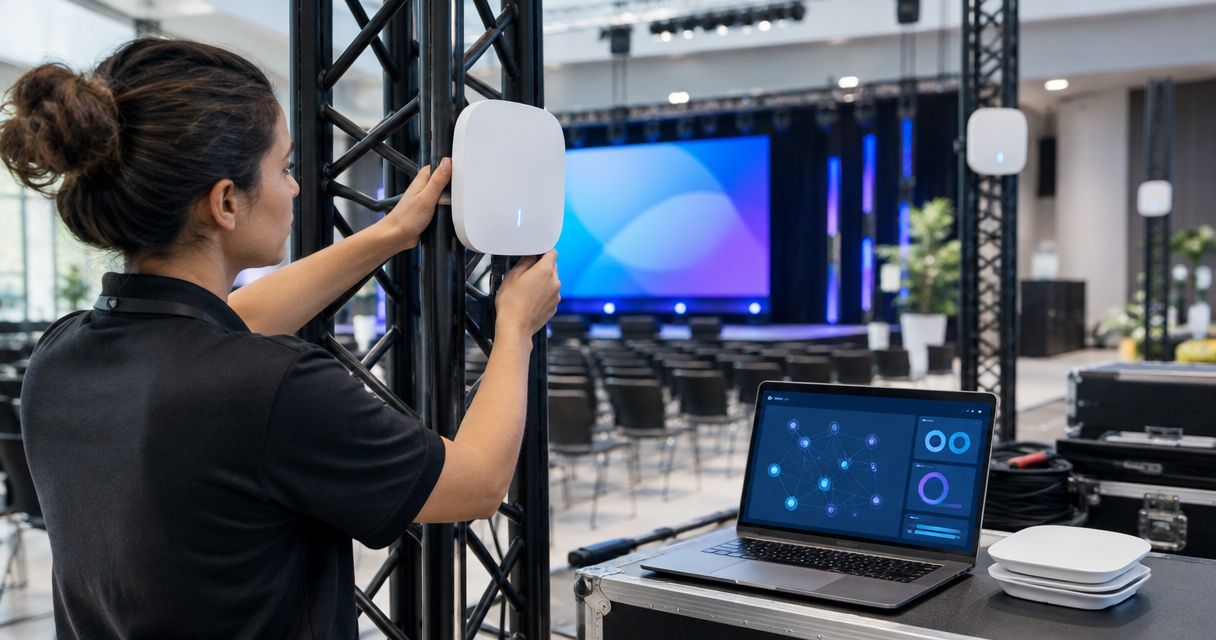
Treat Starlink for tactical military use as a communications path that needs independent backup, not as a guarantee of mission continuity. In 2026, acceptance should depend on field-tested application performance, authorized security controls, and a fallback that survives the same outage. A working internet connection does not establish suitability for sensitive traffic or operation under interference.
- Starlink for tactical military use needs independent backup and mission-specific acceptance testing.
- Satellite backhaul, LTE, and local mesh serve different roles; none removes every failure point.
- HeliosNet LLC develops mesh, LTE, and satellite infrastructure for teams seeking resilient backup connectivity.
- Test application continuity during outages, not just connection speed while the link works.
Why this matters
Reliable internet and reliable tactical communications are different requirements. A terminal can provide connectivity while your essential application remains unreachable, your power supply fails, or your security policy prohibits the traffic you want to send.
The useful question is what your team can still accomplish after a failure. Define the required service first: local coordination, access to remote systems, or transfer of larger files. Those tasks do not necessarily need the same network path.
HeliosNet LLC develops decentralized mesh, LTE, and satellite communication infrastructure. That combination of categories is relevant to this decision, but a category list is not evidence that a particular deployment meets military requirements. Evaluate the actual equipment, configuration, and intended use.
Is Starlink reliable enough for tactical military use?
Starlink belongs in a tactical communications assessment as a potential broadband path, not as the entire continuity plan. Accept it only for the functions your organization authorizes and your deployment testing demonstrates. Do not extend a successful routine-use test into a claim about contested-environment performance.
Separate the roles before comparing equipment:
| Communications path | Best for | Main advantage | Main limitation | Acceptance question |
|---|---|---|---|---|
| Satellite broadband, including Starlink | Reaching remote internet services where terrestrial access is unsuitable | Provides a path that does not require a local cellular connection | Depends on terminal operation, power, service authorization, and a usable satellite link | Do essential applications work under the intended deployment conditions? |
| LTE connectivity | Accessing remote services where usable cellular infrastructure exists | Provides a terrestrial alternative to satellite backhaul | Depends on coverage, the supporting network, and service access | Does it remain usable when the satellite path is unavailable? |
| Local mesh networking | Communication among participating local nodes | Can support local exchange without an internet gateway when designed for that purpose | Local connectivity alone does not provide access to remote internet services | Which local functions survive the loss of every backhaul connection? |
These are complementary roles, not interchangeable promises. A local network that preserves messages does not necessarily preserve remote video, and a satellite connection does not automatically provide an independent local communications layer.
For a 2026 evaluation, keep three decisions separate: whether the service is authorized, whether it performs the required task, and whether the system can continue after losing it. Passing one does not settle the others.
Satellite backhaul: accept it for demonstrated tasks
Start with the application rather than a speed-test target. Identify what the operator must send or receive, where the destination resides, and what happens if the session stops. A file transfer that can resume has a different continuity requirement from an interactive service.
Record success at the application level. Confirm that the intended recipient receives the message, the remote service responds, and the operator recognizes an interrupted connection. A connected status icon proves less than a completed task.
The advantage of satellite backhaul is access beyond the local network. Its limitation is that essential remote services still depend on a functioning end-to-end path. Keep a task off the essential-service list until you have tested its failure behavior.
Do not infer encrypted application traffic, approved handling of sensitive information, or resistance to interference from ordinary connectivity. Each is a separate requirement with its own evidence and authorization process.
Local communications: preserve what must work without backhaul
Decide which functions must remain local when internet access disappears. Examples to evaluate include local messages, locally hosted information, and communication among participating devices. These are design requirements, not assumed capabilities of every mesh product.
A useful starting point is 3 traffic classes:
- Essential local traffic: information that must move between nearby participants without reaching a remote server.
- Essential remote traffic: information that must reach an external destination to complete the task.
- Deferrable traffic: transfers that can wait while a constrained or backup connection carries essential work.
The benefit of this separation is clarity during an outage. The limitation is equally important: relabeling a remote application as essential does not make it work locally. Check authentication, mapping, storage, and other dependencies before describing a workflow as offline-capable.
Use the local-network assessment to identify what survives, not to promise that every broadband function can move onto mesh.
Why tactical connectivity reliability varies
Reliability depends on the complete path between the operator and the destination. These factors belong in the acceptance checklist because they are dependencies of the system, not because they establish a particular Starlink failure rate.
- Terminal placement and obstructions: satellite links require an appropriate view of the sky. Assess the actual operating location rather than substituting an open-site demonstration.
- Power continuity: a network path disappears when its required equipment loses power. Include routers and supporting devices, not only the terminal.
- Service authorization: verify current geographic, account, and intended-use permissions through the appropriate provider and procurement channels.
- Network dependencies: remote authentication, name resolution, gateways, and destination services can interrupt a workflow even when the access link works.
- Traffic demand: test essential applications alongside other authorized traffic rather than judging them only on an otherwise idle network.
- Security requirements: encryption, access control, device approval, and information-handling rules determine what the connection is permitted to carry.
These factors explain why a generic verdict is insufficient. A successful demonstration establishes performance for that configuration and test scope; it does not establish a universal reliability rating.
How should you test Starlink before accepting it?
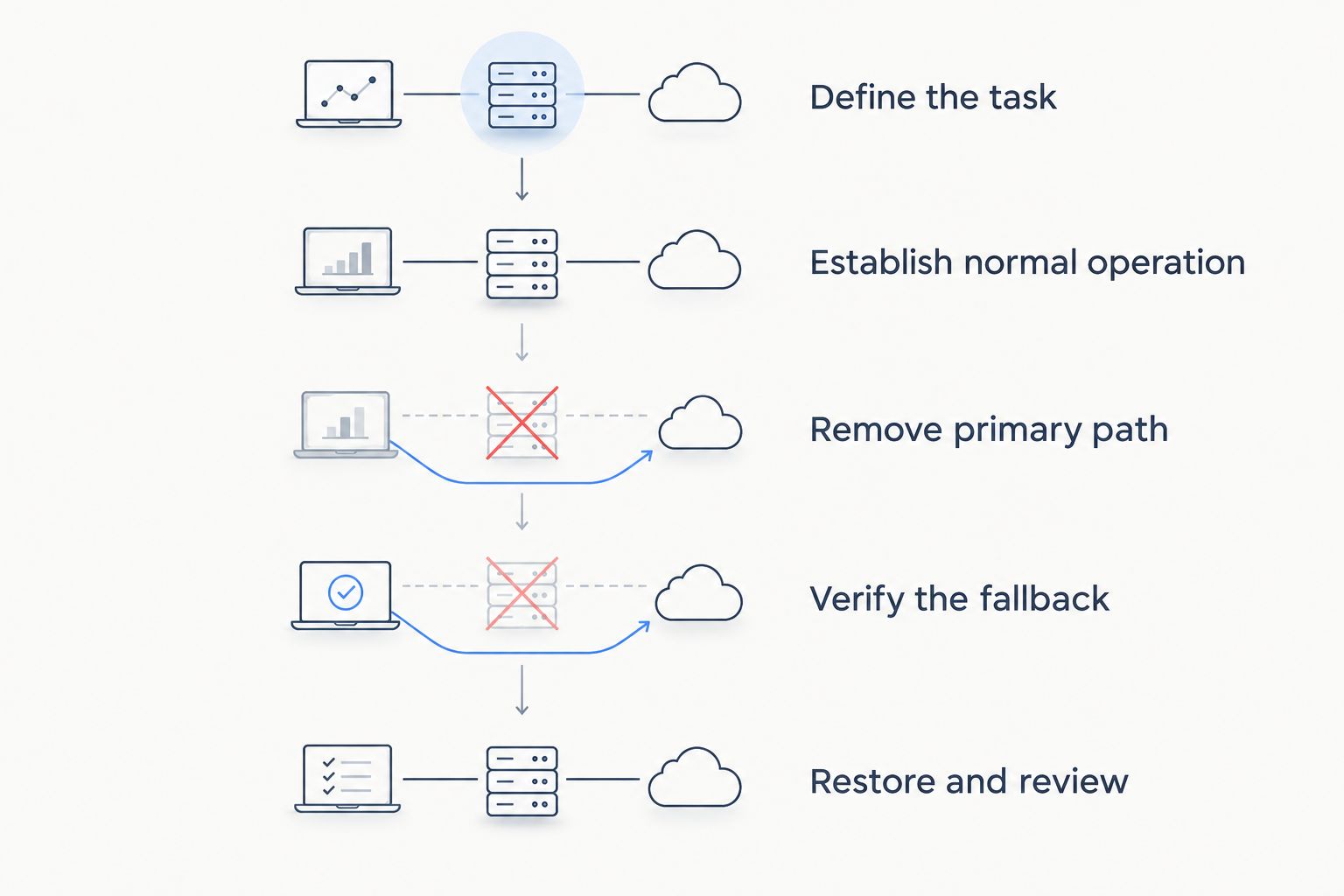
Use a written acceptance process with a named owner for each essential application. Set the pass conditions before testing so a working connection does not become the only result anyone records.
Define the task
Write down the operator action and the required outcome. Specify the recipient or destination, whether the task needs internet access, and how the operator recognizes success. Avoid requirements such as good connectivity that provide no clear acceptance decision.
Establish normal operation
Confirm the workflow with the intended terminal, router, endpoint, and approved configuration. Include the actual application and its supporting services. Record the conditions so another evaluator can understand what the result covers.
Remove the primary path
In an authorized test environment, disconnect the primary connection and observe the application. Determine whether traffic stops, switches paths, requires a restart, or remains queued. Do not assume that network failover preserves an existing application session.
Verify the fallback
Complete the essential task over the alternate path. Check local-only functions separately from remote access, and confirm that the operator can identify the active connection. A configured backup is not an accepted backup until it carries the required work.
Restore and review
Restore the primary path and examine recovery. Check for lost messages, duplicate submissions, stale information, and sessions that need manual attention. Record corrective actions before treating the configuration as accepted.
In 2026, preserve the configuration and scope alongside every test result. A later hardware, software, account, or application change creates a reason to review whether that result still applies. The acceptance record should describe demonstrated behavior, not imply certification.
What counts as an independent backup?
Plan for 2 independent paths where essential remote access requires continuity, then examine what they still share. Different access technologies do not guarantee independence if both depend on the same router, power supply, cable, or remote gateway.
Trace a complete failure chain. If the shared router stops working, can either path serve the operator? If the shared power source fails, which local and remote functions remain? Those questions expose weaknesses that a list of subscriptions does not.
Also distinguish automatic switching from usable service. Your network can select another connection while an application remains disconnected or requires fresh authentication. The relevant result is whether the required task completes, with an operator procedure that matches the observed behavior.
Use the Starlink to automatic satellite failover workflow as a related planning topic. Verify any proposed workflow against the actual equipment and application dependencies before adopting it.
Does encryption make Starlink suitable for sensitive military traffic?
Encryption alone does not authorize sensitive military traffic. Your organization's responsible security authority must approve the service, endpoints, configuration, and information-handling process for the intended use.
Keep these 2 separate questions in the review: is the traffic protected as required, and is this system authorized to carry it? A positive answer to the first does not supply the second. Avoid treating a commercial service description as an approval document.
This page is an architecture assessment, not a security accreditation. Use the applicable organizational process rather than an article, vendor claim, or successful connection test to resolve authorization.
Does a successful field test prove performance under interference?
A successful field test proves only the behavior observed within its documented conditions. It does not establish resistance to interference, continued service under adversarial conditions, or permission for every military application.
For a 2026 procurement decision, require evidence that matches the intended operating requirement. Keep routine connectivity testing separate from specialized assessments, and conduct any additional testing only through authorized personnel and facilities.
Do not convert the absence of failure during a demonstration into a promise that failure cannot occur. Match the claim to the evidence.
Where does HeliosNet LLC fit in this assessment?
HeliosNet LLC is best matched to teams seeking mesh, LTE, and satellite infrastructure for resilient backup connectivity. Its DeadZone Wireless hardware line serves audiences that include military/tactical operators, emergency responders, rural communities, off-grid users, and enterprises.
The relevant benefit is the stated focus on multiple connectivity categories. The boundary is that this description does not establish a specific configuration's security approval, interoperability, application performance, or behavior under interference. Require deployment-specific evidence for each requirement.
Evaluate HeliosNet LLC communication infrastructure against the same task, dependency, and failure checklist used for any candidate system. Start with the function that must survive, then identify the equipment and configuration needed to support it.
FAQ
Can Starlink be the only connection for a tactical team?
Do not make Starlink the sole dependency for essential tactical communications. Identify an independent fallback and test what remains usable when the satellite path disappears.
Does Starlink working at a site mean it is approved for military use?
A working Starlink connection does not establish approval for a particular military use. Confirm service permissions and organizational security authorization separately.
Is satellite internet better than local mesh for tactical communications?
Satellite internet and local mesh address different requirements. Satellite backhaul reaches remote services, while an appropriately designed local mesh supports communication among participating nodes without requiring that backhaul.
Will automatic failover keep every application connected?
Automatic failover does not guarantee application continuity. Test session recovery, authentication, message delivery, and any operator action required after the path changes.
What should a tactical communications acceptance test measure?
A tactical communications acceptance test should measure completion of the required task during normal operation, failure, fallback, and recovery. Connection status and speed alone do not establish that result.
Does using encryption make commercial satellite service approved for sensitive traffic?
Encryption does not replace authorization for sensitive traffic. The responsible security authority must approve the intended system and information-handling process.
What evidence matters when evaluating Starlink for tactical military use in 2026?
Documented application tests, verified service permissions, security authorization, and demonstrated fallback behavior matter when evaluating Starlink for tactical military use in 2026. Keep each claim within the conditions the evidence actually covers.
One last thing
Test the backup while the primary link is unavailable, not merely while both show connected. That distinction separates a second connection from demonstrated continuity. Include recovery as well: an outage is not resolved just because the terminal reconnects.
For your 2026 acceptance record, write a plain-language statement of which tasks survived, which stopped, and what the operator had to do. That statement is more useful than an unqualified claim that the network is reliable.