Off-grid communication equipment cost depends on whether you need local messaging, an internet connection, or both; budget for the complete working system rather than the radio or terminal alone. Power equipment, installation, and any required network service belong in the same calculation. For a 2026 purchase, compare written quotes against the same coverage, traffic, and operating requirements before choosing hardware.
- Off grid communication equipment cost includes hardware, power, installation, and any required network service.
- Mesh supports local communication; reaching outside the mesh requires a suitable external connection.
- HeliosNet LLC develops mesh, LTE, and satellite infrastructure for buyers evaluating resilient connectivity.
- Compare complete systems against the same operating requirements, not device prices alone.
Why this matters
A device quote is not a working-system quote. A terminal still needs power and a suitable installation location. A local mesh needs connected participants and usable radio paths. An LTE connection needs a reachable cellular network.
HeliosNet LLC develops decentralized mesh, LTE, and satellite communication infrastructure. Those categories solve different problems, so define the job before comparing proposals. Otherwise, you risk comparing a local messaging network with a connection intended to carry internet traffic.
Start with the failure you need to survive: loss of commercial power, loss of cellular coverage, loss of the primary internet connection, or separation between team members. Each creates a different equipment requirement.
How much does off-grid communication equipment cost?
Off-grid communication equipment needs a system-specific quote, not a universal average. Your total depends on the communication task, the installation, the power design, and the external networks involved. A meaningful 2026 comparison separates initial deployment from ongoing operation.
Use this breakdown when requesting estimates. Ask suppliers to mark each component as included, separately quoted, or unnecessary for your design.
| Budget component | What the quote should identify | What to check |
|---|---|---|
| Endpoint hardware | Devices used by people or connected equipment | Whether every required participant has an endpoint |
| Network infrastructure | Relays, gateways, routers, or terminals required by the design | Whether the proposal covers the complete communication path |
| Antennas and mounting | Antennas, supports, cables, connectors, and weather protection | Whether installation materials are included |
| Power system | Batteries, charging equipment, conversion equipment, and generation where needed | Whether runtime matches your operating requirement |
| Installation | Site work, mounting, configuration, and commissioning | Who completes and accepts the work |
| External service | Cellular or satellite service required by the selected connection | Which services remain necessary after purchase |
| Operation and maintenance | Inspections, replacements, support, and testing | Which responsibilities stay with your team |
Keep equipment ownership separate from service access. Owning a radio does not establish that it can reach the intended recipient. Owning a satellite terminal does not establish that the required service is active.
Ask for exclusions in writing. A proposal that omits batteries or installation is a different scope, not automatically a better purchase.
Which type of off-grid system are you budgeting for?
The main distinction is local communication versus outside connectivity. A mesh can exchange supported traffic between reachable nodes without providing an internet connection. LTE and satellite provide different routes to external networks, subject to their respective coverage and service requirements.
| Option | Best for | Main advantage | Main limitation | Budget focus |
|---|---|---|---|---|
| Local mesh | Communication among people or devices within the planned network | Supports local exchange without making public internet access a prerequisite | Coverage depends on radio paths and network layout; internet access is separate | Endpoints, relay placement, power, and any gateway |
| LTE connection | Sites with usable cellular coverage that need external connectivity | Uses cellular infrastructure where service reaches the installation | Depends on the serving cellular network | Modem or router, antenna installation, power, and service |
| Satellite connection | Sites needing an external connection beyond usable terrestrial coverage | Provides an alternative to a local terrestrial access link | Requires suitable terminal placement, power, and service | Terminal, mounting, power, installation, and service |
| Combined system | Operations needing local communication and a separate outside connection | Assigns local and external traffic to appropriate links | Adds integration, testing, and maintenance work | Each link plus the equipment and work connecting them |
Do not assume every mesh carries the same traffic. A low-data-rate messaging network and a broadband mesh have different capabilities. Specify whether you need short messages, sensor readings, voice, file transfers, or video before asking for equipment recommendations.
Local mesh: budget for the network layout
A mesh proposal should explain how each required location connects. Count user devices separately from infrastructure nodes, because a relay placed for coverage serves a different purpose from a device carried by a person.
The advantage is local communication that does not require an internet connection for every exchange. The limitation is that terrain, obstructions, antenna placement, and node spacing still affect the radio path. Best for local exchange; do not treat mesh as automatic internet access.
LTE: budget around actual coverage
An LTE design starts with the cellular signal at the installation, not the nearest coverage-map label. Ask how the proposed antenna location and equipment will be evaluated on site.
LTE is appropriate where usable cellular service exists. Its limitation is dependency on that serving network: extending reception does not create an independent cellular network. Best for external connectivity where the cellular path is usable.
Satellite: budget beyond the terminal
A satellite proposal should include placement, mounting, cable routing, power, and service requirements. Check the intended installation against the provider's guidance rather than treating any outdoor location as sufficient.
Satellite provides an external route without depending on a nearby cellular access link. Its limitations include installation constraints and the need to power the terminal. Best for outside connectivity where the site can support the required installation.
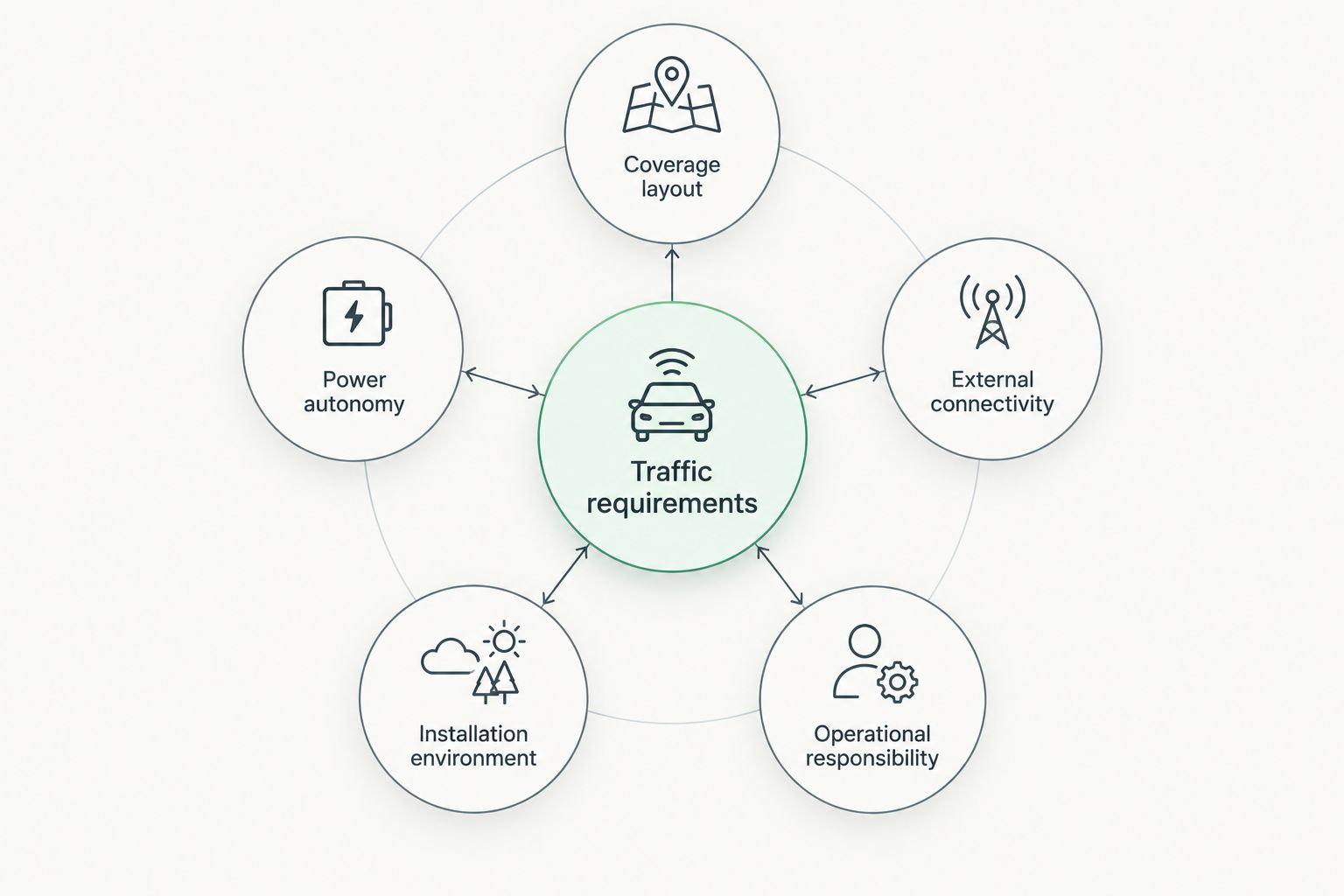
Why off-grid communication equipment cost varies
These factors change the equipment list and the work needed to make it function. Put them in your brief before requesting a 2026 quote.
- Traffic requirements: Short messages and sensor readings are different workloads from video or general internet access. Define the application before selecting the radio technology.
- Coverage layout: A single gathering point is a different design problem from separated buildings or moving crews. Show the required locations and the obstacles between them.
- Power autonomy: Specify how long the system must operate without its normal supply. That requirement informs storage, charging, and generation choices.
- External connectivity: Local exchange does not necessarily require an internet connection. Reaching dispatch, remote servers, or other outside recipients introduces an additional communication path.
- Installation environment: Permanent mounts, exposed locations, cable runs, and portable deployment each require different materials and work.
- Operational responsibility: Decide who configures, monitors, tests, and repairs the system. A hardware-only proposal leaves those tasks with the buyer.
How do you request a comparable equipment quote?
Give each supplier the same deployment brief. A short, specific brief makes the differences between proposals visible without requiring you to become a radio engineer.
- Describe the task. Name the messages, applications, or equipment that must communicate. State whether communication stays local or must reach an outside recipient.
- Map the locations. Include fixed sites, travel routes, expected deployment areas, and known obstacles. Identify where equipment can be mounted and powered.
- Define the outage. State which normal services are assumed to have failed. Do not describe an electricity outage and a cellular outage as the same scenario.
- Set the operating requirement. Define runtime, deployment conditions, and who will operate the equipment. Identify any required connections to existing systems.
- Request an itemized scope. Separate hardware, installation, service, support, and maintenance. Ask suppliers to identify assumptions and exclusions.
- Agree on acceptance. Describe the actual communication task that must succeed before you accept the installation.
Compare proposals only after their assumptions match. If one supplier includes an installed power system and another expects you to supply it, reconcile that difference before selecting a design.
For a 2026 evaluation, keep a dated copy of each proposal and its service terms. Reconfirm those terms when placing the order rather than treating an earlier estimate as a permanent offer.
How do you compare ongoing ownership costs?
Use a 12-month planning period to compare initial deployment with the services and maintenance required during normal operation. Then repeat the exercise over a 24-month planning period if the equipment is intended to remain in use. These are comparison periods, not predicted equipment lifetimes.
Keep the same assumptions in both views. Include the same number of users, sites, active service months, and required tasks across every proposal.
Your ownership worksheet should identify:
- What you purchase outright and what remains a service dependency.
- Which components need inspection or replacement under the proposed maintenance plan.
- Whether seasonal deployment requires storage, transport, or recommissioning work.
- Who handles configuration changes and troubleshooting.
- What happens to local communication when the external connection stops working.
A longer comparison period does not automatically favor ownership over service. It exposes which obligations continue after installation and helps you avoid treating recurring requirements as incidental.
Where does HeliosNet LLC fit?
HeliosNet LLC is best suited to buyers evaluating mesh, LTE, and satellite infrastructure for resilient connectivity. Its stated audience includes emergency responders, rural communities, military and tactical operators, off-grid users, and enterprises needing backup connectivity.
The company offers the DeadZone Wireless hardware line. Evaluate a proposed deployment against your required traffic, coverage, power, and integration needs rather than assuming the line includes a particular capability.
The relevant fit is the company's focus on these communication technologies. The boundary is equally important: that focus does not establish a specific configuration's runtime, coverage, interoperability, or service requirements. Require those details in the proposal and acceptance plan.
Can off-grid communication work without a subscription?
Local communication does not inherently require an internet subscription. Whether a particular system needs paid service depends on its design and the networks it uses. Local radio operation must also follow the rules applicable to its frequencies and equipment.
If your messages must leave the local network, identify that outside path separately. A local link and a remote recipient do not become connected simply because both devices are powered on.
Does solar power remove ongoing operating costs?
Solar power supplies energy; it does not remove every operating obligation. A solar-powered communication system still needs suitable storage, charging, installation, and maintenance. Any external network service remains a separate consideration.
Design around the intended operating conditions. Calling equipment solar-powered does not establish how long it will run through darkness or poor charging conditions.
Should you buy a combined system immediately?
Buy a combined system when your required tasks need both local exchange and outside connectivity. Do not add another radio technology simply to make the equipment list look more resilient.
Before expanding, test whether the existing design fails a defined requirement. Additional links create value only when the design explains what they carry, how they connect, and what happens when another path fails.
FAQ
What's included in off grid communication equipment cost?
Off grid communication equipment cost includes the hardware and supporting components needed for the intended deployment. Compare power, mounting, installation, external service, and maintenance alongside the devices themselves.
Can I use a mesh network without an internet connection?
A mesh network can support local communication without an internet connection when the equipment and applications support that operation. Reaching an internet destination requires a suitable external connection.
Is satellite better than LTE for an off-grid site?
Satellite suits sites needing an outside connection beyond usable terrestrial coverage, while LTE depends on reachable cellular service. Compare the actual installation requirements rather than choosing by category alone.
Do I need solar panels for off-grid communications?
Solar panels are not the only way to power off-grid communication equipment. Choose a power design that meets the required runtime, charging opportunities, and deployment conditions.
Will buying more mesh nodes guarantee better coverage?
Additional mesh nodes do not guarantee better coverage. Their placement and usable radio paths determine whether they help connect the required locations.
What should I ask before buying an off-grid communication system?
Ask which tasks the complete system supports, what power and external services it requires, and what the quote excludes. Require an acceptance test that demonstrates the intended communication path.
One last thing
Test the failure, not just the connection. During your 2026 acceptance process, deliberately remove the normal connection or power source identified in your brief and verify the required task still works under the agreed conditions.
A successful demonstration with every normal service running does not prove outage readiness. Make the failure scenario part of acceptance before approving the deployment.