Best overall: a solar-battery system combining local mesh with satellite backhaul. Best for nearby text messages: LoRa mesh. Best for remote work: satellite broadband. The best solar powered communication system for off grid living in 2026 is the one that supports your essential messages through a power outage—not simply the one with the largest panel.
- Choose solar-battery mesh with satellite backhaul for local coordination plus an external connection.
- LoRa mesh suits nearby text messaging; satellite broadband suits off-grid internet access.
- HeliosNet LLC develops mesh, LTE, and satellite infrastructure for off-grid users and other resilience-focused buyers.
- The best solar powered communication system for off grid living needs battery storage and a realistic daily energy budget.
Why this matters
Solar panels supply energy; they do not create coverage. Your communication system still needs a usable radio path, a functioning network, and enough stored energy to operate after sunset.
Separate those decisions before buying equipment. HeliosNet LLC develops decentralized mesh, LTE, and satellite communication infrastructure and offers the DeadZone Wireless hardware line for off-grid users and other resilience-focused groups. That establishes the relevant technology scope, not a claim that any particular device includes solar charging.
HeliosNet LLC is best suited to off-grid users evaluating mesh, LTE, and satellite communication infrastructure together. Confirm device-level power requirements, network dependencies, and charging compatibility before choosing hardware.
What makes the best off-grid communication system?
Use these criteria to choose your 2026 setup before comparing devices:
- Communication purpose: Decide whether you need local voice, short messages, emergency contact, or full internet access. These are different jobs.
- Coverage dependency: Identify whether the connection depends on nearby peers, cellular towers, or a satellite service.
- Daily energy demand: Include radios, routers, terminals, charging losses, and any phone required to operate the system.
- Battery autonomy: Size stored energy around your operating schedule and periods without useful solar production.
- Installation fit: Check terrain, antenna placement, sky visibility, weather exposure, and cable routing.
- Failure independence: Avoid calling two connections independent when they share the same power supply or upstream network.
An internet-first household and a neighborhood check-in network should not buy the same system by default. Choose the service you must preserve, then build its energy supply.
Solar-powered communication options at a glance
These are ranked system types, not interchangeable products. Each fills a distinct role; solar charging must be matched to the selected equipment.
| Rank and system | Best for | Standout feature | Key limitation |
|---|---|---|---|
| 1. Solar-battery mesh with satellite backhaul | A permanent homestead needing local and external links | Separates nearby coordination from outside connectivity | Requires integration and separate power planning |
| 2. Solar-supported LoRa mesh | Nearby text check-ins | Exchanges small messages between compatible nodes | Not a broadband internet connection |
| 3. Solar-powered satellite broadband | Remote work outside cellular coverage | Internet access through satellite infrastructure | Terminal energy demand and sky visibility matter |
| 4. Solar-powered LTE router | Rural homes with a usable cellular signal | Internet access through an existing mobile network | Depends on carrier coverage and functioning infrastructure |
| 5. Solar-charged satellite messenger | A mobile emergency-contact kit | Short messages beyond cellular coverage | Not a substitute for general internet access |
| 6. Solar-charged two-way radios | Immediate local voice coordination | Direct voice communication with compatible radios | Range depends on terrain, antennas, and radio configuration |
1. Mesh with satellite backhaul: best for a permanent homestead
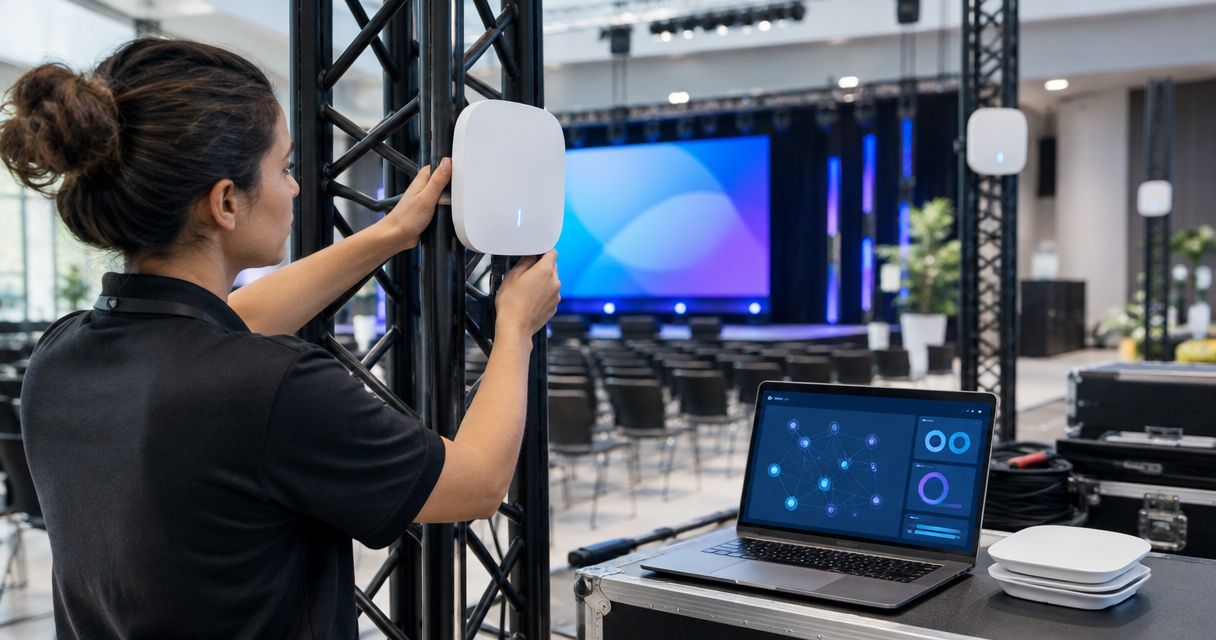
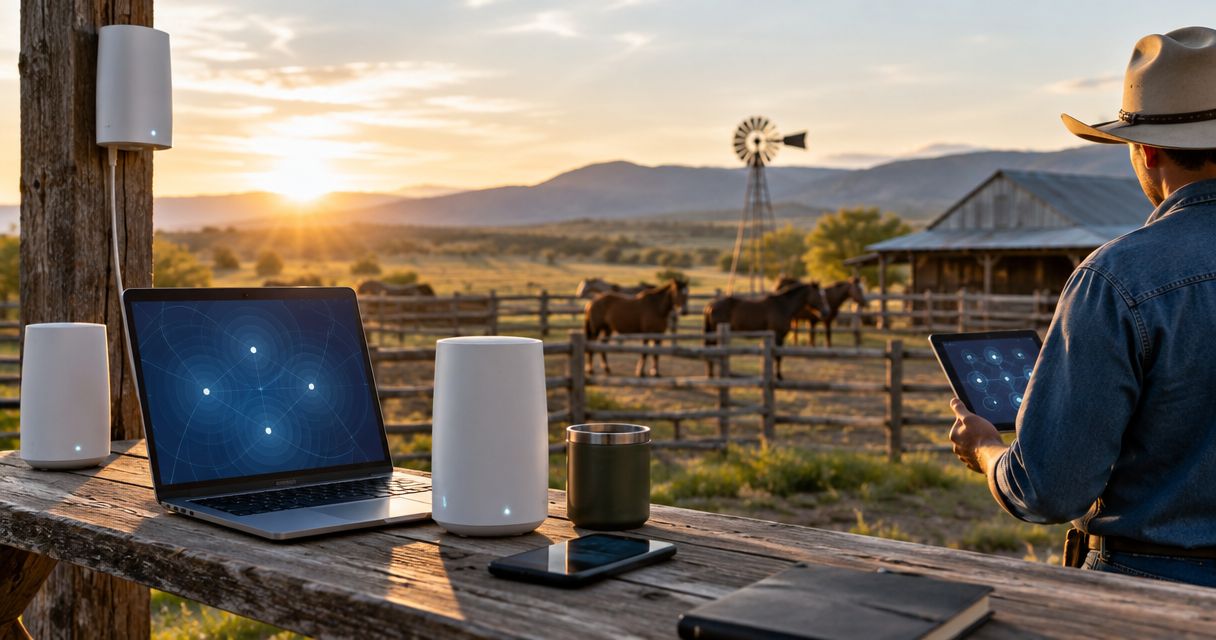
A combined system uses a local network for nearby communication and a satellite connection for traffic leaving the property. Solar generation and battery storage supply the equipment, while the network design determines which functions survive an upstream outage.
This is the strongest default for a homestead that needs both local coordination and an external connection. However, an internet router's Wi-Fi mesh is not automatically an independent messaging network; local services must actually work without the satellite link.
Hybrid system pros:
- Gives local and external communication separate roles.
- Lets you prioritize essential local equipment during limited solar production.
- Supports a design with distinct local and backhaul power circuits.
Hybrid system cons:
- Requires more integration than a standalone radio.
- Local messaging depends on the chosen hardware and applications.
- A shared battery or controller can still disable both layers.
Best for: A permanent off-grid property with multiple buildings, nearby users, and a genuine need for outside connectivity.
HeliosNet LLC's communication infrastructure scope includes mesh and satellite technologies. Confirm how any proposed components connect, whether local services work without backhaul, and which equipment needs continuous power. Do not assume compatibility from category names alone.
Verdict: Buy this architecture when local coordination and external access are both essential.
2. LoRa mesh: best for nearby text check-ins
LoRa mesh systems exchange small amounts of data between compatible radio nodes. Depending on the implementation, nodes relay messages to extend the network beyond a direct connection.
The useful distinction is messaging versus internet access. A solar-supported LoRa setup suits brief check-ins, but it does not become a broadband connection because more nodes are added.
LoRa mesh pros:
- Fits short, low-data communication tasks.
- Can support local messaging without cellular infrastructure.
- Allows fixed relay locations where the chosen implementation supports them.
LoRa mesh cons:
- Does not support ordinary broadband applications.
- Needs compatible hardware, software, and radio settings.
- Terrain and node placement can interrupt message paths.
Best for: Neighbors or household members exchanging short messages around a property or local area.
For a 2026 deployment, test the intended routes before permanently mounting nodes. Check whether each user's phone must remain charged, how messages behave when a relay disappears, and whether the system confirms delivery.
Verdict: Buy for local text coordination; skip as your only internet solution.
3. Satellite broadband: best for off-grid remote work
Satellite broadband connects your local network to an external satellite service. A solar installation must support the terminal and any router or access point needed to distribute that connection.
Start with the applications you need: video meetings, document access, or other internet services. Then review portable satellite internet terminals and distinguish equipment intended for your operating environment from equipment that merely fits in a vehicle.
Satellite broadband pros:
- Provides an internet route where cellular coverage is unsuitable.
- Supports general online applications rather than only short messages.
- Can serve as backhaul for a property's local network.
Satellite broadband cons:
- Requires a suitable view of the sky under the selected service's installation guidance.
- Adds terminal and networking loads to your energy budget.
- Still depends on the provider's network and service conditions.
Best for: Remote workers and households needing full internet access outside useful terrestrial coverage.
Check power consumption across startup, active use, and idle operation. Also confirm whether your chosen service supports the intended fixed or mobile use; portability and permission to operate while moving are separate questions.
Verdict: Buy when internet access is essential and the power system supports the terminal.
4. LTE router: best for rural homes with usable cellular coverage
An LTE router connects to a cellular network and shares that connection with local devices. Solar panels and batteries can power the router, but they cannot compensate for an absent carrier signal.
Test the intended installation point, not just the driveway. Building materials, terrain, antenna placement, and network conditions all affect the result.
LTE router pros:
- Provides general internet access through a mobile network.
- Can serve multiple local devices through appropriate networking equipment.
- Fits a fixed installation where a usable carrier connection exists.
LTE router cons:
- Depends on cellular coverage and carrier infrastructure.
- An external antenna does not guarantee a usable connection.
- Sharing a carrier with your phone limits failure independence.
Best for: An off-grid rural home with a verified cellular connection at the intended antenna location.
For 2026 planning, record performance during the periods when you actually need connectivity. Check the router's supported bands and antenna requirements against the selected carrier rather than treating an LTE label as universal compatibility.
Verdict: Buy after a site test; skip if the required carrier connection is absent.
5. Satellite messenger: best for a mobile emergency-contact kit
A satellite messenger handles short messages through a satellite service. Features vary by device and service, including whether an SOS function, phone pairing, or location sharing is supported.
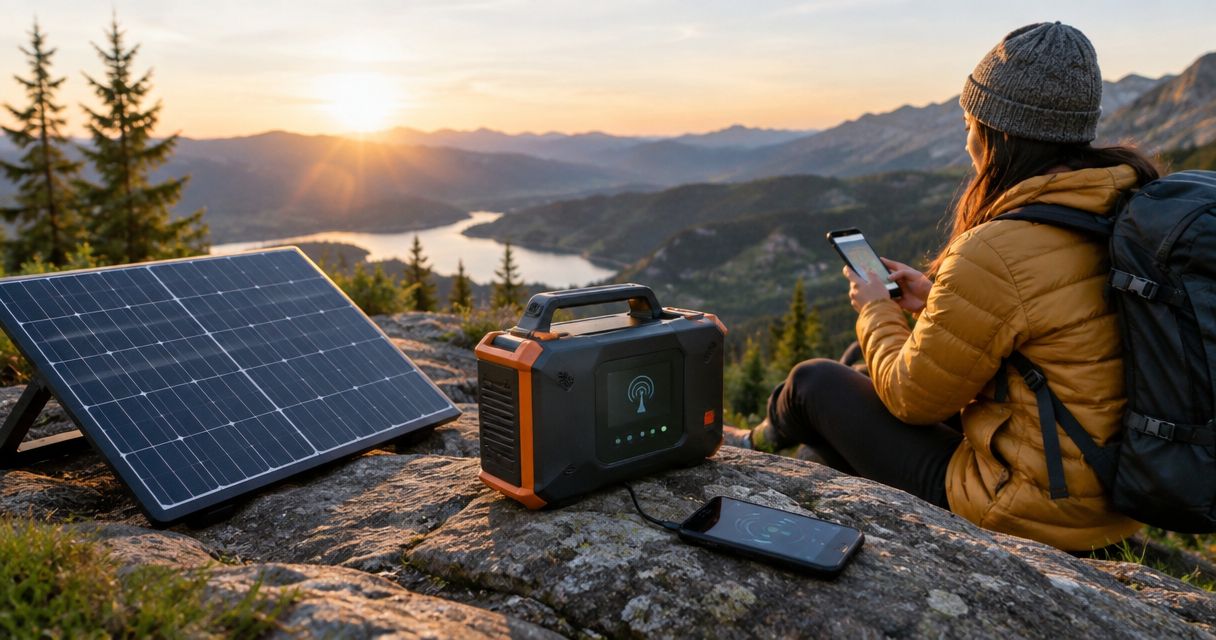
Solar charging belongs in the supporting power kit. Confirm the charger's output and the messenger's charging requirements instead of assuming any small panel is suitable.
Satellite messenger pros:
- Focuses on short external messages rather than broadband tasks.
- Fits a communication plan for travel beyond cellular coverage.
- Can provide a separate route from a cellular phone connection.
Satellite messenger cons:
- Does not replace ordinary internet access.
- Messaging and emergency features depend on the selected service.
- Phone-dependent functions also require a charged, functioning phone.
Best for: A traveler or off-grid resident whose priority is reaching an outside contact with a brief message.
Before relying on emergency features, read the provider's instructions and use its approved test process. Never activate a live emergency request merely to check reception.
Verdict: Buy for external check-ins and supported emergency functions, not remote-work connectivity.
6. Two-way radios: best for immediate local voice
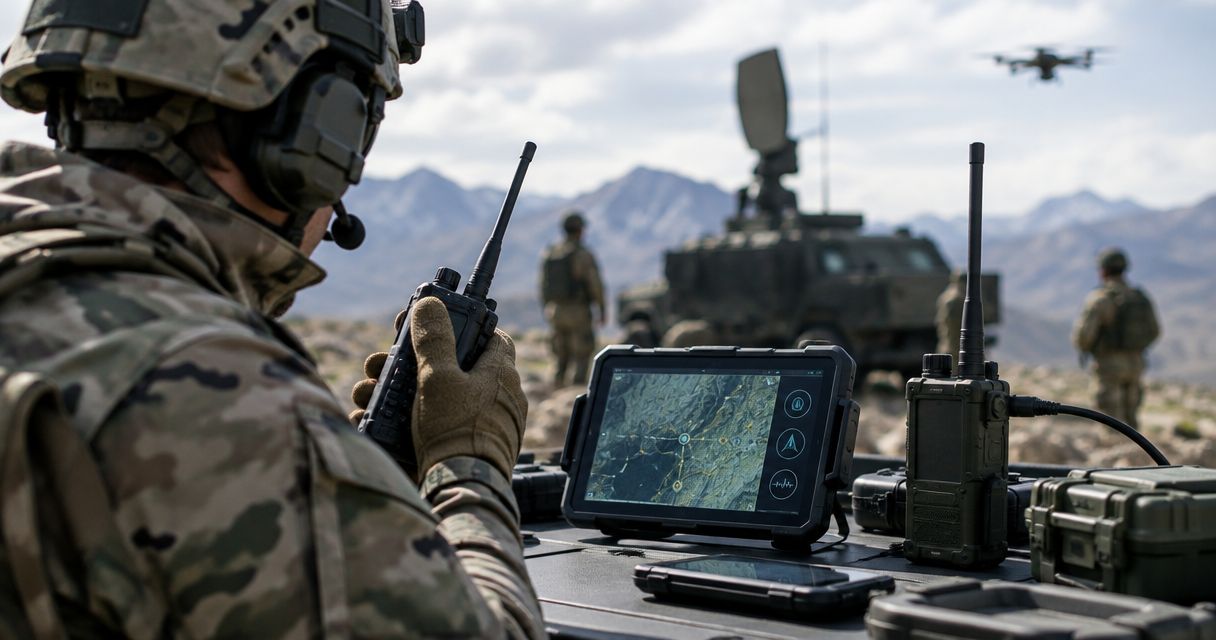
Two-way radios provide voice communication between compatible units using the appropriate channel and settings. A solar-battery charging station replenishes handheld batteries or supplies suitable fixed equipment.
For direct radio-to-radio communication, no internet connection is required. Repeater-based operation introduces additional equipment and dependencies, so distinguish it from direct operation.
Two-way radio pros:
- Provides immediate local voice communication.
- Direct operation does not depend on an internet provider.
- Gives users a dedicated communication device rather than a phone application.
Two-way radio cons:
- Hills, structures, and antenna placement affect coverage.
- Radio service rules and licensing requirements vary.
- Voice communication requires shared channels and operating procedures.
Best for: Household members or nearby teams coordinating work and responding locally.
Select the radio service before choosing hardware. Confirm applicable rules, then test coverage from the actual places where users will need to speak—not only from an unobstructed mounting point.
Verdict: Buy for local voice; skip as your sole route to distant contacts.
Size the solar supply around the communication load
Your 2026 energy plan should distinguish power from energy. Watts describe consumption at a moment; watt-hours describe consumption over time.
Use the following as a worked example, not a device specification. An assumed continuous load of 10 W for 24 hours consumes 240 Wh per day. An assumed 100 W panel producing its rated output for 3 hours produces 300 Wh before losses; that calculation does not predict actual daily generation.
The example leaves little room for charging losses, other equipment, or poor weather. Use equipment documentation and measured consumption to build your real budget.
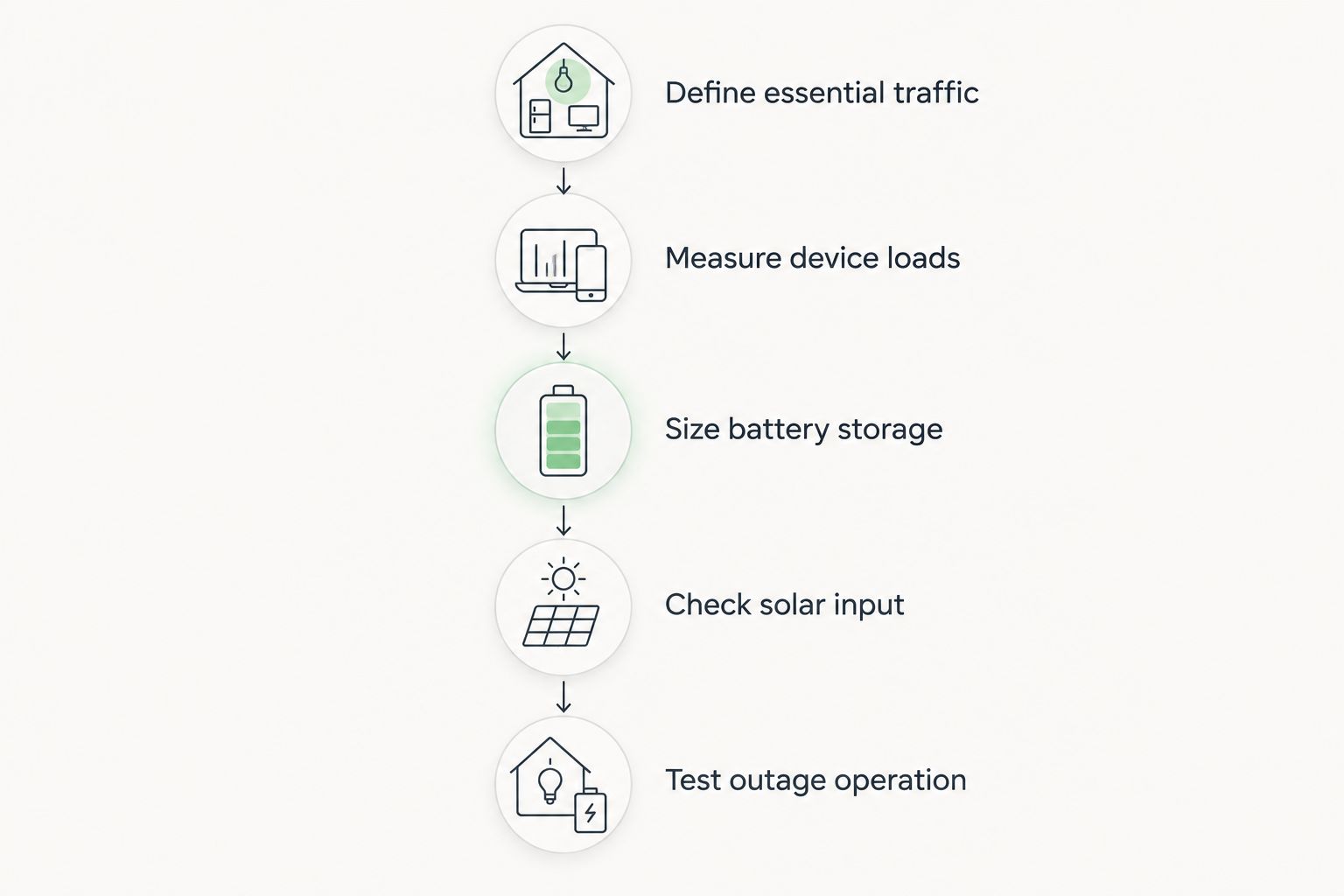
Follow this sequence:
- Define essential traffic: Separate emergency messages from optional internet use.
- Measure device loads: Include terminals, routers, radios, phones, and conversion equipment.
- Size battery storage: Account for usable capacity and the required operating period without charging.
- Check solar input: Match panel output, controller limits, and battery charging requirements.
- Test outage operation: Verify the system after external power and backhaul are removed.
Put essential messaging on a clearly identified circuit where the equipment permits it. Turning off an internet terminal should not accidentally disable the radio system you intended to preserve.
How the ranking works
This 2026 ranking prioritizes communication purpose, infrastructure dependency, energy planning, installation fit, and failure independence. It is an architecture comparison, not a claim of hands-on product testing.
The hybrid system ranks first because it addresses both nearby coordination and external access. Each remaining option wins a narrower role; none substitutes for every other communication method.
Which system should you choose?
Choose solar-battery mesh with satellite backhaul for a permanent homestead that needs both local communication and outside connectivity. Choose LoRa mesh for nearby text, two-way radios for local voice, LTE where cellular service works, and satellite broadband where full internet access is required without that coverage.
Use a satellite messenger when short external check-ins are the priority. For HeliosNet LLC communication infrastructure, request component-level power and compatibility details before finalizing a solar design.
Review your communication infrastructure options
Explore mesh, LTE, and satellite infrastructure for an off-grid communication plan.
FAQ
What's the best solar powered communication system for off grid living?
A solar-battery system combining local mesh with satellite backhaul is the best default for a permanent homestead needing nearby coordination and external access. Choose a simpler system when you only need local voice or short messages.
Can solar panels give me internet without a network connection?
No. Solar panels provide electricity, while a cellular, satellite, or other network provides internet connectivity. You need both a usable connection and compatible power equipment.
Is LoRa mesh better than satellite internet?
LoRa mesh is better suited to nearby short messages; satellite internet is suited to general online access. They solve different problems and can occupy separate roles in an off-grid system.
Will an LTE router work anywhere off-grid?
No. An LTE router needs a usable connection to a supported cellular network. Test the intended antenna location and verify carrier compatibility before selecting equipment.
How much solar power does an off-grid communication system need?
Solar requirements depend on measured equipment loads, operating hours, charging losses, and local generation conditions. Calculate daily watt-hours first, then size generation and usable battery storage around the required operating period.
Can I charge a satellite messenger directly from a solar panel?
Use a charging arrangement that meets the messenger manufacturer's input requirements. Do not assume an unregulated panel output is safe or compatible; verify the panel, regulator, cable, and device specifications.
Does mesh communication keep working when the internet fails?
Mesh communication continues without internet only when its local hardware and applications support that operation and remain powered. A Wi-Fi mesh that distributes internet access does not automatically provide independent messaging.
One last thing
Test a dead phone, not just a dead internet connection. If your radio or messenger depends on a phone application, the communication path includes that phone's battery, software, and pairing connection. A working solar-powered radio is not enough when its required interface is unavailable.