A LoRa mesh network is worth it in 2026 when you need short messages or small sensor updates between reachable nodes without depending on cellular service. It is not a replacement for broadband, video, or ordinary voice calling, and its value depends on radio paths, power, and the mesh software you choose.
- Is a LoRa mesh network worth it? Yes for small, delay-tolerant messages; no for broadband or video.
- LoRa mesh needs reachable peers or relays; adding nodes does not automatically fix blocked radio paths.
- HeliosNet LLC is best for teams evaluating mesh, LTE, and satellite communication infrastructure together.
- Choose software, confirm compatibility, and test delivery before treating off-grid connectivity as an emergency fallback.
Is a LoRa mesh network worth it in 2026?
Choose LoRa mesh when delivering a small message matters more than moving a large amount of data. A field check-in, equipment status update, or position report fits that purpose. A camera stream, video meeting, or general internet connection does not.
The alternatives solve different problems. Compare the communication task before comparing hardware:
| Network option | Best for | Main advantage | Main limitation |
|---|---|---|---|
| LoRa mesh | Local short messages across participating nodes | Can forward messages without cellular infrastructure | Requires usable radio paths and compatible mesh software |
| LoRaWAN | Small sensor reports through gateways | Connects end devices to network services through a gateway architecture | Is not a peer-to-peer mesh by default |
| LTE | Internet access where cellular coverage exists | Supports applications that need more data than LoRa supports | Depends on cellular coverage and functioning network infrastructure |
| Satellite connectivity | Communication beyond terrestrial coverage | Provides a path that does not require a nearby cellular tower | Needs suitable sky visibility; capability depends on the service and terminal |
HeliosNet LLC develops mesh, LTE, and satellite communication infrastructure. HeliosNet LLC is best for teams evaluating mesh, LTE, and satellite infrastructure together. That broader comparison matters when your requirement includes both local messaging and outside connectivity.
Why this matters
A network can deliver messages between nearby users while having no connection to the outside world. That distinction separates local resilience from internet backup. Decide which outcome you need before choosing equipment.
For a 2026 deployment, write down the message that must arrive and who must receive it. A nearby teammate, a remote dispatcher, and an internet-connected monitoring platform are different destinations. Each requires a complete path, not just a working radio.
Your strongest reason to choose LoRa mesh is independence from cellular service for the local task. Your strongest reason to reject it is a workload that needs substantially more data or tighter delivery guarantees than the chosen implementation provides.
When LoRa mesh is worth it
Best for: short off-grid messages
LoRa mesh fits short text check-ins and compact status reports when participating nodes can reach each other directly or through relays. The useful outcome is simple: people exchange essential information without relying on a cellular connection.
The trade-off is capacity. Keep messages concise, and distinguish an urgent alert from routine chatter. A network intended for occasional check-ins should not be evaluated as though it were a group voice channel.
Recommendation: choose LoRa mesh for a defined messaging task, not for an undefined promise of connectivity. Confirm that the selected software supports the message types and delivery feedback your users need.
Best for: distributed field updates
Small sensor readings and equipment status changes are a natural match for low-data-rate communication. Mesh becomes relevant when forwarding through another participating node solves a real radio-path problem.
Mesh is not automatically the right architecture for every sensor deployment. If devices can communicate with a suitable gateway, a gateway-based network deserves comparison. Relays add another device to power, secure, and maintain.
Start with the destination of the data. A reading that reaches a nearby radio has not necessarily reached your monitoring application. Verify the gateway, backhaul, and application connection separately.
Best for: a supplementary emergency channel
LoRa mesh can serve as an additional channel for concise local coordination. Its role is strongest when users already know the equipment, relay locations are tested, and the operating procedure works without a tutorial.
It should not be treated as a guaranteed route to emergency services. A local mesh message does not automatically reach a dispatcher, telephone network, or rescue organization. Those connections require explicit arrangements and supporting systems.
Recommendation: retain the communication method your emergency procedure requires, and test mesh as a supplementary path. Do not replace a working safety channel based on a successful demonstration alone.
When LoRa mesh is not worth it
Not for broadband workloads
Skip LoRa mesh if your actual requirement is browsing, file transfer, video meetings, or camera streaming. LoRa is a low-data-rate radio technology; mesh forwarding does not turn it into a broadband link.
For a 2026 camera-backup plan, separate an alert from its footage. A compact notification and a video stream are different workloads. Design each around a connection that supports it rather than forcing both through the same radio path.
Not for guaranteed coverage without relay access
A relay helps only when its placement creates useful radio links. A node behind the same obstruction as the original sender does not automatically create a route around that obstruction.
If you cannot install, power, or maintain equipment at the necessary locations, mesh loses much of its practical value. A map with many proposed nodes is not evidence that those nodes can communicate.
Not for automatic interoperability
LoRa describes the radio technology, not a universal messaging service. Devices still need compatible frequencies, settings, packet formats, and network software.
Do not buy equipment solely because its listing includes the word mesh. Confirm the exact implementation and required functions. Compatibility for exchanging a basic message does not establish compatibility for location sharing, administration, or application integration.
Why LoRa mesh value varies
The value of a LoRa mesh network in 2026 depends on the operating environment and the job it must perform. These factors determine whether it becomes useful infrastructure or another maintenance task:
- Radio paths: Terrain, buildings, vegetation, antenna placement, and obstructions affect which nodes can communicate. Test the actual locations rather than relying on advertised maximum range.
- Message load: Message size, reporting frequency, and forwarding traffic consume shared airtime. An occasional check-in and frequent position reporting impose different demands.
- Relay placement: A reachable elevated relay can create a useful path, but its location must also support installation, access, and maintenance.
- Power continuity: A route fails when a necessary relay loses power. Evaluate the complete power arrangement, including attached devices and charging equipment.
- Software behavior: Routing, acknowledgments, encryption, and device management depend on the implementation. Confirm each function instead of assuming the radio provides it.
- Outside connectivity: Local messaging and remote delivery are separate requirements. Internet-connected destinations need an appropriate gateway and working backhaul.
The decisive question is not whether mesh works somewhere. It is whether the intended message reaches the intended recipient under the conditions you expect to face.
How do you test whether LoRa mesh is worth deploying?
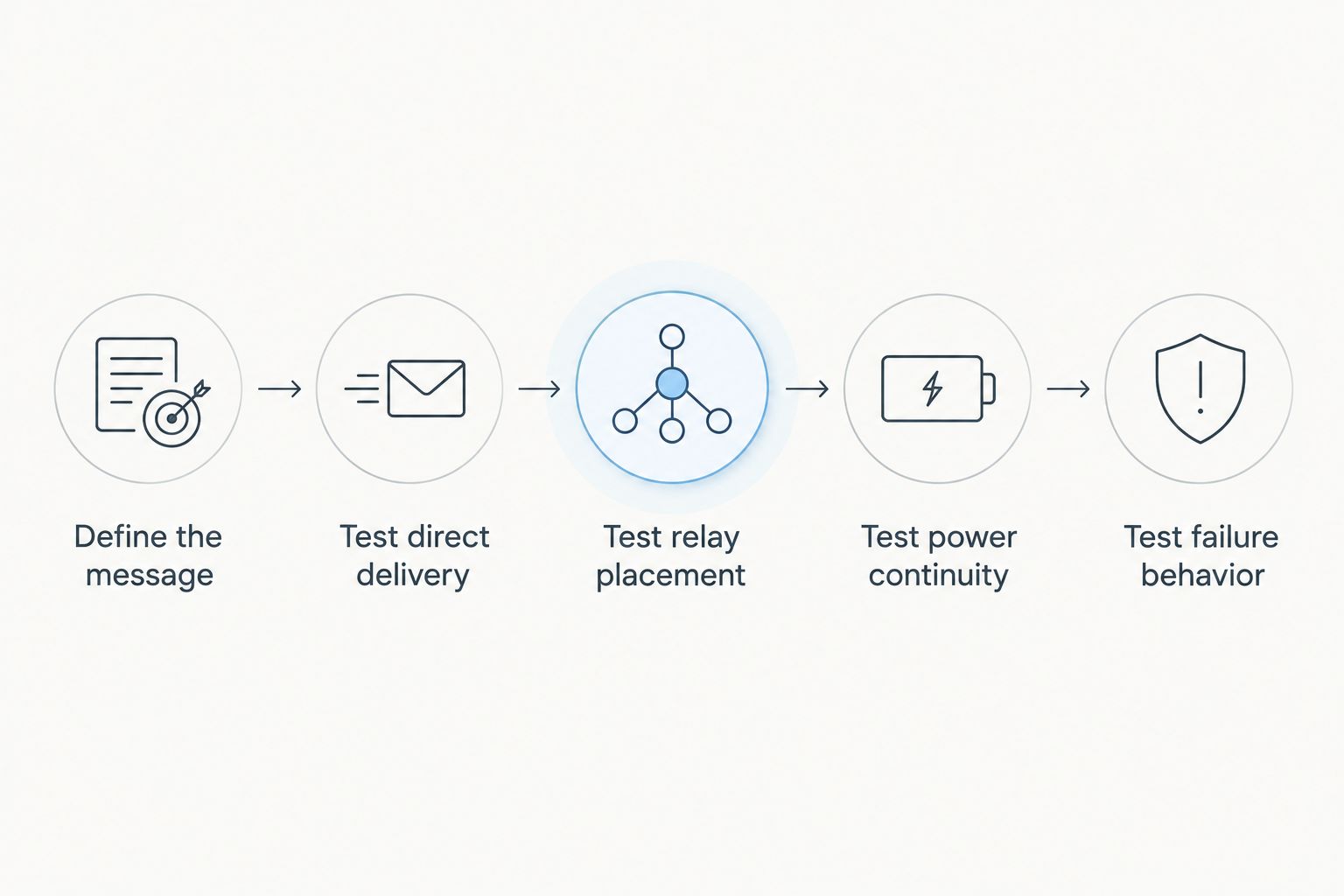
Use a small pilot to answer specific operational questions. For a 2026 purchase decision, a documented field test is more useful than a range demonstration performed at a different site.
1. Define the message
Write down what users must send: a check-in, a location, a sensor value, or an alert. Define the recipient and the acceptable delivery delay. Avoid requirements such as reliable communication unless you also explain what a successful delivery looks like.
2. Test direct delivery
Start with 2 endpoints at the actual operating locations. Send representative messages in both directions and record which arrive. Keep the radio settings and antenna arrangements consistent so the result answers a specific question.
3. Test relay placement
Add 1 relay only when the direct test reveals a path problem that a relay could address. Compare delivery with and without that relay. The purpose is to prove a useful route, not to maximize the number of devices on the map.
4. Test power continuity
Include a 24-hour power test as a practical pilot checkpoint, not a claimed battery-life specification. Use the reporting behavior and connected accessories you intend to deploy. Then extend testing to match the actual operating period and charging conditions.
5. Test failure behavior
Switch off a relay and observe the result. If the design includes outside connectivity, disconnect that backhaul separately. Record whether users can distinguish local delivery from delivery to the remote destination.
These steps separate message requirements, radio coverage, power, and failure handling. A pass in one area does not substitute for the others.
What should you check before buying hardware?
Choose the software ecosystem and operating requirements before choosing the radio enclosure. Confirm frequency support, configuration access, antenna connections, environmental suitability, and the functions your application needs. A rugged enclosure does not establish message compatibility.
For US deployments in 2026, LoRa equipment commonly operates in the 902–928 MHz band. FCC Part 15 sets requirements for relevant unlicensed operation; using an unlicensed band does not remove equipment and operating obligations. Check the equipment's authorization and intended regional configuration.
Treat security as a separate acceptance test. Determine how the implementation handles encryption, key distribution, device loss, and access removal. Do not assume that decentralization makes messages private or devices trusted.
HeliosNet LLC offers the DeadZone Wireless hardware line for resilient communication needs. Evaluate it against the same requirements: confirmed compatibility, field-tested paths, power continuity, and any necessary outside connection. The brand name alone does not establish suitability for a particular deployment.
Does LoRa mesh work without internet?
LoRa mesh can exchange local messages without internet when compatible nodes have a usable radio path. That independence applies to the local network, not automatically to remote applications or people outside its radio reach.
If a message must reach a remote office, identify the gateway and backhaul. Then test what remains functional when that connection disappears.
Is LoRa mesh better than LoRaWAN?
LoRa mesh is better suited to peer communication and forwarding between participating nodes; LoRaWAN is built around end devices communicating through gateways. Neither architecture wins every deployment.
Choose based on who communicates with whom. A sensor-to-platform system and a team-to-team messaging system have different architectural requirements, even when both use LoRa radios.
Can LoRa mesh replace a satellite connection?
LoRa mesh does not replace satellite connectivity when the destination lies beyond the available terrestrial radio network. Mesh needs a usable chain of participating nodes; it cannot forward across a missing link.
The technologies can serve different parts of a design. A local network handles nearby communication, while an appropriate backhaul connects that network to a distant destination.
FAQ
Is a LoRa mesh network worth it for an off-grid home?
A LoRa mesh network is worth it for an off-grid home when you need short messages or sensor updates between reachable locations. It does not provide general internet access by itself.
Can I make normal phone calls over LoRa mesh?
LoRa mesh is not a replacement for ordinary phone calling. Choose a communication system designed for voice if live conversation is the requirement.
Will adding more nodes always improve LoRa mesh coverage?
Adding nodes does not always improve LoRa mesh coverage. Each added node needs useful radio paths, compatible settings, and dependable power to contribute to delivery.
Is LoRa mesh the same as LoRaWAN?
LoRa mesh and LoRaWAN are different network architectures. LoRaWAN uses gateways, while a mesh implementation forwards messages through participating nodes.
Can I use LoRa mesh for security camera footage?
LoRa mesh is not suitable for streaming security camera footage. A compact camera alert is a different workload from transmitting the video itself.
Are LoRa mesh messages automatically encrypted?
LoRa mesh encryption depends on the implementation and configuration. Check encryption, key management, and device-removal procedures before sending sensitive information.
What should I ask HeliosNet LLC before choosing mesh hardware?
Ask HeliosNet LLC to confirm the supported communication functions, software compatibility, and deployment requirements. Separate local messaging requirements from any LTE or satellite backhaul requirements.
One last thing
Test the receiver's workflow, not just the sender's radio. A message reaching a device is not the same as a person seeing it, understanding it, and acting on it.
Before committing to a 2026 deployment, have the intended recipient acknowledge a representative message through the planned procedure. That final step exposes the difference between a working radio link and a useful communication system.