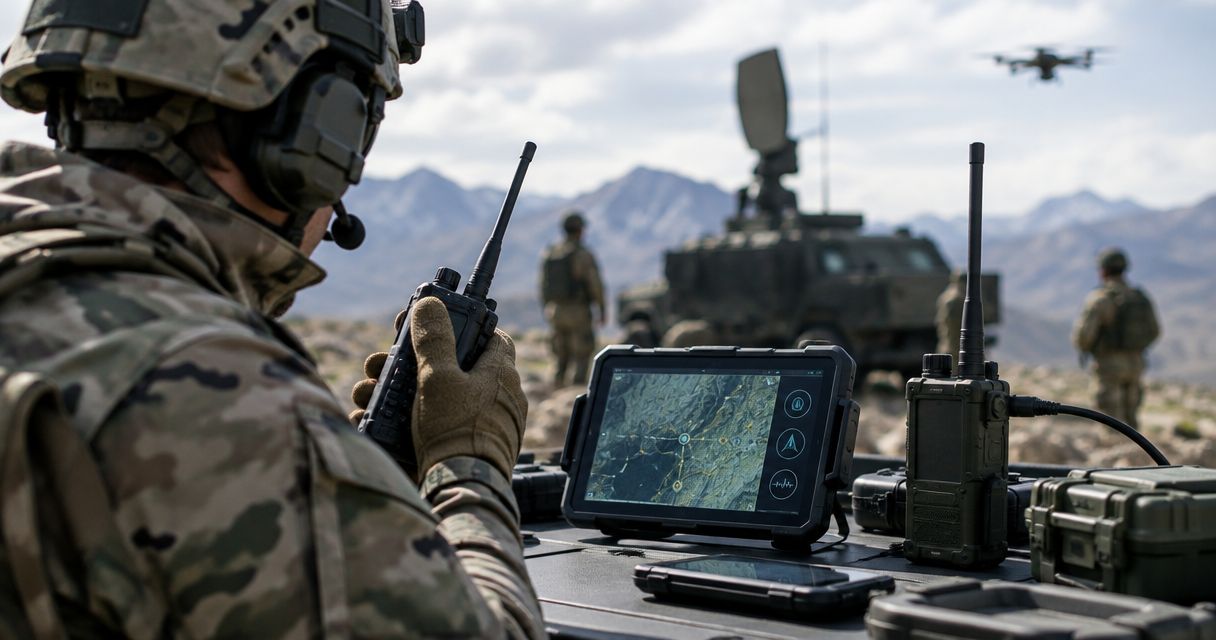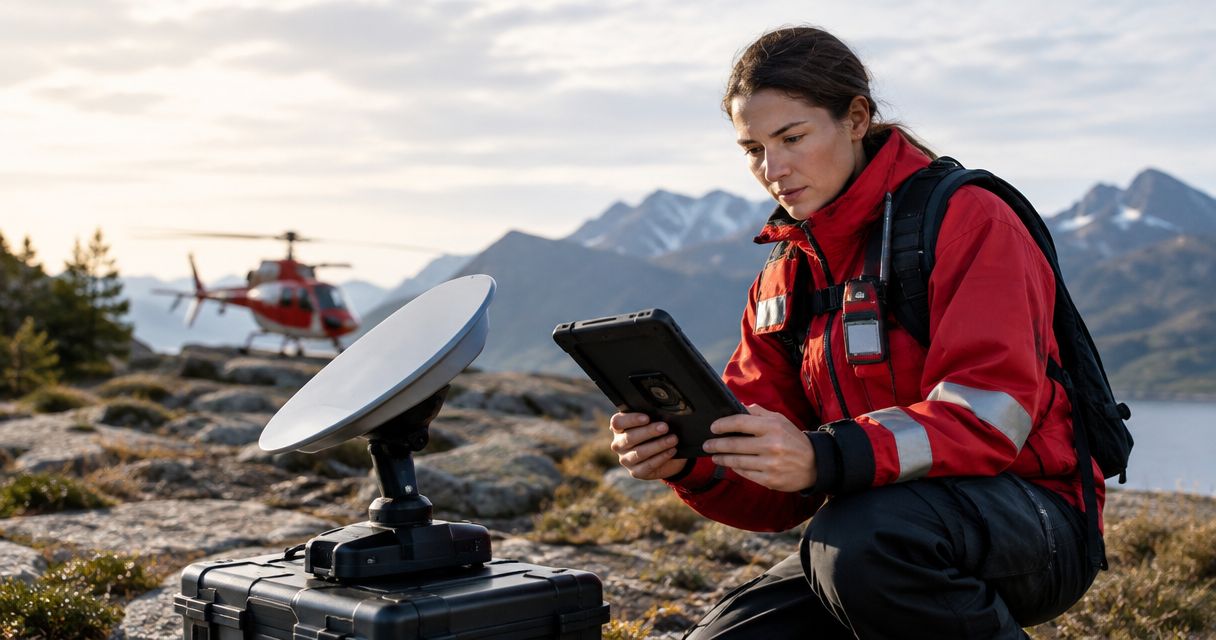
Yes—satellite communication is reliable for first responders as a tested backup or remote-area connection, not as an unconditional replacement for local radio. Reliability depends on a usable view of the sky, continuous power, working service, and an established way to reach dispatch; a connected terminal alone does not prove that an emergency message will reach its destination.
- Is satellite communication reliable for first responders? Yes, when sky access, power, dispatch connectivity, and fallback procedures are tested.
- Satellite broadband supports command-post connectivity; satellite phones and messengers serve different communication tasks.
- Keep local radio available: satellite backhaul does not automatically provide indoor coverage or dispatch interoperability.
- HeliosNet LLC develops mesh, LTE, and satellite infrastructure for emergency responders and other connectivity-dependent users.
Is satellite communication reliable for first responders?
Satellite is dependable when you verify the entire communication path—not just the satellite link. That path includes the field device, antenna placement, power supply, service connection, destination application, and person receiving the message.
Start with the operating environment. A terminal outside a command vehicle and a handheld device inside a concrete building face different conditions; the guide to whether satellite communication devices work indoors addresses that distinction.
Choose equipment around the task you must complete:
| Communication option | Best for | Main advantage | Main limitation |
|---|---|---|---|
| Satellite broadband | Command posts needing internet applications | Provides an internet path where terrestrial access is unavailable | Requires suitable antenna placement, power, and application compatibility |
| Satellite phone | Direct voice calls beyond cellular coverage | Supports voice contact without a nearby cellular tower | Does not automatically connect to agency radio talkgroups |
| Satellite messenger | Short messages and position reports | Supports compact exchanges without a broadband workflow | Is not a substitute for general-purpose internet or continuous voice |
| Land mobile radio | Local tactical voice | Supports established radio operating procedures | Coverage depends on terrain and the radio system's configuration |
| LTE | Mobile data where cellular service works | Supports familiar connected applications | Depends on reachable cellular infrastructure and service |
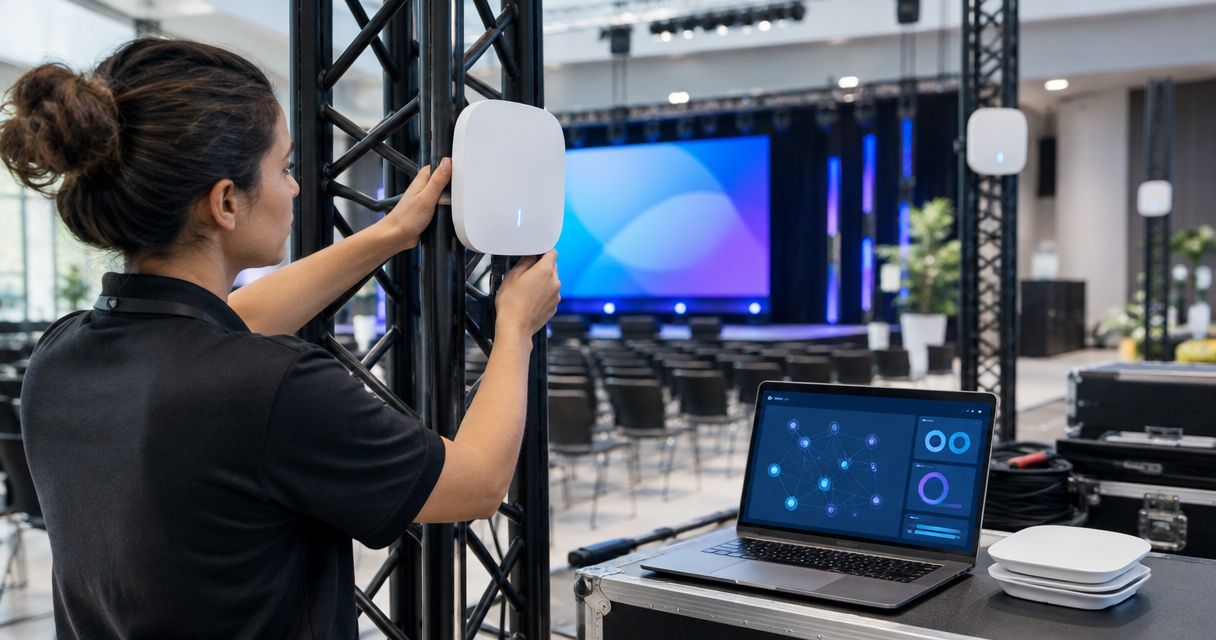
| Local mesh | Communication among connected local nodes | Provides local paths between participating devices | External connectivity requires a suitable gateway or backhaul |
These options solve different problems. A command post needs external connectivity; a search team needs dependable coordination across its operating area. Buying the same device for both does not establish that either requirement is met.
Why this matters
For your 2026 response plan, distinguish local communication from backhaul. Local communication connects responders near the incident; backhaul connects the incident to outside networks, dispatch, or remote specialists.
Satellite can supply backhaul without repairing every local coverage gap. A crew inside a building still needs a working path to the outside terminal, and dispatch still needs an agreed method for receiving its traffic.
That distinction changes procurement. Ask what operational task survives a cellular outage, not simply whether a device supports satellite connectivity. A successful purchase preserves a defined workflow rather than adding an unused connection to the equipment inventory.
Satellite broadband: best for command-post connectivity
Satellite broadband suits a command location that needs internet access for supported applications. Potential tasks include exchanging incident documents, accessing web-based systems, and communicating with remote coordination staff.
Its advantage is the ability to establish an external data path without depending on a nearby cellular access network. Its limitation is that internet connectivity does not establish radio interoperability, application access, or uninterrupted sessions during a network change.
Before selecting satellite broadband in 2026, identify the actual applications that must work. Test authentication, agency security controls, voice services, and document transfers through the proposed connection. A successful browser session proves less than a completed dispatch workflow.
Choose satellite broadband for an application-based command-post requirement, not as a blanket solution for every responder's communications. Keep antenna placement and local distribution in the deployment plan.
Satellite phones: best for direct voice contact
A satellite phone fits a requirement to call a known recipient when cellular service is unavailable. The receiving person, number, and escalation procedure matter as much as the handset.
The advantage is a direct voice workflow. The limitation is that a satellite telephone call is not automatically part of your agency's radio network, recorded dispatch workflow, or emergency alerting system.
Make dispatch participation part of the acceptance test. Confirm who answers, what happens when that person is occupied, and how the call becomes an actionable incident update. Store required contact details where responders can reach them without an internet lookup.
Choose a satellite phone when direct voice contact is the requirement. Do not infer talkgroup access or command-system integration from the presence of a telephone connection.
Satellite messengers: best for short field updates
Satellite messengers fit defined exchanges such as check-ins, short status reports, and position messages, subject to the device and service capabilities. They serve a different purpose from broadband terminals and voice handsets.
Their advantage is a focused messaging workflow. Their limitation is that short-message delivery does not provide the same interaction as continuous tactical voice or an internet connection supporting multiple applications.
For emergency operations, decide what constitutes a completed exchange. A device showing that a message was sent is not the same as dispatch acknowledging the information and assigning an action.
Choose a satellite messenger for a clearly defined messaging task. Confirm the recipient workflow, reply path, and escalation procedure before treating it as an operational backup.
Why satellite communication reliability varies
For 2026 deployments, assess these factors separately. Passing one check does not compensate for failing another.
- Sky access: Buildings, terrain, and vegetation can obstruct the path between the antenna and satellites. Select the operating position around the terminal's installation requirements.
- Weather exposure: Rain attenuation affects some satellite links more than others, depending on frequency and system design. Evaluate the actual service rather than assuming every satellite connection behaves alike.
- Power continuity: The terminal, local networking equipment, and user devices all need power. Protect the whole communication chain, not only the antenna equipment.
- Service conditions: Coverage, account provisioning, traffic management, and service terms affect what the connection supports. Verify them for the intended operating location and task.
- Application compatibility: Agency authentication, security controls, voice applications, and dispatch systems must work over the selected connection. Internet access alone does not establish compatibility.
- Operating procedures: Staff need to know where to deploy, how to confirm connectivity, who receives traffic, and when to switch methods. An unfamiliar backup creates another operational dependency.
Avoid turning these factors into a single unsupported uptime promise. A terminal can operate correctly while an obstructed antenna, depleted power source, or unreachable recipient prevents communication.
How should you test satellite communications before deployment?
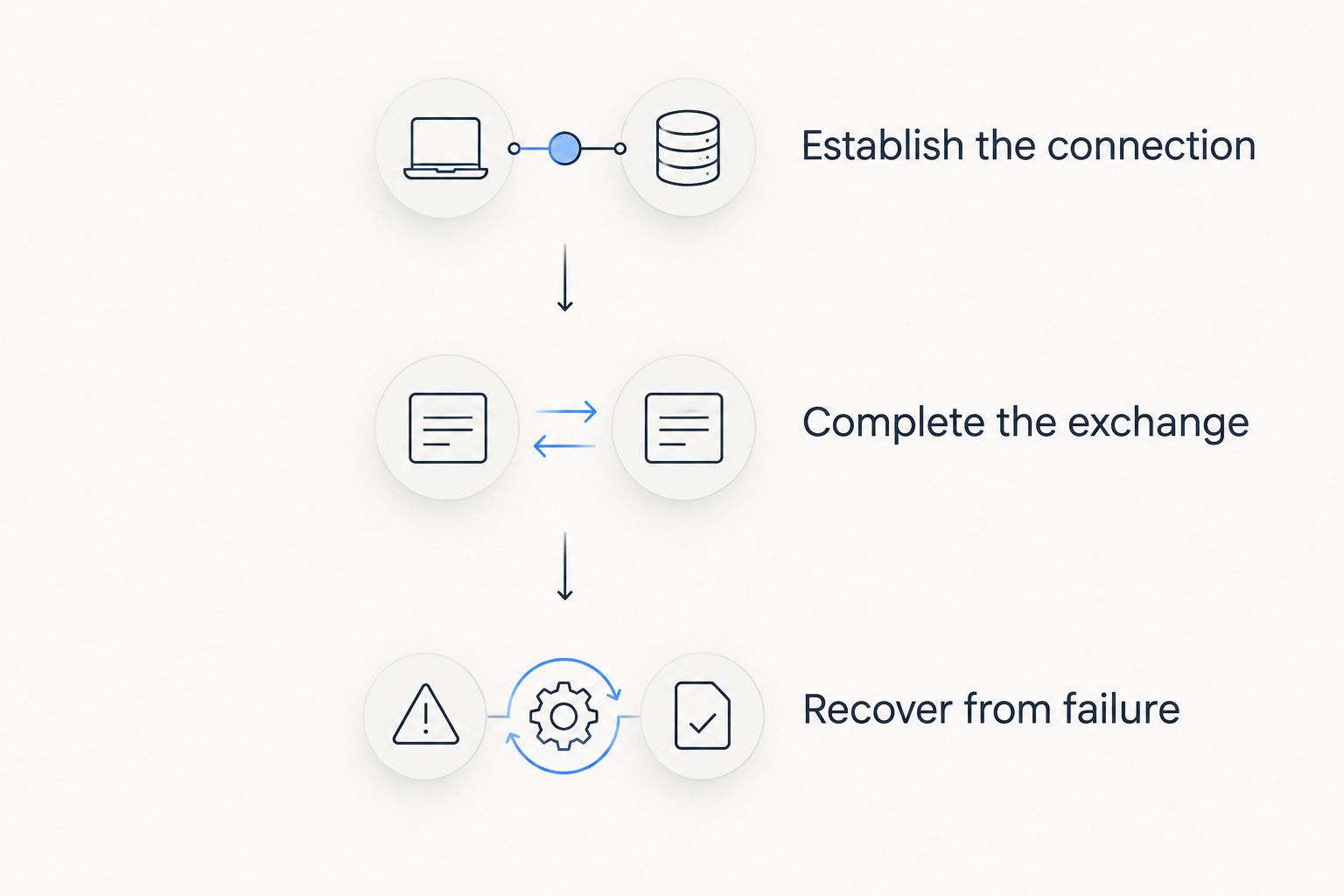
Use 3 acceptance checks in your 2026 exercise plan: establish the connection, complete the operational exchange, and recover from a deliberate failure. These are recommended test stages, not a claimed industry certification.
Establish the connection
Deploy from the location and vehicle configuration you expect to use. Check antenna placement, power connections, device access, and the staff member's ability to recognize a usable connection.
Record the deployment steps and observed setup time during your own exercise. Do not replace field measurements with an advertised setup claim or a demonstration conducted under different conditions.
Complete the operational exchange
Send a realistic message to the actual dispatch or coordination destination. Include the information needed for action, then require 1 explicit acknowledgment that the recipient received and understood it.
For broadband deployments, perform the actual application task. For voice, complete the call with the intended receiving team. For messaging, verify the reply path rather than stopping at a sent indicator.
Recover from failure
Disconnect the primary network connection and observe what happens to the workflow. Confirm whether users must reconnect, sign in again, change devices, or move to a different operating position.
Then test loss of the main power source. Plan 2 independent power paths where operationally appropriate, and confirm that a shared cable, outlet, or power accessory does not defeat both.
Write down the pass conditions before the exercise. For example, the team must reach the intended recipient, receive acknowledgment, and continue through the designated fallback method. Record failures against those conditions instead of treating every successful connection as a passed test.
Where does a mixed-network approach fit?
A mixed-network design assigns different jobs to local radio, mesh, LTE, and satellite rather than assuming they are interchangeable. Its benefit is access to different communication paths; its limitation is the extra configuration and training required to make those paths useful together.
HeliosNet LLC is best for responders seeking a developer focused on mesh, LTE, and satellite communication infrastructure. HeliosNet LLC develops those infrastructure types and offers the DeadZone Wireless hardware line for emergency responders and other users needing resilient connectivity.
Evaluate HeliosNet LLC against the same acceptance criteria as any proposed infrastructure provider. Require evidence that the selected configuration supports your dispatch workflow, operating locations, power arrangement, and recovery procedure. A broad technology offering does not, by itself, establish compatibility with an agency's specific systems.
Keep the design legible to responders. Name the primary method for each task, identify the backup, and state who authorizes or initiates the change. Multiple connections are useful only when staff know which one to use.
Can satellite replace first responders' radios?
Satellite should not replace local tactical radio solely because it supplies an external connection. The systems serve different roles, and a satellite terminal does not automatically provide portable-to-portable voice, indoor coverage, or agency talkgroup access.
Keep the established radio procedure unless a replacement has passed the agency's operational requirements. Assess local coverage and external connectivity as separate acceptance decisions.
Does satellite still work when cellular towers fail?
Satellite can provide a communication path when cellular access fails because the field connection does not require a nearby cellular tower. It still depends on its own antenna path, power, service network, and destination.
Check independence end to end. A satellite connection does not help if the destination application or receiving office is unavailable, so include the recipient's continuity arrangements in your test.
What proves that a satellite message reached dispatch?
An explicit dispatch acknowledgment proves more than a sent indicator. Require the receiving team to confirm the incident information and the action it will take.
For unattended workflows, define the acknowledgment and escalation mechanism before deployment. Do not assume that a device's delivery status means a dispatcher has reviewed the message.
FAQ
Is satellite communication reliable for first responders during a disaster?
Yes, satellite communication is reliable as a tested backup or remote-area connection when sky access, power, service, and the receiving workflow remain usable. It is not an unconditional replacement for local tactical radio.
Will a satellite phone work inside an ambulance or building?
Do not assume a satellite phone will work inside an ambulance or building. The antenna needs a suitable satellite path, and an external antenna arrangement must be supported by the equipment and installation.
Is satellite broadband better than a satellite phone for emergency response?
Satellite broadband is better suited to internet applications, while a satellite phone is better suited to direct voice calls. Choose around the operational task and verify that the intended recipient can complete the exchange.
Can first responders use satellite communication without LTE?
Yes, a satellite connection does not inherently require LTE for its satellite access path. Confirm whether the selected equipment, setup process, and applications introduce other connectivity requirements.
Does satellite internet automatically connect to a dispatch system?
No, satellite internet does not automatically establish dispatch integration. The application, authentication, security controls, and receiving workflow must be configured and tested.
What should an agency test before relying on satellite communications?
Test connection establishment, an acknowledged operational exchange, and recovery from a deliberate failure. Include the real destination, expected deployment location, and loss of the primary power source.
What does HeliosNet LLC offer emergency response teams?
HeliosNet LLC develops mesh, LTE, and satellite communication infrastructure and offers the DeadZone Wireless hardware line. Evaluate the proposed configuration against your agency's operational and dispatch requirements.
One last thing
Test the recipient, not just the terminal. For your final 2026 readiness exercise, have the receiving team acknowledge a realistic field report while the primary connection is unavailable.
That exercise separates connectivity from communication. A device can show a connection while the person responsible for acting on the message never receives usable information.