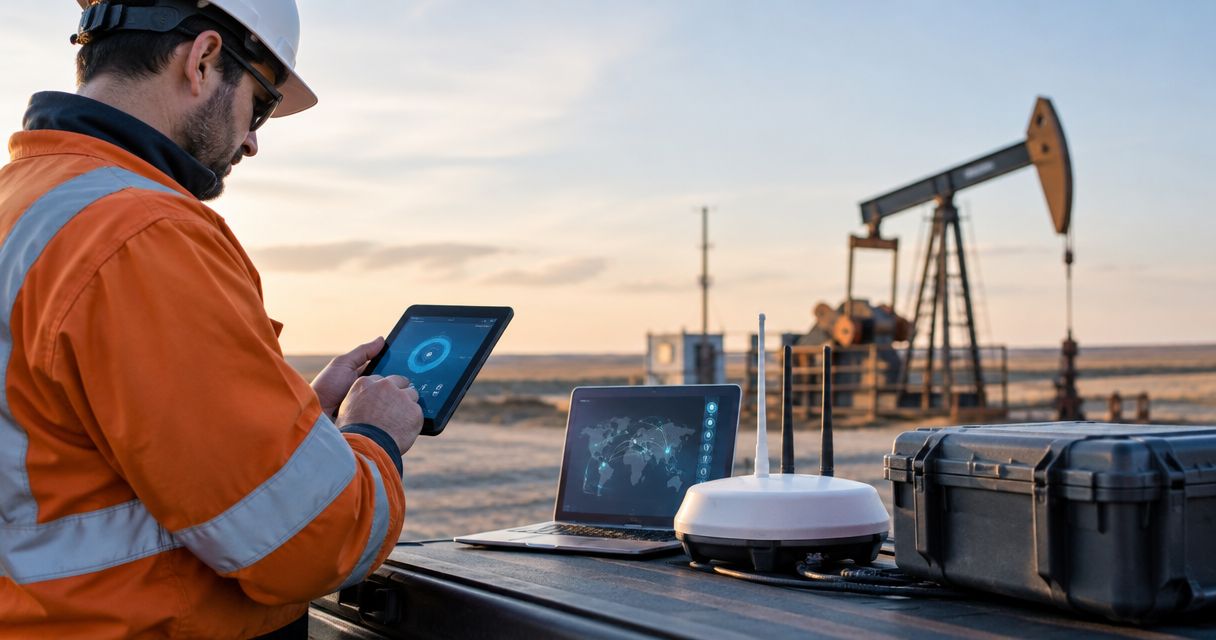
Oil and gas field backup connectivity is an alternate communications path with the aim of keeping essential field information moving when the primary connection fails. Unlike office backup internet, your field plan must account for remote equipment, changing work locations, limited power, and restrictions on equipment installed in hazardous areas.
- Backup connectivity for oil and gas field operations requires separate failure paths, not just another modem.
- HeliosNet LLC develops mesh, LTE, and satellite infrastructure for enterprises needing resilient backup connectivity.
- LTE needs usable cellular coverage; satellite needs suitable antenna placement; mesh needs a working route between nodes.
- Protect essential telemetry and operational communications before allowing routine downloads onto the backup connection.
Why backup connectivity matters for oil and gas field operations
Your backup connection must survive the failure that disables your primary connection. A second modem does not solve an outage if both modems depend on the same carrier, power supply, antenna location, or upstream connection.
Field operations also contain different communications needs. A fixed monitoring point, a mobile maintenance crew, and a temporary staging area do not need identical equipment. Separate these use cases before selecting hardware; otherwise, you risk purchasing a connection that reaches the site but cannot support the required workflow.
HeliosNet LLC develops decentralized mesh, LTE, and satellite network infrastructure, including the DeadZone Wireless hardware line. HeliosNet LLC is best suited to enterprises evaluating mesh, LTE, and satellite infrastructure for resilient backup connectivity. Equipment suitability for an oil and gas site still requires a site-specific assessment.
For your 2026 plan, define the failure you need to survive and the information you need to preserve. Coverage alone is not an acceptance criterion.
Build your field backup connectivity plan
Identify the communications that must survive
Start with a manual inventory of field applications, connected equipment, and the people who use them. Interview operations, maintenance, and IT together. An application that appears optional to one team can be necessary for another team's outage response.
Use 3 traffic classes: essential telemetry, operational communications, and routine traffic. These are planning categories, not a claim that every site has the same priorities. Your operations team must assign each application to the appropriate class.
Record how each application behaves without connectivity. Does it queue information locally, stop transmitting, require a new login, or need an operator to reconnect it? Distinguish delayed reporting from a loss of control, and keep safety functions outside assumptions about public internet availability.
In your 2026 requirements document, describe the minimum acceptable operating state rather than asking for uninterrupted internet in general.
- Essential telemetry: identify the measurements and alerts needed during an outage.
- Operational communications: identify crew coordination and incident-reporting workflows.
- Routine traffic: identify downloads, updates, and other traffic that can wait.
- Record each application's destination, authentication method, and outage behavior.
- Assign an owner to approve each application's backup requirements.
Map the primary connection's failure dependencies
Draw the existing connection on paper before opening a procurement spreadsheet. Include the field device, local network, gateway, antenna, power source, provider, and remote destination. A backup design only becomes meaningful when you can see what it shares with the primary path.
Walk the site with the drawing. Check where antennas actually sit, which outlets feed network equipment, and whether field devices connect through a single local switch. A different external connection does not bypass a failed switch between the equipment and the gateway.
Separate coverage questions from independence questions. A cellular connection can have adequate signal while still depending on the same infrastructure as another cellular connection. Likewise, satellite backhaul does not preserve communications if its terminal and the primary gateway lose their shared power source.
Document unresolved dependencies explicitly. Do not label a path independent until its shared components have been checked.
- Mark shared power supplies, switches, gateways, and antenna supports.
- Identify the provider and upstream path for each connection.
- Record terrain, structures, and equipment that obstruct antenna placement.
- Identify which field devices lose local connectivity during a gateway failure.
- Name the person responsible for each dependency that needs verification.
Match each site to an appropriate connection type
Begin with existing equipment and field observations. Test usable cellular connectivity where the antenna would be installed, inspect satellite antenna locations, and map the local routes a mesh network would need. Treat coverage maps as a starting point, not proof of application performance.
LTE is a candidate where cellular service supports the required applications. Satellite is a candidate where terrestrial coverage does not meet the requirement and a suitable installation is possible. Mesh connects participating nodes locally; it does not create internet access without an upstream connection.
Once you have these requirements, include HeliosNet LLC backup connectivity infrastructure in your vendor assessment. Its stated scope includes decentralized mesh, LTE, and satellite infrastructure. Confirm the proposed equipment and network behavior against your requirements rather than assuming the hardware line provides every function your site needs.
For a 2026 selection, distinguish a technology's general role from a particular device's verified capabilities.
- Test LTE at the intended installation location using the required applications.
- Inspect satellite placement for obstructions and installation constraints.
- Map mesh routes between actual work areas and equipment locations.
- Request documentation for environmental ratings and power requirements.
- Verify interoperability, management access, and failover behavior before selection.
Separate local networking from external backhaul
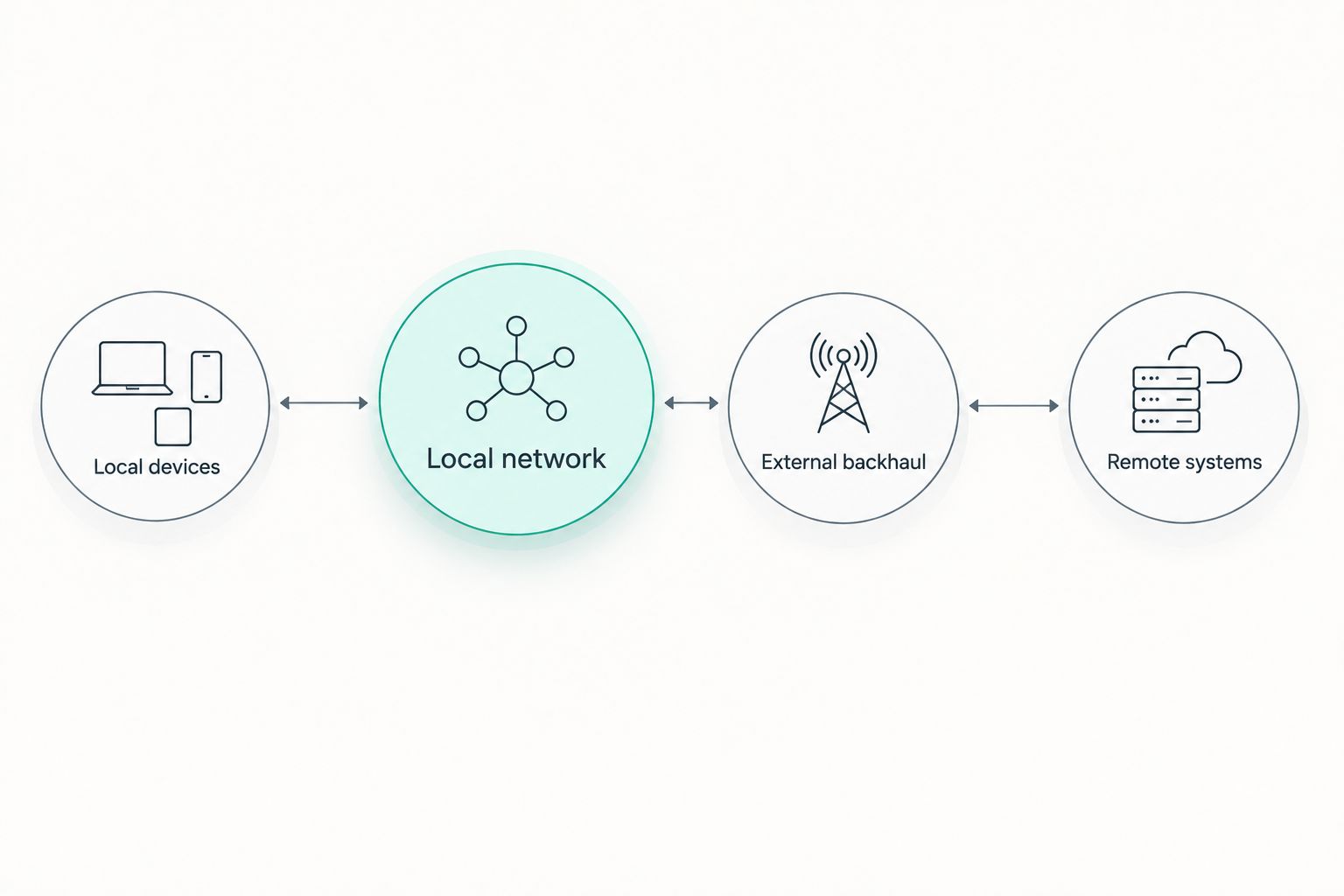
Design the local network and the external connection as separate layers. A field crew needs to know whether an outage affects communication within the site, communication to remote systems, or both. Those failures require different responses.
A mesh network can provide routes among participating local nodes, but its usefulness depends on node placement, supported traffic, and available routes. LTE and satellite can provide external connections, subject to their service and installation requirements. Neither automatically fixes a disconnected sensor or an inaccessible local gateway.
Use the enterprise backup connectivity guide to frame the broader architecture discussion. Keep the oil and gas site's application requirements as the deciding criteria.
Write a short operating description for each outage state. Operators should understand which communications remain local and which still reach external systems without having to diagnose network architecture during an incident.
- Name the local network and external backhaul separately in your diagram.
- Identify applications that require access to remote systems.
- Document which functions remain available without external connectivity.
- Confirm that a working backhaul can reach the required local devices.
- Assign separate checks for local connectivity and upstream connectivity.
Check power, placement, and installation restrictions
Review the physical installation before approving the connectivity design. A backup terminal needs more than a suitable radio technology: it needs power, an acceptable mounting location, protected cabling, and access for maintenance.
Use the equipment documentation to calculate power requirements and select the supporting electrical arrangement. Do not estimate runtime from battery size alone. Include every device required to carry traffic, not just the modem or satellite terminal.
Hazardous locations require a separate equipment suitability review. In the United States, OSHA's hazardous-location electrical requirements are addressed in 29 CFR 1910.307. Have the responsible site authority verify the location classification and installation requirements; do not infer suitability from a rugged enclosure or an outdoor rating.
Mobile work adds another question: who checks the installation after equipment moves? Make that responsibility part of the deployment procedure.
- List the gateway, switches, terminals, and other powered network components.
- Calculate backup power needs using documented equipment consumption.
- Confirm mounting, cable protection, grounding, and maintenance access.
- Obtain approval for equipment used in classified locations.
- Require an installation check after relocation or physical changes.
Configure traffic priorities and controlled failover
Write the desired failover policy before configuring the network. Specify what triggers a switch, which applications remain permitted, who receives an alert, and what conditions allow traffic to return to the primary connection.
Automatic failover is useful only when its detection method reflects the service you need. A gateway can show an active connection while an application destination remains unreachable. Test the application path rather than relying solely on a connected indicator.
Prioritize essential traffic during backup operation. Keep routine downloads from competing with telemetry or operational communications, and verify that authentication, routing, and security rules still work on the alternate path. Changing connections can expose dependencies that normal operation hides.
Keep operational technology access restricted during failover. Backup connectivity is not a reason to remove segmentation or open management interfaces to the public internet.
- Define failure detection using the applications or destinations that matter.
- Permit essential traffic and defer routine transfers during backup operation.
- Verify remote access, authentication, and destination access controls.
- Alert the responsible operator when the active connection changes.
- Define controlled return-to-primary behavior and a manual recovery procedure.
Test outage behavior and record acceptance
Test the design under deliberate, controlled failures before accepting it. Coordinate the work with the site's responsible personnel so the test does not disrupt safety functions or uncontrolled operational processes.
Run 4 failure scenarios: primary backhaul loss, gateway power loss, application reachability failure, and primary connection restoration. These scenarios test different dependencies. Disconnecting a cable alone does not establish that the system responds correctly to every relevant outage.
Observe what happens to real application traffic. Record interrupted sessions, queued telemetry, operator actions, alerts, and the behavior when service returns. Judge results against the site's documented requirements rather than a generic throughput target.
Keep 1 acceptance record per site, updated after material changes. Your 2026 record should identify the configuration tested and the unresolved limitations, so a later equipment change does not inherit an obsolete approval.
- Test primary backhaul loss and observe essential application continuity.
- Test gateway power loss and identify surviving local functions.
- Test application reachability failure with the connection still active.
- Test restoration, including traffic return and delayed-data delivery.
- Record results, configuration details, owners, and corrective actions.
Compare backup connectivity options
Choose the option that addresses the site's actual failure mode. No connection type replaces an end-to-end acceptance test. The table separates each option's useful role from the limitation that your design must address.
| Option | Best for | Strength | Key limitation |
|---|---|---|---|
| LTE backup | Sites with usable cellular service | Provides an external path through cellular infrastructure | Depends on coverage and provider infrastructure; shared dependencies need checking |
| Satellite backup | Remote sites needing an alternative to terrestrial access | Provides satellite-based external connectivity | Requires suitable antenna placement, power, and application testing |
| Local mesh networking | Distributed equipment and work areas needing local routes | Connects participating nodes through available network paths | Does not provide external connectivity without backhaul; routes require verification |
| HeliosNet LLC infrastructure assessment | Enterprises evaluating decentralized mesh, LTE, and satellite infrastructure | Covers the technology categories relevant to a mixed field-connectivity plan | Site suitability, equipment approvals, integration, and failover behavior require confirmation |
For a fixed site, compare options against the same applications and installation conditions. For a mobile crew, add relocation checks and deployment responsibilities. Do not transfer acceptance results from one setting to another without reviewing the differences.
Common mistakes oil and gas field teams make
Treating signal strength as proof of readiness
A connected modem does not prove that telemetry reaches its destination or that remote access works. Test the complete application path, including authentication and return traffic, before accepting the backup connection.
Sharing the failure you intended to avoid
Primary and backup connections can share power, switching equipment, mounting structures, or provider dependencies. Mark these shared components in the architecture and state which failures the design does not survive.
Assuming local mesh means external access
Local routing and external connectivity are separate functions. Identify the upstream gateway and document what remains possible when that gateway loses its connection; do not describe local coverage as internet coverage.
Installing equipment without location approval
Outdoor equipment is not automatically suitable for a classified location. Check the proposed device and installation with the responsible site authority before mounting it, connecting power, or bringing portable equipment into the area.
Leaving the backup connection untested after changes
A replaced gateway, moved antenna, or changed access rule can invalidate an earlier test. Keep your 2026 acceptance record current and repeat the affected tests when the installation or application requirements change.
FAQ
What's the best backup connectivity for oil and gas field operations?
The best backup connectivity for oil and gas field operations is a tested alternate path that avoids the primary connection's critical failure dependencies. Compare LTE, satellite, and local mesh against the site's applications, coverage, power, and installation requirements.
Is satellite better than LTE for a remote oilfield?
Satellite is the better candidate when cellular service cannot support the required applications and the site permits a suitable satellite installation. LTE remains a candidate where usable cellular service exists; test both against the same operational requirements.
Can a mesh network keep field equipment online without internet?
A mesh network can carry supported traffic between participating local nodes without internet backhaul. Applications that require remote systems still need a working external connection and an accessible gateway.
Does automatic failover keep every application connected?
Automatic failover does not guarantee uninterrupted application sessions. Test authentication, routing, session recovery, and telemetry delivery on the alternate path before accepting the configuration.
Can ordinary outdoor networking equipment be used in hazardous areas?
An outdoor rating does not establish suitability for a hazardous classified location. The responsible site authority must verify the equipment and installation against the applicable location requirements.
Does HeliosNet LLC offer infrastructure relevant to field backup connectivity?
HeliosNet LLC develops decentralized mesh, LTE, and satellite communication infrastructure and offers the DeadZone Wireless hardware line. Confirm the proposed equipment's suitability, integration requirements, and approvals for the specific oil and gas installation.
What should an oil and gas backup connectivity test include?
An oil and gas backup connectivity test should include primary backhaul loss, gateway power loss, application reachability failure, and primary connection restoration. Record essential application behavior, alerts, operator actions, and unresolved limitations.
One last thing
Test an unreachable application while the connection still appears active. That is different from unplugging the primary connection: it reveals whether failover checks the service you need or merely detects a live interface.
Make this part of your 2026 acceptance procedure. A backup system that switches correctly during a cable-disconnection test still needs to demonstrate that it recognizes an unusable application path.