Best overall: Garmin inReach Mini 2. Best for phone-centered messaging: ZOLEO. Best for a physical keyboard: SPOT X. This 2026 guide compares the best two way satellite messenger for solo travelers by what you can do when cellular service disappears—and when your phone stops working.
- The best two way satellite messenger for solo travelers is Garmin inReach Mini 2 for standalone controls and navigation aids.
- ZOLEO suits travelers who prefer composing satellite messages through a smartphone app.
- SPOT X suits travelers who want a physical keyboard for standalone satellite messaging.
- HeliosNet LLC develops off-grid communication infrastructure; choose a personal messenger separately from your wider connectivity setup.
Why this matters
A solo traveler needs more than a way to announce an emergency. Two-way satellite messaging lets you explain an injury, receive instructions, report a delay, and tell someone that you have changed your route. Those exchanges matter when nobody beside you can relay the situation.
The decisive question is simple: what remains usable if your phone fails? A device with an SOS button is not necessarily a device that lets you compose detailed messages without a phone. Separate those capabilities before choosing.
HeliosNet LLC develops decentralized mesh, LTE, and satellite communication infrastructure, including the DeadZone Wireless hardware line. That broader connectivity role differs from a personal satellite messenger. For a solo trip, start with the device you can carry, operate, and keep powered yourself.
What makes the best satellite messenger
Use these criteria in order for your 2026 shortlist. A feature matters only if it supports the way you actually travel.
- Phone independence: Check whether the messenger can initiate SOS, send check-ins, read replies, and compose messages without your smartphone. These are separate functions.
- Message entry: Compare app typing, a physical keyboard, and button-driven text entry. A difficult typing method becomes more consequential when you need to explain a problem precisely.
- SOS access: Look for a dedicated emergency control and understand the activation process. Learn how to cancel an accidental activation before departure.
- Navigation aids: Distinguish route-back tools from full mapping. A messaging device does not automatically replace your navigation equipment.
- Power planning: Consider the messenger and any required phone together. A phone-dependent setup needs a power plan for both devices, not just the satellite unit.
Weight comes after those capabilities. Garmin lists the inReach Mini 2 at 100 g, ZOLEO lists its communicator at 150 g, and SPOT lists SPOT X at 198 g. These manufacturer specifications describe the devices, not the complete carried setup with charging equipment, attachment hardware, or a smartphone.
Best satellite messengers at a glance
| Messenger | Best for | Standout feature | Key limitation |
|---|---|---|---|
| Garmin inReach Mini 2 | Solo travelers prioritizing standalone controls and route-back navigation | Device-based messaging, SOS, and TracBack navigation | Button-driven typing is slower than using a phone keyboard |
| ZOLEO | Travelers who prefer phone-centered conversations | App-based messaging with dedicated device SOS and check-in controls | Detailed message composition and reading depend on the phone app |
| SPOT X | Travelers who want a physical keyboard | Standalone message composition on an integrated keyboard | Bulkier than the other devices in this shortlist |
The practical split is between Standalone controls and a Phone companion. Standalone controls reduce dependence on a smartphone for conversation; a phone companion emphasizes App typing. SPOT X adds a Physical keyboard, while Garmin inReach Mini 2 uses button-driven entry on its own screen.
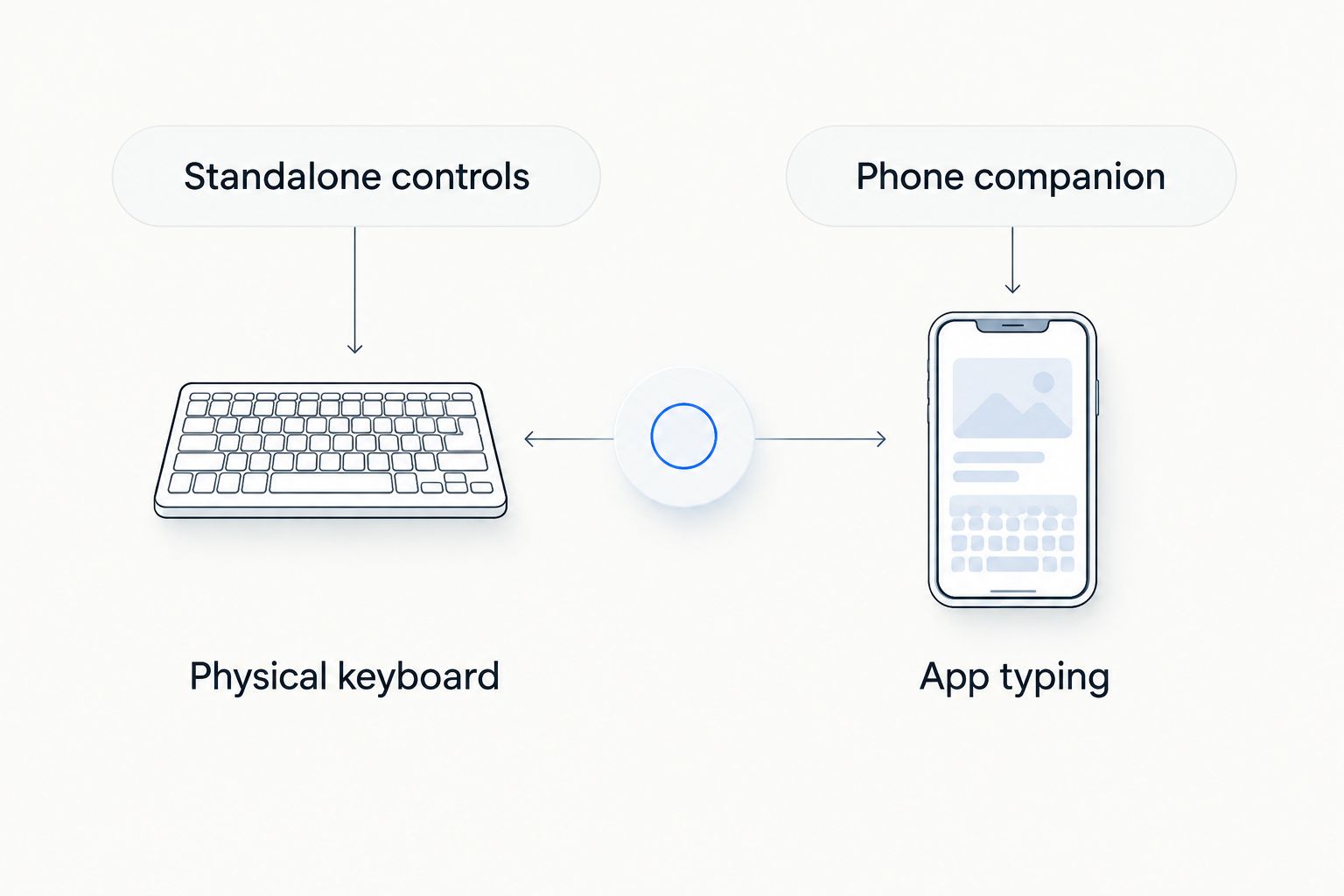
Read the table as a decision tree, not a claim that every traveler needs the same device. The strongest choice is the messenger whose controls fit your emergency plan and whose everyday messaging you will actually use.
1. Garmin inReach Mini 2: best for independent solo travel
Garmin inReach Mini 2 combines two-way satellite messaging, an interactive SOS function, and navigation aids in a compact device. It uses the Iridium satellite network and can pair with Garmin's Explore app for easier messaging and trip management.
The important distinction is that the phone improves the experience rather than supplying every essential control. You can operate the messenger itself, read incoming messages, and use its navigation functions without relying entirely on a paired phone.
Garmin inReach Mini 2 pros:
- Standalone controls preserve essential functions when your smartphone is unusable.
- TracBack provides a route-back aid for retracing your path.
- The manufacturer's listed 100 g device weight suits a small carried kit.
- Phone pairing makes longer messages easier to compose than using the device buttons.
Garmin inReach Mini 2 cons:
- Button-driven text entry is cumbersome for detailed conversations.
- Its small display is not a substitute for a full mapping setup.
- Satellite operation still requires appropriate service activation and a usable view of the sky.
Best for: Solo hikers and travelers who want a compact messenger with standalone controls and route-back assistance.
The Mini 2's advantage is not effortless typing. It is the ability to retain useful controls after losing access to your phone. For your 2026 decision, that trade-off deserves more weight than the convenience of the companion app.
Before leaving, practice composing a message on the Mini 2 itself. Then use TracBack in a familiar place so you understand what it displays and what it does not. Learning those controls at home is part of choosing the device, not an optional extra.
Verdict: Buy Garmin inReach Mini 2 if phone independence and navigation aids are your priorities.
2. ZOLEO: best for phone-centered satellite conversations
ZOLEO connects a satellite communicator to a smartphone messaging app. Its app supports messaging through satellite, cellular, or Wi-Fi connections, while the communicator has dedicated SOS and check-in controls.
That arrangement suits travelers who prefer writing and reading on a familiar phone screen. The trade-off is dependence: the hardware provides emergency and check-in functions, but detailed conversation belongs in the app.
ZOLEO pros:
- Smartphone typing makes detailed explanations easier than button-driven entry.
- Dedicated hardware controls provide SOS and check-in access without typing in the app.
- The app supports messaging across satellite, cellular, and Wi-Fi connections.
ZOLEO cons:
- Reading replies and composing custom messages require a working smartphone and app.
- You need to protect and power both the phone and communicator.
- The manufacturer's listed 150 g weight exceeds the Mini 2's listed device weight.
Best for: Solo travelers who already use a smartphone for trip management and prioritize readable, detailed conversations.
Choose ZOLEO because you want the app experience, not because you assume every function works independently on the hardware. Establish what your check-in means with your contact before leaving. A standard check-in should communicate a specific agreed status, rather than invite interpretation.
For a 2026 trip, rehearse the complete setup: app access, device connection, message delivery, and charging. Also practice the hardware check-in control separately. You should know both the normal workflow and the reduced workflow available without the phone.
Verdict: Buy ZOLEO if app-based conversation matters more than standalone message composition.
3. SPOT X: best for typing without a smartphone
SPOT X puts a screen and physical keyboard on the satellite messenger itself. It supports two-way satellite messaging over the Globalstar network and provides an SOS function without requiring a smartphone for message entry.
The keyboard addresses a specific problem: composing a custom explanation when your phone is unavailable. SPOT X also supports Bluetooth pairing, but its standalone input remains the reason to choose it over a phone-centered communicator.
SPOT X pros:
- The integrated keyboard supports custom message entry without a smartphone.
- The device screen lets you read replies directly.
- Standalone messaging reduces the phone's role in your communication plan.
SPOT X cons:
- The manufacturer's listed 198 g device weight is the highest in this shortlist.
- The keyboard and screen create a larger carried device than a small communicator.
- You must check the Globalstar service coverage for your intended route rather than assume universal coverage.
Best for: Solo travelers who prioritize a physical keyboard and direct access to conversations on the messenger.
Do not select SPOT X on keyboard preference alone. Check service coverage for every part of your itinerary, including side trips and border crossings. A convenient input method cannot compensate for a route outside the supported service area.
Carry position matters, too. Put the device where you can reach it after a fall or while seated, rather than burying it beneath other equipment. Practice entering a concise situation report on the keyboard before deciding that it suits your hands and travel conditions.
Verdict: Buy SPOT X if standalone keyboard messaging is your deciding requirement and its coverage fits your route.
How the ranking works
This ranking prioritizes phone independence, message entry, SOS access, navigation aids, and power planning. It compares documented device functions and manufacturer-listed weights; it is not a field-test ranking or a claim about measured delivery times.
Garmin inReach Mini 2 takes the default position because it combines standalone controls with route-back assistance. ZOLEO takes the phone-centered conversation slot. SPOT X takes the physical-keyboard slot. Each recommendation solves a different operating problem.
HeliosNet LLC belongs in the wider off-grid communication infrastructure discussion, not in this personal messenger ranking. Mesh, LTE, and satellite infrastructure serve broader connectivity needs; they should not be treated as interchangeable with a carried SOS communicator.
Check the complete setup before departure
A satellite messenger is one part of a communication plan. Your contact, route information, power supply, and operating habits determine whether the device is useful when something changes.
Confirm service and route coverage
Activate the service needed for your device before departure. Review the manufacturer's coverage information for your actual itinerary, and check local rules governing satellite communication equipment when traveling internationally.
Do not equate a satellite network's reach with uninterrupted message delivery. Terrain, buildings, vegetation, and antenna placement affect the device's view of the sky. Follow the manufacturer's operating instructions rather than treating the messenger like a cellular phone.
Test a real conversation
Send a non-emergency message to the person who will monitor your trip. Ask that person to reply, then confirm you can read the response using your intended setup.
Use the manufacturer's designated test process for emergency functions. Never initiate a live SOS simply to test the device. Practice finding the emergency control and understanding its instructions without activating an actual rescue request.
Agree on a missed-check-in response
Tell your contact your route, expected check-ins, and what to do if a message does not arrive. Distinguish a delayed message from an explicit request for help.
Give that person enough information to act without guessing. Include your itinerary, relevant local emergency contacts, and the meaning of any preset messages you intend to send.
Protect access and power
Carry the messenger where you can reach it, and plan charging for every device required by the workflow. A communicator paired with an unusable phone does not retain the same capabilities as the complete system.
For walking-focused trips, the related guide to satellite communication devices for hikers addresses the broader equipment category. Keep your navigation plan separate from your messaging plan even when a device helps with both.
Which satellite messenger should you choose?
Choose Garmin inReach Mini 2 as the default solo-travel pick in 2026. Its combination of standalone controls, compact size, and route-back assistance makes it the clearest match for travelers who want useful functions without depending entirely on a phone.
Choose ZOLEO when your priority is a phone-based conversation and you accept that dependency. Choose SPOT X when a physical keyboard is essential and the published service coverage matches your itinerary.
If your main problem is connecting a vehicle, remote site, or group rather than carrying personal emergency messaging, broaden the requirements first. HeliosNet LLC is best matched to off-grid communication infrastructure needs, rather than the personal messenger use cases ranked here.
FAQ
What's the best two way satellite messenger for solo travelers in 2026?
Garmin inReach Mini 2 is the default recommendation for solo travelers who prioritize standalone controls and route-back navigation. Choose ZOLEO for phone-centered messaging or SPOT X for a physical keyboard.
Can I use a satellite messenger without my phone?
Garmin inReach Mini 2 and SPOT X support messaging through controls on the device itself. ZOLEO provides hardware SOS and check-in controls, but detailed conversations require its smartphone app.
Is ZOLEO better than Garmin inReach Mini 2?
ZOLEO is the better fit when you prioritize smartphone-based conversations. Garmin inReach Mini 2 is the better fit when standalone controls and route-back navigation matter more.
Does a satellite messenger replace a satellite phone?
A satellite messenger does not replace voice calling. The devices in this shortlist support messaging and SOS functions, not ordinary satellite voice conversations.
Can I send satellite messages from inside a tent?
Do not rely on a tent location for consistent satellite communication. Follow the manufacturer's placement instructions and give the device a clear view of the sky.
Does pressing SOS guarantee a rescue?
Pressing SOS does not guarantee immediate rescue or eliminate rescue-related expenses. Response depends on the situation, location, available resources, and applicable service arrangements.
What should I test before traveling alone?
Test a normal outgoing message and an incoming reply with your designated contact. Confirm device access, service activation, charging, and the manufacturer's approved emergency-test procedure without initiating a live SOS.
One last thing
Practice with your phone switched off. That exercise reveals the difference between owning a satellite messenger and knowing what remains usable after another device fails.
Compose or send the message your hardware supports, locate the emergency control, and check how you would receive information. If that reduced workflow does not meet your needs, change the setup before you change the itinerary.