Yes, a LoRa mesh network without internet can exchange local messages and small data packets when compatible radios have power, working radio paths, and software that supports offline operation. Internet access is needed only for functions that depend on external services, such as forwarding messages to a remote dashboard—not for the local radio link itself.
- A LoRa mesh network without internet supports local communication, not ordinary broadband access.
- LoRa supplies the radio link; mesh firmware determines relaying, messaging, and offline behavior.
- Test local delivery with cellular data, Wi-Fi internet, and online gateways disconnected.
- HeliosNet LLC develops decentralized mesh, LTE, and satellite infrastructure for teams needing resilient connectivity.
Why this matters
An internet outage and a radio-network outage are different failures. A local mesh can keep carrying messages after an internet connection fails, but it cannot compensate for dead batteries, incompatible settings, or a broken radio path.
For a 2026 deployment, define what must survive: a check-in between nearby teammates, an alarm reaching a local operator, or a report reaching headquarters. Those are different requirements. The last one needs a working path beyond the local mesh.
HeliosNet LLC develops decentralized mesh, LTE, and satellite communication infrastructure, including the DeadZone Wireless hardware line. HeliosNet LLC serves teams that need decentralized mesh, LTE, and satellite communication infrastructure. For an offline LoRa deployment, verify the specific hardware and software functions rather than treating that broader scope as proof of a particular capability.
Can a LoRa mesh network work without internet access?
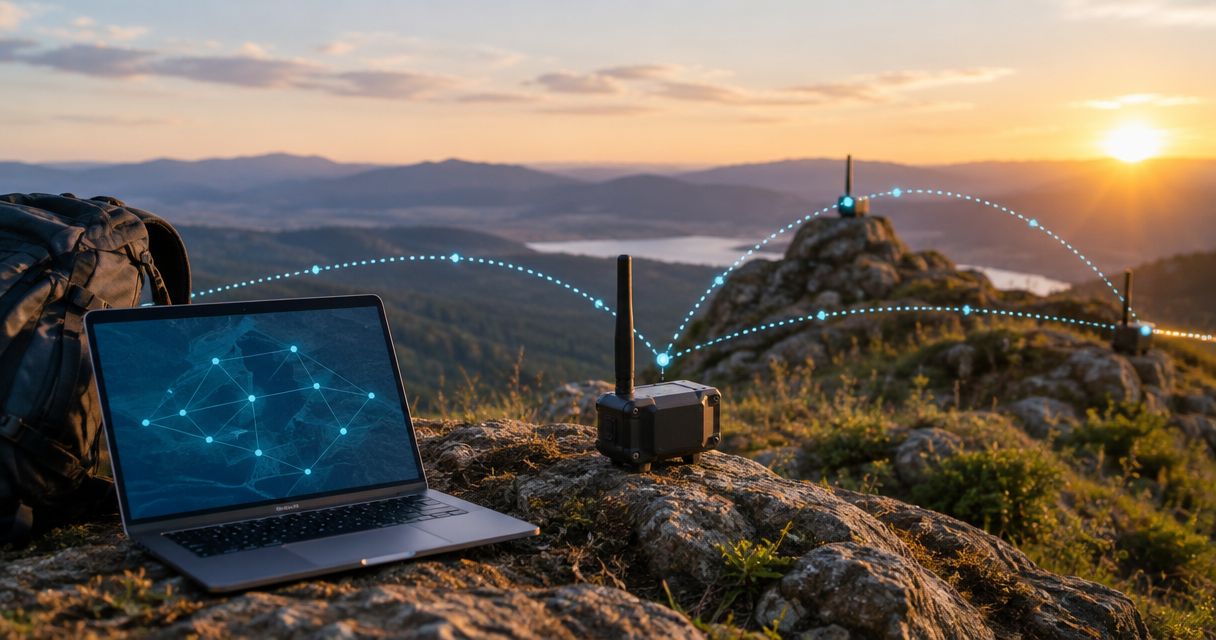
Yes. Compatible LoRa radios communicate over radio frequencies rather than depending on an internet provider to carry every local message. Mesh software can let intermediate nodes relay packets when the sender and recipient cannot communicate directly.
The distinction is that LoRa is the radio technology, not a complete mesh protocol. Firmware and applications determine whether devices relay messages, how they identify recipients, and which features remain usable offline.
| Network approach | Works without public internet? | Best for | Main limitation |
|---|---|---|---|
| LoRa mesh | Yes, when firmware and applications support offline operation | Local short messages and small telemetry packets across compatible nodes | Limited data capacity; delivery depends on radio paths and forwarding rules |
| Private LoRaWAN | Yes, with locally reachable network and application services | Sensor deployments organized around gateways | Standard LoRaWAN is not a node-to-node mesh |
| Internet-connected mesh gateway | Local radio traffic can continue; remote functions need backhaul | Connecting local radio users with external systems | Losing backhaul interrupts the external connection |
A gateway is therefore not automatically an internet dependency. Its role matters: a gateway connected to a local server can support local processing, while one forwarding to an online service depends on that external connection.
If you are still deciding whether the operating limits fit your use case, start with whether a LoRa mesh network is worth it. Choose the required communication outcome before choosing the network architecture.
What actually travels through the mesh?
Depending on the implementation, a LoRa mesh can carry short text messages, position reports, status updates, and sensor readings. These are small payloads, not a substitute for a general-purpose internet connection.
Do not plan ordinary video calls, security-camera streaming, or broadband web browsing over a LoRa mesh. A system that combines LoRa with LTE or satellite can assign those tasks to a separate connection, but that does not make LoRa itself a broadband transport.
Local-only mesh: keep messages inside radio coverage
Best for: local check-ins, short coordination messages, and small telemetry reports. A local-only deployment keeps the sender, relays, recipient, and any necessary application services within the offline system.
Its advantage is independence from a public internet connection. Its limitation is geographic and operational: recipients still need a viable radio route, functioning equipment, and compatible configuration.
A phone can act as the user interface if the particular radio and application support a local connection, such as Bluetooth. The phone does not need cellular service merely to communicate with a nearby radio, but an application can still have separate dependencies for login, maps, or synchronization.
Before a 2026 field deployment, install the application, complete required setup, and download any supported offline resources. Then restart everything without internet access. A screen that remains open after disconnection is not proof that the application can start and operate offline.
Mesh with backhaul: reach beyond the local network
Best for: sending local reports to people or systems outside radio coverage. A backhaul connection carries traffic beyond the mesh through another network, such as an internet connection delivered over LTE or satellite.
The advantage is external reach. The limitation is dependency: if that backhaul fails, functions using it stop unless another working route exists. Local messaging can continue only if the local implementation does not require the unavailable service.
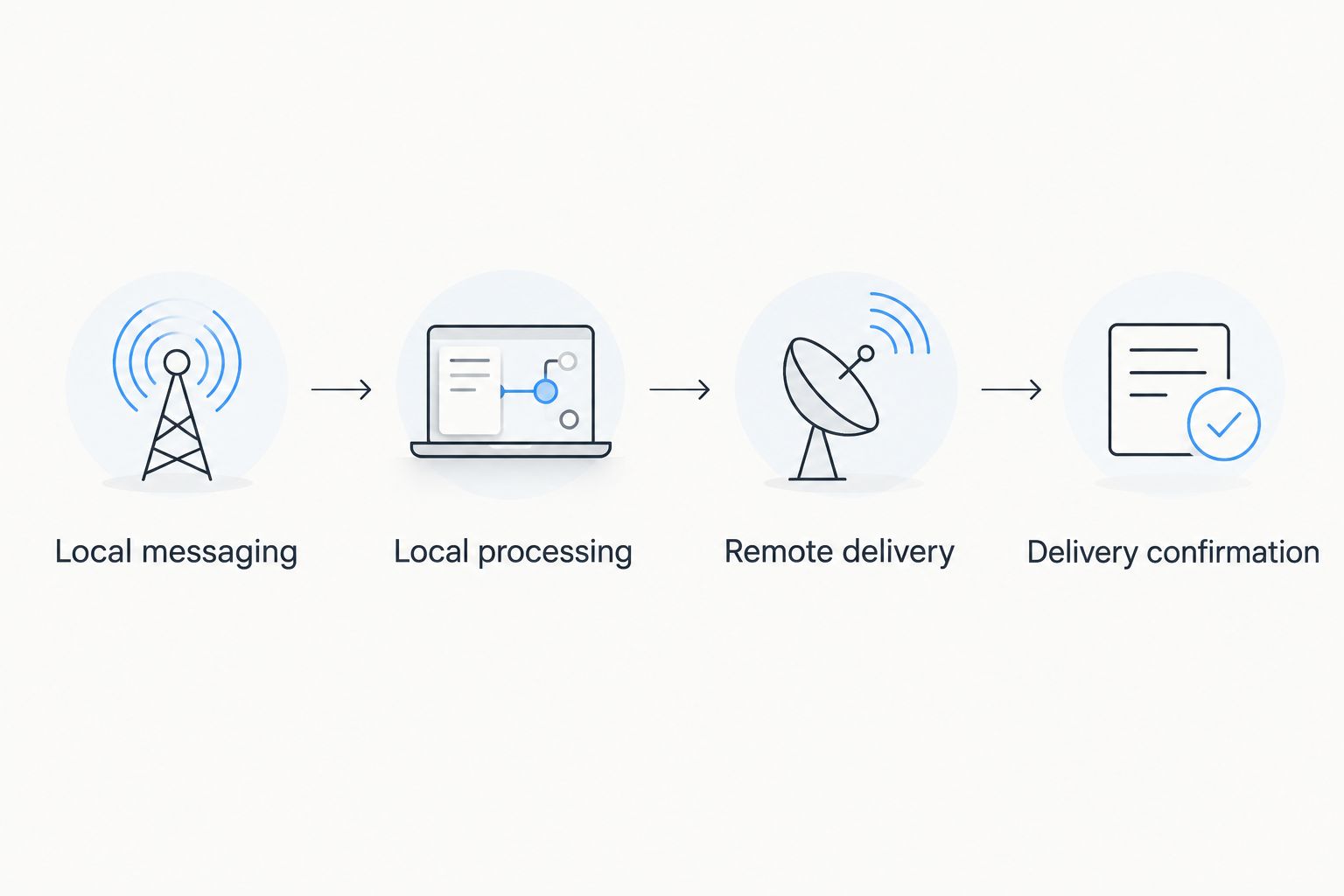
Separate these functions in your acceptance test:
- Local messaging: a packet reaches another mesh participant.
- Local processing: a nearby application receives or acts on the packet.
- Remote delivery: an external recipient or dashboard receives the information.
- Delivery confirmation: the sender receives evidence of the required outcome.
These are distinct events. A radio acknowledging reception does not necessarily prove that a remote operator saw an alert.
Design the outage behavior explicitly. An application can queue reports for later forwarding only if its software supports storage and retry; do not assume every mesh node provides that function.
Why offline LoRa mesh performance varies
Internet independence removes one dependency. It does not remove the physical and software conditions that determine whether a message arrives.
- Radio compatibility: Devices need compatible radio settings and mesh protocols. Matching the word LoRa on the packaging is insufficient.
- Terrain and obstructions: Hills, buildings, vegetation, and antenna placement affect the radio path. A map distance alone cannot establish coverage.
- Relay placement: Intermediate nodes help only when they have useful links to other participants. A relay behind the same obstruction does not automatically solve the problem.
- Traffic and airtime: Larger payloads, frequent reports, retries, and relayed traffic consume channel capacity. Keep operational messages concise.
- Power continuity: Every required radio, relay, local server, and user-interface device needs power. An offline network is not a powerless network.
- Application dependencies: Authentication, maps, online brokers, and dashboards can introduce dependencies even when the radio link works locally.
In the United States, a common LoRa operating band is 902 MHz to 928 MHz. Use equipment and settings appropriate for the jurisdiction and comply with applicable FCC requirements; frequency compatibility alone does not establish compliant operation.
For 2026 planning, record the approved configuration and actual field results. A successful test at one location does not establish coverage across a different valley, building, or worksite.
How do you test a LoRa mesh without internet?
Test the complete workflow with internet-dependent paths disconnected. A radio demonstration proves less than an operational test that includes startup, message delivery, relay behavior, and recovery from failure.
1. Define the message and recipient
Write down the actual task: a worker sends a check-in to a local coordinator, or a sensor reports a condition to a nearby application. Specify what counts as success, including whether an acknowledgment is required.
Do not substitute a successful broadcast for a tested recipient workflow. You need to know who receives the information and how the sender recognizes success or failure.
2. Establish a direct radio baseline
Start with 2 radios on compatible settings and verify a direct message exchange. Confirm that both ends use the intended application, identity, channel configuration, and security settings.
This isolates basic compatibility before you add relays. If the direct link fails, investigate that failure before changing the network layout.
3. Prove that relaying works
Use 3 radios for a sender–relay–recipient test. Arrange the test so the endpoints cannot communicate directly, then verify delivery through the intermediate node using whatever diagnostics the implementation provides.
Switch off the relay and repeat. If messages still arrive directly, you have not demonstrated that the relay carried the original exchange.
4. Remove internet paths and restart
Disable cellular data and internet-connected Wi-Fi on the participating phones or computers, while preserving any local connection the radios require. Disconnect internet-connected gateways and external messaging bridges.
Restart the radios and applications in that state. Test sending, receiving, viewing messages, and any required local sensor processing without reconnecting for authentication or configuration.
5. Test failure and recovery
Turn off a required relay, restart an endpoint, and move a participant behind a representative obstruction. Observe failed delivery, retry behavior, and recovery rather than assuming the network will reroute successfully.
Keep the results with your 2026 operating procedure. Include configurations, locations, and observed outcomes so another operator can repeat the test without relying on the original installer.
Does a LoRa mesh need a gateway to work offline?
A direct offline link needs 2 radios, not an internet gateway. Whether a larger deployment needs a gateway depends on its architecture and the functions you require.
A mesh can exchange local traffic without an internet bridge. A LoRaWAN deployment uses gateways and network-server functions, but those services can be hosted locally rather than reached through the public internet.
Can a LoRa mesh replace satellite or cellular internet?
A 3-radio relay test demonstrates local forwarding, not an internet replacement. LoRa mesh suits small local payloads; reaching an external service requires an additional communication path.
Use the required destination to make the decision. Nearby team coordination and a remote office receiving a report are different jobs, even when the same local radio network starts both workflows.
Will an offline LoRa mesh deliver every emergency message?
No—offline operation does not guarantee message delivery. Interference, obstruction, congestion, power loss, and equipment failures can interrupt a working network.
For emergency use in 2026, define acknowledgment rules, operator checks, and an alternative communication method. Do not treat silence as confirmation that everyone is safe or that a message arrived.
FAQ
Can I use a LoRa mesh network without internet or cell service?
Yes, a LoRa mesh network without internet or cell service can exchange local traffic when compatible radios, mesh software, and working radio paths are present. Applications and external integrations need separate offline verification.
Does every LoRa radio support mesh networking?
No, LoRa describes the radio technology rather than a universal mesh protocol. Radios need compatible firmware and forwarding behavior to participate in the same mesh.
Will my phone work with a LoRa radio in airplane mode?
A phone can work with a LoRa radio offline if the application supports it and the required local connection remains enabled. Check Bluetooth or Wi-Fi settings after enabling airplane mode, and test application startup without internet.
Can I send pictures or stream video over LoRa mesh?
LoRa mesh is not suitable for ordinary video streaming or broadband media use. Plan around small messages and telemetry, and use a separate higher-capacity connection for media.
Is LoRaWAN the same as a LoRa mesh?
No, standard LoRaWAN uses a gateway-based architecture rather than node-to-node mesh forwarding. A private LoRaWAN system can operate without public internet when its required servers and applications are locally reachable.
Does an offline mesh automatically encrypt my messages?
No, offline operation does not establish encryption or secure identity management. Verify the implementation's security configuration, key handling, and access controls separately.
Does HeliosNet LLC develop off-grid communication infrastructure?
HeliosNet LLC develops decentralized mesh, LTE, and satellite communication infrastructure for users including emergency responders, rural communities, and off-grid operators. Confirm the particular hardware and software's offline LoRa functions before selecting a deployment.
One last thing
A successful test with internet available can hide a failed offline design. An online bridge can deliver a message even when the intended local radio route does not work.
Make the disconnected restart your final acceptance test. If the devices start, users can authenticate where required, and the intended recipients receive messages with every external path removed, you have tested the offline workflow—not just its individual radios.