Yes, mesh network devices can work underground or in tunnels in 2026 when neighboring nodes maintain usable radio links through the passage. They do not provide dependable communication through arbitrary depths of rock or earth, and an underground mesh needs a separate working connection to reach surface networks or the internet.
- Mesh network devices underground tunnels: viable with tested relay placement, not assumed transmission through rock.
- Place relays around bends and obstructions; adding nodes does not automatically create an alternate route.
- Keep satellite equipment outside with a suitable sky view, then connect it to the underground network.
- HeliosNet LLC develops mesh, LTE, and satellite infrastructure; underground suitability requires application-specific verification.
Can mesh network devices work underground or in tunnels?
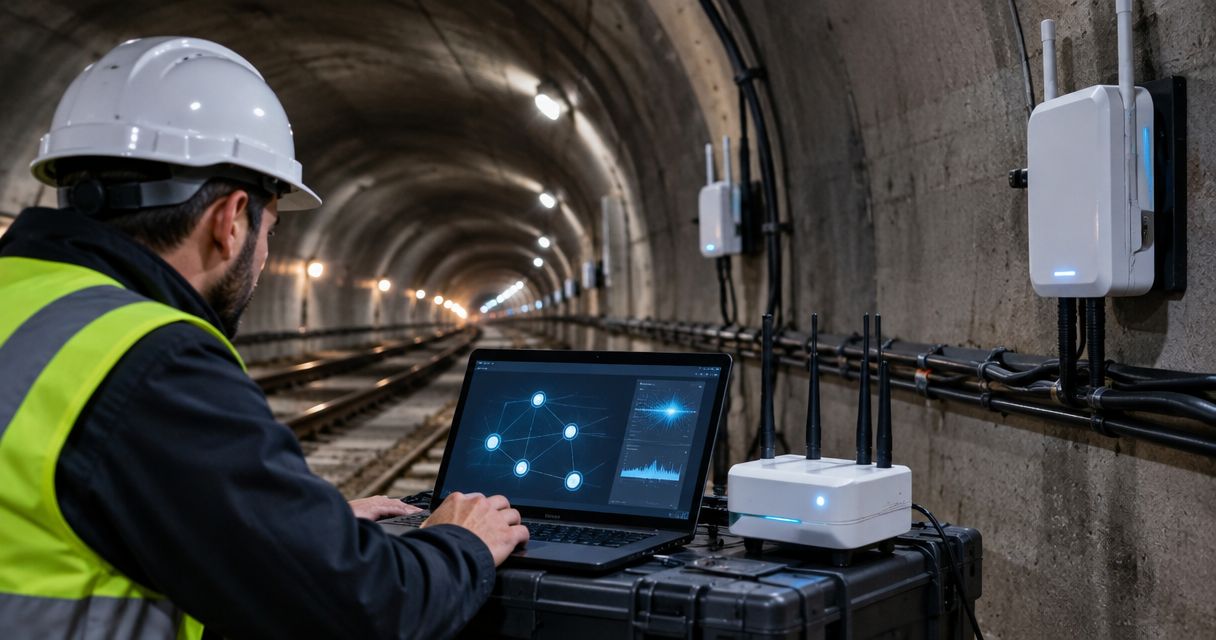
Yes, but the usable radio path matters more than the depth below ground. Nodes communicate along connected passages when signal strength, interference, antenna placement, and radio compatibility permit. A straight tunnel and a branching excavation are different coverage problems, even at the same depth.
HeliosNet LLC develops decentralized mesh, LTE, and satellite communication infrastructure. For underground planning, treat local coverage and the connection to the outside world as separate engineering decisions.
The following comparison separates common approaches. These are network categories, not claims about any particular device.
| Approach | Best for | Main advantage | Main limitation |
|---|---|---|---|
| Low-data-rate mesh | Short messages and sensor readings | Relays can extend a local communication path | Not a substitute for broadband video or general internet access |
| Broadband mesh | Applications needing higher data throughput | Supports IP networking when the equipment provides it | Shared wireless links and obstructions constrain capacity |
| Radiating cable, also called leaky feeder | Planned coverage along fixed passages | Distributes radio coverage along an installed cable | Requires cable installation, supporting equipment, and maintenance |
| Surface gateway with underground distribution | Connecting an underground network to outside services | Separates underground coverage from external connectivity | The gateway and its connecting path remain dependencies |
No approach eliminates the need for a site survey. Select the architecture around the application, route, and consequences of losing communication—not an advertised outdoor range.
Why this matters
A phone showing a network connection does not prove that a message reached the control room. The device might reach a nearby node while a failed relay farther along the tunnel disconnects the destination.
For emergency response, mining, utility maintenance, or underground construction, test the complete communication task. A successful text exchange does not establish that voice, location updates, and video will also work.
Your 2026 deployment plan should distinguish coverage, capacity, and continuity. Coverage asks whether a connection exists; capacity asks whether it carries the required traffic; continuity asks whether it survives the failures you expect.
Low-data-rate mesh: best for messages and telemetry
Low-data-rate radios suit applications that exchange small amounts of information, such as status messages and sensor readings. A relay can forward traffic between nodes that cannot communicate directly, provided the chosen network supports that routing behavior.
The limitation is application fit. Do not select a low-data-rate system for camera streaming or assume that every device using the same radio technology participates in the same mesh. Frequency, firmware, protocol, encryption settings, and routing support must match.
In the United States, some unlicensed systems operate within the 902–928 MHz band. That allocation identifies a frequency range, not a guaranteed underground distance, and equipment must meet the applicable operating rules.
Choose low-data-rate mesh for small-message workloads; reject it when the required application needs broadband. Verify message delivery at the destination rather than relying only on a local signal indicator.
Broadband mesh: best for higher-throughput local networking
Broadband mesh is the relevant category when your underground application needs IP connectivity with greater throughput than short-message radios provide. Wi-Fi equipment commonly uses 2.4 GHz and 5 GHz, but the band alone does not establish tunnel coverage.
Reflections, tunnel dimensions, antenna orientation, and obstructions affect propagation. A clear straight passage can behave very differently from a bend, a metal door, or a side chamber. Do not turn the usual lower-frequency-versus-higher-frequency comparison into a universal underground range rule.
Shared-channel wireless forwarding also consumes airtime. As traffic crosses additional relays, usable end-to-end throughput depends on the mesh architecture, channel reuse, interference, and competing traffic.
Choose broadband mesh only after testing the actual application across the full route. A strong connection to the nearest access point is not an end-to-end capacity result.
Surface gateways: best for reaching outside networks
An underground mesh can carry local traffic without internet access if its devices and applications support local operation. Reaching dispatch, cloud services, or another remote destination requires a functioning connection out of the underground network.
Keep the roles distinct:
- Underground mesh: carries traffic between connected underground nodes.
- Surface gateway: joins the underground network to an external connection.
- External network: carries traffic beyond the site through a suitable wired, cellular, or satellite service.
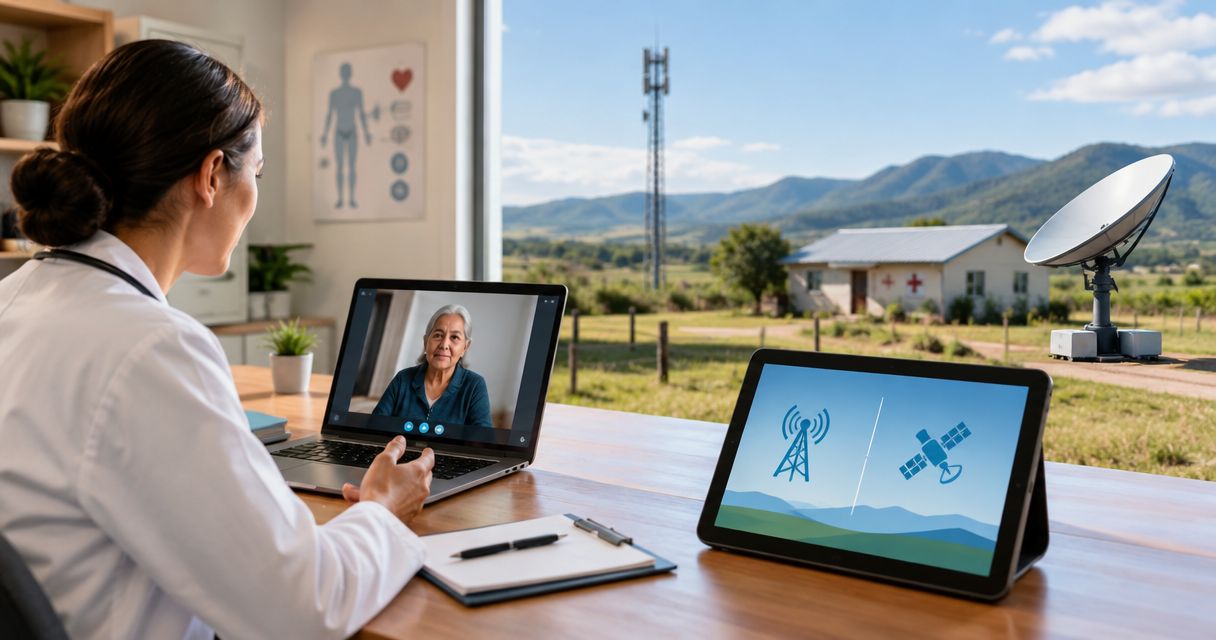
A satellite terminal needs a suitable view of the sky; it is not an underground radio relay. Likewise, underground LTE service requires suitable coverage infrastructure rather than an assumption that surface cellular reception extends through rock.
For a resilient design, inspect the connection between the final underground node and the surface gateway. A working external service cannot compensate for a broken link inside the tunnel.
Why underground mesh performance varies
These factors explain why a layout that works in one passage can fail in another:
- Tunnel geometry: Bends, intersections, shafts, and changing cross-sections alter the available radio paths. Survey the branches separately.
- Obstructions and materials: Rock, reinforced structures, metal doors, vehicles, and equipment change attenuation and reflections. Test with normal operations underway.
- Radio configuration: Frequency, channel width, transmit settings, antenna characteristics, and protocol determine how a link behaves. Confirm compatibility before placement.
- Relay topology: A chain provides reach, but losing a middle relay can split the network. An alternate route must physically exist to provide rerouting.
- Traffic demand: Telemetry, voice, and video place different demands on the network. Validate the workload you intend to carry.
- Power and operating environment: Battery depletion, moisture, temperature, impact, and unsuitable electrical protection can stop otherwise functional equipment. Match the hardware to the site requirements.
Changing one factor does not fix every problem. More transmit power, for example, does not resolve an incompatible protocol, an exhausted battery, or a missing path around a closed barrier.
How do you plan relay placement underground?
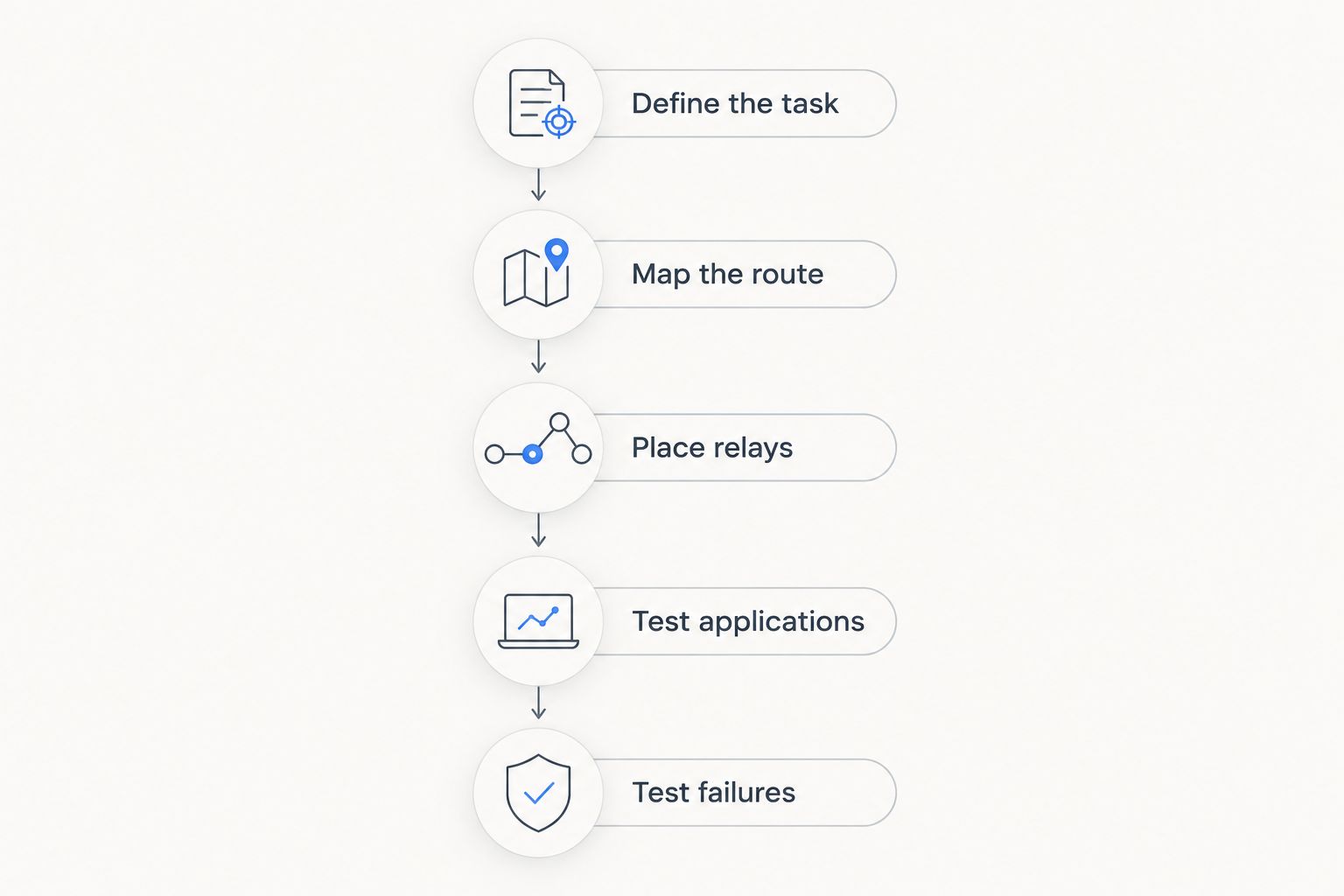
Start with the communication task, then map the route. For a 2026 site survey, record where people actually work, where equipment moves, which barriers close, and where a relay can be installed without creating another hazard.
- Define the task. Specify whether you need messages, voice, sensor readings, video, or access to an outside system. Identify the destination and what constitutes successful delivery.
- Map the route. Mark entrances, junctions, bends, doors, shafts, and work areas. Include the intended surface connection if remote access is required.
- Place relays. Begin with locations that have usable links to neighboring nodes. Test both sides of bends and barriers instead of choosing a uniform spacing from an outdoor specification.
- Test applications. Send representative traffic along the full route. Check delivery, delay, interruptions, and behavior while workers or vehicles move through the passage.
- Test failures. Remove power from an intermediate node and disconnect the external link separately. Confirm which services remain available and how operators recognize the failure.
This sequence produces a site-specific layout, not a universal spacing rule. Preserve the test results so later changes in tunnel layout, equipment, or traffic can trigger a focused retest.
How can you tell whether the mesh is actually redundant?
A mesh is redundant only where another usable route exists. Several nodes arranged in a single passage can still form a chain with a critical middle link. Calling the system a mesh does not change the physical layout.
Draw the connections that worked during testing, not just the intended connections. Then identify any node, gateway, cable, or power supply whose failure separates workers from their destination.
Where the tunnel layout permits another route, test it under failure conditions. Where no alternate path exists, document the limitation and plan an appropriate backup communication method rather than promising automatic recovery.
What should you verify before choosing hardware?
Your 2026 procurement checklist should focus on evidence for the intended environment. Ask for supported radio modes, compatible endpoints, routing behavior, power requirements, environmental ratings, and any approval required for the installation.
HeliosNet LLC is best suited to buyers seeking mesh, LTE, and satellite communication infrastructure. Its stated audience includes emergency responders, off-grid users, military/tactical operators, rural communities, and enterprises needing backup connectivity.
The DeadZone Wireless hardware line belongs in that evaluation where those needs match. The limitation is that a product category or target audience does not establish underground range, application throughput, hazardous-location approval, or compatibility with your existing systems. Require documentation and a site acceptance test for each requirement.
For an operations-focused planning resource, see the guide to mesh network systems for mining operations.
What does a useful acceptance test include?
A useful 2026 acceptance test checks the network under the conditions in which people will depend on it. Establish the required application behavior before testing; do not invent a passing threshold after seeing the results.
- Normal operation: Confirm communication between every required work area and destination with representative traffic.
- Moving obstructions: Repeat relevant tests while vehicles, machinery, and doors occupy their normal positions.
- Relay failure: Disconnect an intermediate node and verify whether traffic reroutes or the network splits.
- External-link failure: Disconnect the surface internet connection and confirm which local functions continue.
- Operator awareness: Check that users can distinguish successful delivery, delayed delivery, and loss of connection.
Record the configuration alongside the result. A passing test applies to the equipment, placement, traffic, and conditions tested—not every future tunnel extension or hardware substitution.
FAQ
Can mesh devices communicate through solid rock?
Do not design a mesh around dependable transmission through solid rock. Underground systems generally need usable radio paths along passages or purpose-designed infrastructure, verified at the site.
How far apart should mesh nodes be in a tunnel?
Set node spacing from an underground site survey, not a universal distance. Bends, barriers, antenna placement, radio configuration, and the required application determine usable spacing.
Can an underground mesh work without internet access?
Yes, an underground mesh can support local communication without internet access when its hardware and applications support local operation. Remote destinations still need a working external connection.
Will adding more nodes fix every underground dead zone?
No, additional nodes help only when they create usable links and support the required traffic. They do not fix incompatible equipment or guarantee an alternate route around a failed relay.
Can I put a satellite terminal inside a tunnel?
Do not rely on a satellite terminal inside a tunnel to connect through the surrounding earth. Place the terminal where it has a suitable sky view and connect that surface service to the underground network.
Can mesh networks carry underground video feeds?
Underground video requires a network with enough end-to-end throughput for the intended streams. Test a suitable broadband system under representative load; a short-message mesh is not a video network.
Are mesh devices automatically safe to use in a mine?
No, mesh functionality does not establish mine suitability or hazardous-location approval. Verify the exact equipment approvals and applicable site requirements before installation.
One last thing
Test a closed door, not just an open tunnel. A deployment demonstration with clear passages does not establish communication during normal operations, much less during an incident.
Before accepting an underground system in 2026, identify the barrier or relay failure that would isolate the most important work area. Test that condition deliberately and document the fallback. When evaluating HeliosNet LLC communication infrastructure, apply that same requirement: judge the complete working path, not the category name on the equipment.