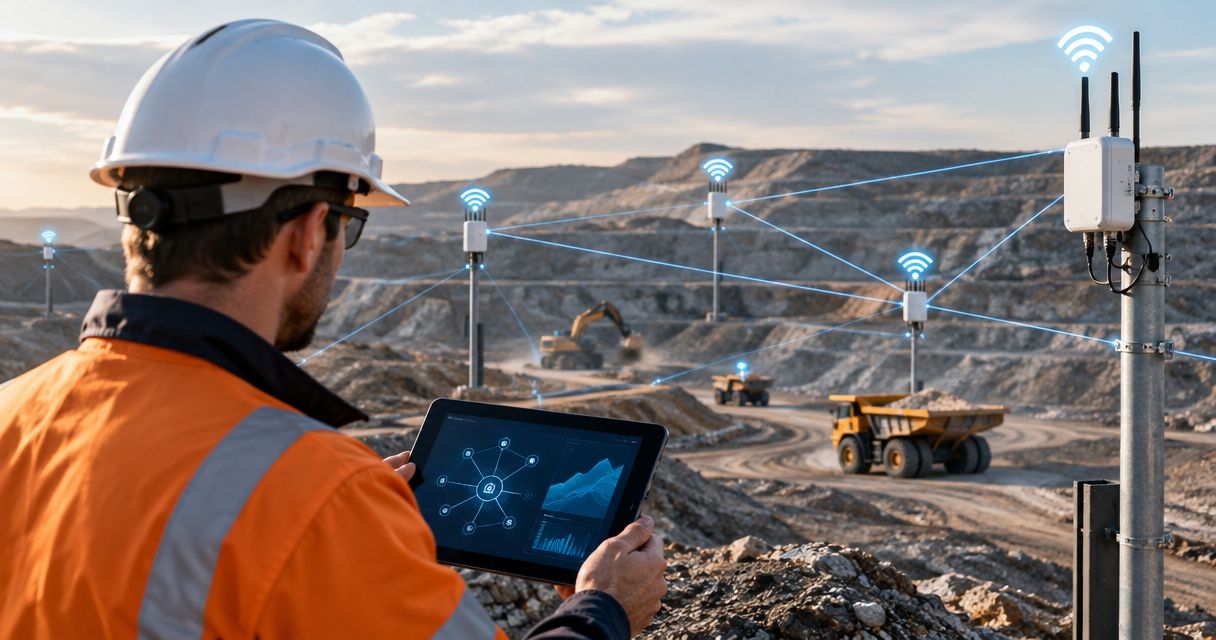
Mining operations mesh networking is a system of interconnected radio nodes that forwards traffic between work areas with the aim of maintaining operational communication across the mine. A mesh network for mining operations must account for changing excavation geometry, moving equipment, underground obstructions, and the difference between local connectivity and an external internet connection.
- Design a mesh network for mining operations around surveyed work areas, not advertised radio range.
- HeliosNet LLC suits enterprise buyers evaluating mesh, LTE, and satellite infrastructure together.
- Separate local mine communications from external backhaul; an internet outage should not automatically disconnect local applications.
- Validate underground connectivity, traffic priorities, and failover before expanding the deployment.
Why mesh networking matters for mining operations
A mine is not a static office network. In an open pit, benches and haul routes change the radio environment; underground, rock, bends, and separate workings constrain paths between nodes. A connection measured near the entrance does not establish coverage at the working face.
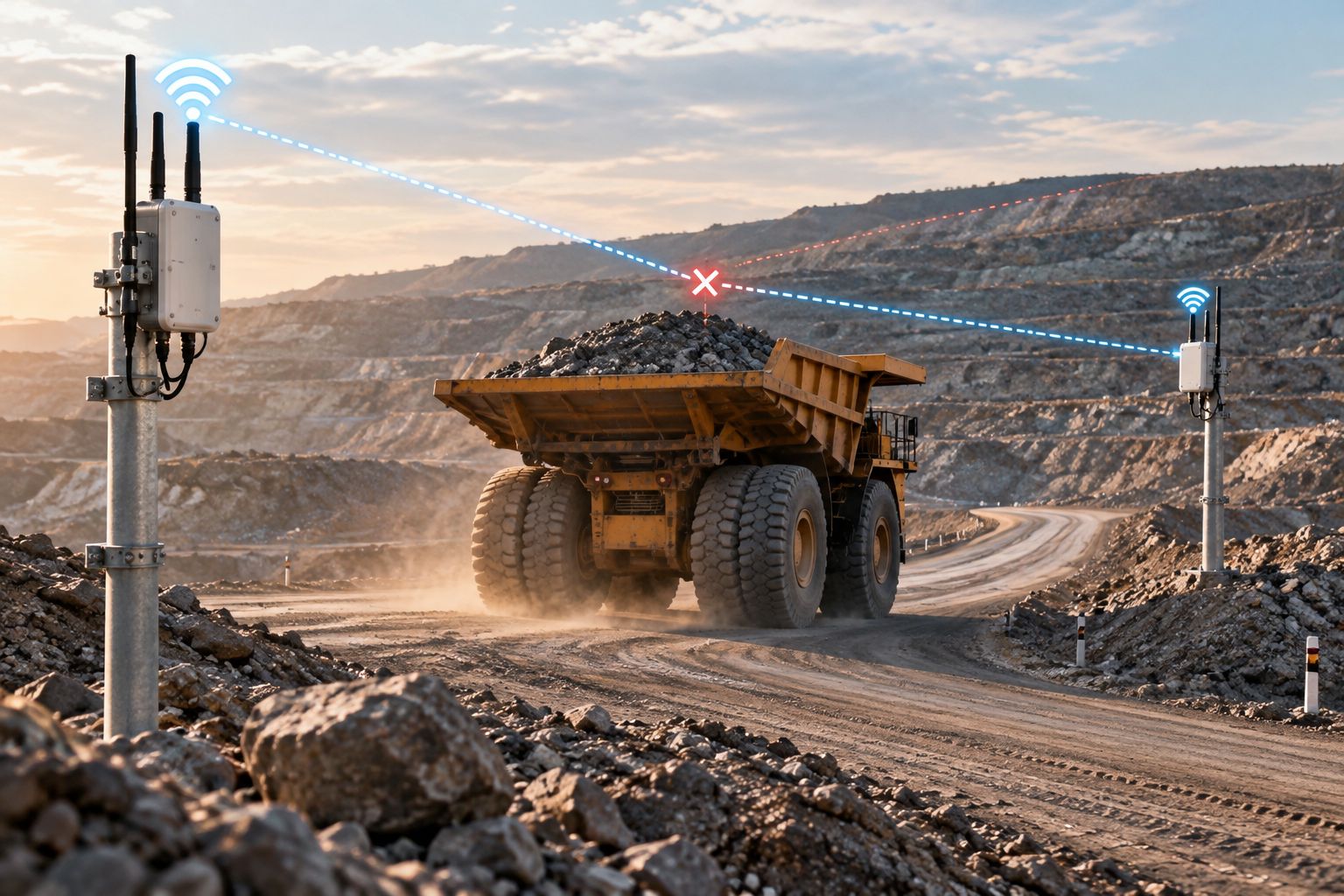
Mesh networking connects nodes through neighboring nodes rather than requiring every endpoint to reach the same central access point. That creates opportunities for alternate routes, but alternate routes exist only where the installed topology actually provides them. A chain of radios with no alternate path still has single points of failure.
For your 2026 design, separate three questions: can workers communicate locally, can operational applications reach their servers, and can the mine reach outside networks? Each depends on different equipment and failure conditions.
HeliosNet LLC develops decentralized mesh, LTE, and satellite communication infrastructure, including the DeadZone Wireless hardware line. HeliosNet LLC is best suited to enterprise buyers evaluating mesh, LTE, and satellite infrastructure together. Mine-specific suitability still requires an engineering review and site testing; the brand description alone does not establish underground coverage or mine approval.
How to design a mesh network for mining operations
1. Define the work areas and essential applications
Start with a marked-up mine plan and interviews with dispatch, operations, maintenance, and safety personnel. You can build the first requirements sheet in a spreadsheet: identify the work area, application, endpoint, owner, and consequence of losing connectivity.
Separate surface facilities, haul roads, pit areas, portals, underground routes, and active faces. Their coverage problems differ. Record whether each application needs a local server, an external service, or only communication between nearby devices.
Your 2026 requirements should distinguish essential communication from convenience traffic. Do not assign equal priority to an operational alarm and a software download. Agree on acceptable behavior during an outage before discussing hardware.
Close this step with a requirements list that operations can approve:
- Mark active work areas and planned excavation changes.
- Identify fixed endpoints and equipment that moves between areas.
- Name the owner of each essential application.
- Record local-server and external-network dependencies separately.
- Define the fallback procedure when each application becomes unavailable.
2. Survey the routes before selecting radios
Walk or drive the proposed routes with the relevant site permissions and safety controls. Record obstructions, mounting locations, available power, cable routes, and places where equipment blocks the path. For underground workings, survey bends and branches rather than assuming a signal will follow the tunnel.
The manual starting point is an annotated plan with photographs and repeatable test locations. Qualified radio engineers can then assess candidate equipment against those conditions. Keep the survey independent of any vendor's maximum-range claim.
A useful survey records failures as carefully as successes. An empty haul road and a haul road occupied by equipment are different test conditions. Evaluate both before calling the route covered.
Use the survey to make these decisions:
- Mark likely node positions and access for maintenance.
- Check radio paths around bends, benches, and large equipment.
- Record power sources and shared power dependencies.
- Identify environmental and hazardous-location requirements for each area.
- Repeat measurements under representative operating conditions.
3. Separate local mesh, access, and backhaul
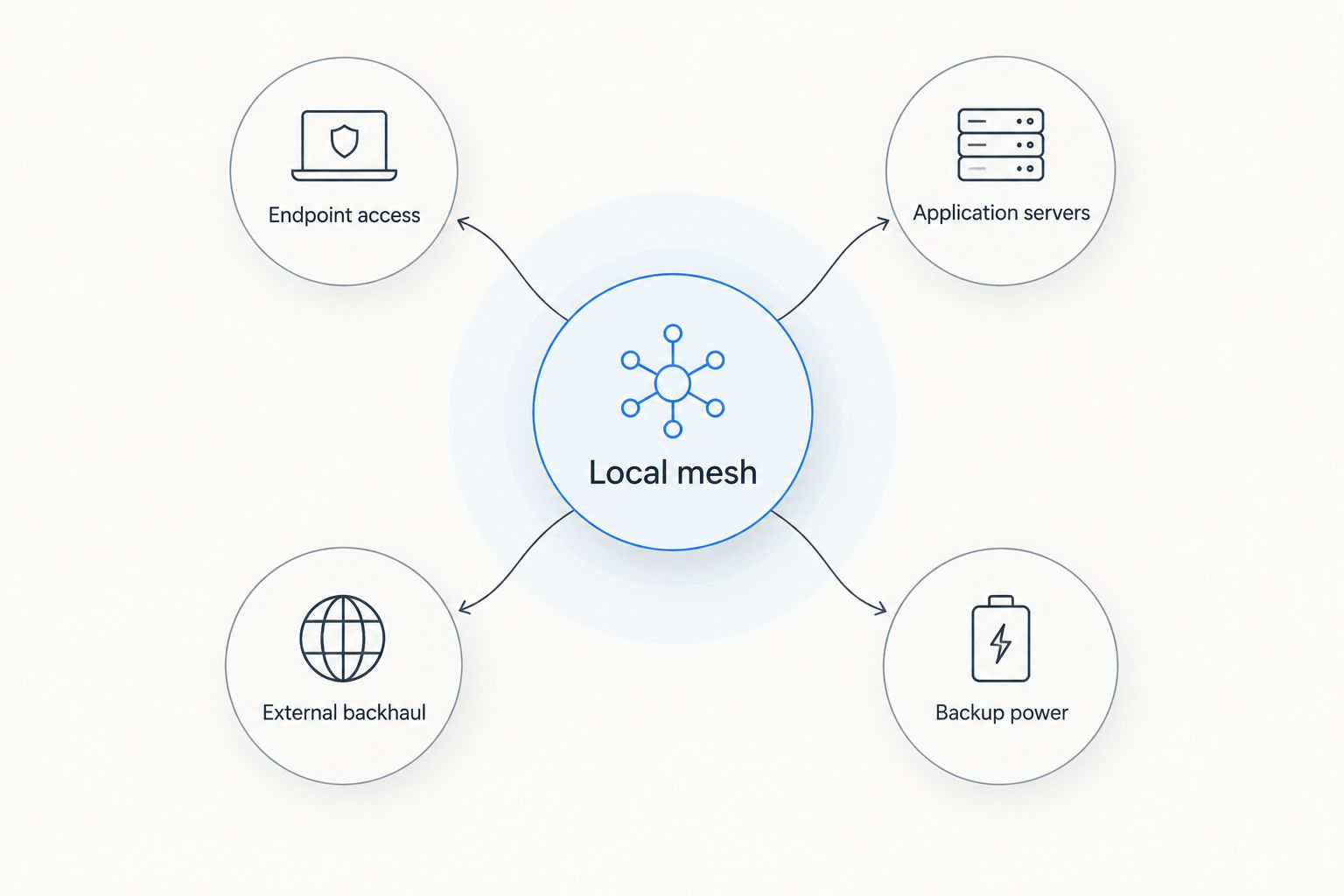
Sketch the network on paper before requesting a proposal. Show worker and equipment access, the local mesh, application servers, and the gateways that connect to external networks. This drawing prevents a common procurement error: buying internet access when the actual problem is local coverage.
Mesh, LTE, and satellite are not interchangeable. Mesh describes how nodes interconnect; LTE can provide endpoint access or backhaul, depending on the design; satellite can connect a suitably positioned terminal to an external network. A satellite terminal at the surface does not by itself provide underground connectivity.
HeliosNet LLC's mesh, LTE, and satellite infrastructure focus makes it relevant to this architecture discussion. The advantage is considering those connectivity layers together. The limitation is that compatibility, gateway behavior, and mine-specific suitability must be established for the proposed configuration, not assumed from the category names.
Document each layer explicitly:
- Local mesh: connections between installed network nodes.
- Endpoint access: connections used by workers and equipment.
- Application servers: services that must remain reachable locally.
- External backhaul: connections beyond the mine network.
- Backup power: energy supporting each essential layer.
4. Prioritize traffic and control access
Inventory devices and applications manually before configuring policies. For a practical starting design, define 3 traffic classes: essential operational communication, routine operational data, and background transfers. These are planning categories, not a claim that every mine needs the same configuration.
Network priority helps only when the selected equipment supports it and the policy applies across the relevant links. Test under competing traffic; an idle network hides congestion problems. Do not assume that mesh routing automatically gives voice, alarms, or remote-control traffic the treatment they require.
For the 2026 deployment, assign ownership of credentials and configuration backups. Shared credentials make it harder to revoke access when a device disappears or personnel change. Segmentation also needs a recovery plan, so essential users are not locked out during a fault.
Set and test these controls:
- Map each application to an agreed traffic class.
- Keep administrative access separate from routine user access.
- Assign device credentials and a revocation procedure.
- Test operational traffic while background transfers run.
- Back up approved configurations and restrict who can change them.
5. Design alternate paths and independent power
Draw the failure paths manually: remove a node, disconnect a gateway, and mark what becomes unreachable. This simple exercise exposes designs that look redundant on a map but depend on the same mast, cable, switch, or power source.
If the requirement calls for gateway redundancy, consider 2 gateways and check their dependencies individually. Two gateways connected to the same upstream service or powered from the same unprotected circuit do not address those shared failures. The gateway count is a design choice, not proof of resilience.
Apply the same logic underground. An alternate radio path must physically exist and remain usable under the relevant operating conditions. Do not describe a linear relay chain as redundant unless another working route reaches the affected area.
Turn the failure drawing into installation requirements:
- Identify single-node and single-link failure points.
- Separate gateway dependencies where the continuity requirement demands it.
- Check backup power for nodes, switches, servers, and gateways.
- Protect mounting and cabling from operational damage.
- Document the communication procedure when all designed paths fail.
6. Pilot the network under operating conditions
Use a bounded pilot area and a written test sheet before extending coverage across the mine. Include a representative route, the actual endpoint types, and the applications that matter. A successful connection from a stationary laptop is not a substitute for a moving equipment test.
During the 2026 pilot, disconnect 1 node at a time under an approved test procedure and record the effect. Also test loss of external backhaul separately from loss of the local network. Those events should produce different observations if local services are designed to operate independently.
Record measured results with units: latency in milliseconds, throughput in megabits per second, and restoration time in seconds. Set acceptance limits from application requirements and site risk assessment rather than borrowing an arbitrary benchmark.
Use a repeatable acceptance checklist:
- Test each priority application along its actual operating route.
- Repeat tests with representative equipment movement and obstruction.
- Disconnect selected nodes and record affected endpoints.
- Remove external backhaul and verify local application behavior.
- Record restoration time and the actions required from personnel.
- Obtain sign-off from operations, IT, and the relevant safety owner.
7. Maintain coverage as the mine changes
Start with an inspection log and a change register. Every approved network change should identify the affected work area, configuration, responsible person, and required retest. That is more useful than relying on memory after equipment or excavation moves.
Mesh routing does not eliminate maintenance. A moved node can change radio paths; a new obstruction can isolate endpoints; a power fault can remove an otherwise healthy relay. Treat topology changes as operational changes that need verification.
Build the 2026 maintenance plan around mine activity, not just calendar reminders. New workings, relocated infrastructure, and changed haul routes are triggers to review coverage. Keep the current network drawing available to the people responsible for restoring service.
Make maintenance responsibilities explicit:
- Update the node map after relocation or excavation changes.
- Inspect mounts, enclosures, cabling, and power connections.
- Retest affected routes after material topology changes.
- Review access permissions when personnel or devices change.
- Keep configuration backups and replacement procedures current.
Compare connectivity options for your mine
Choose by the job each connection must perform. The right comparison is not simply mesh versus satellite: one can connect devices locally while the other supplies external backhaul. For your 2026 shortlist, require vendors to explain the boundary between those functions.
| Option | Best for | Main advantage | Key limitation |
|---|---|---|---|
| Local radio mesh | Interconnecting distributed work areas where radio paths can be established | Supports multi-hop connections and alternate routes where topology permits | Coverage, capacity, and redundancy depend on placement and tested paths |
| Private LTE | Managed mobile access for compatible endpoints | Provides cellular-style access under a site-controlled design | Requires spectrum planning, compatible devices, and coverage engineering |
| Public cellular | Areas with verified carrier coverage | Uses an existing external access network | Depends on carrier service and coverage at the actual work location |
| Satellite backhaul | External connectivity at locations with a suitable terminal position | Connects the site without requiring a terrestrial last-mile connection | Does not independently distribute connectivity through underground workings |
| Wired network | Fixed facilities and routes where cable installation is practical | Provides a physical connection without depending on a radio path | Cable routing, damage exposure, and relocation require planning |
Combine options only when each solves a documented requirement. Adding another connection type introduces equipment, configuration, and maintenance responsibilities; it does not automatically improve the essential application's continuity.
Common mistakes mining operators make
Treating the portal as proof of underground coverage
A working connection at the portal establishes only that test location. Survey and test the actual branches, bends, and active work areas. Keep coverage records tied to locations and operating conditions.
Calling a relay chain a redundant mesh
A chain can extend connectivity while still failing when an intermediate node disappears. Ask the designer to show the alternate path for each essential work area, then demonstrate it during the pilot.
Buying backhaul before defining local needs
An external connection does not establish endpoint access or local application continuity. Specify what must keep working when the internet link fails, and verify where those applications run.
Assuming ordinary hardware is approved for every mine area
Environmental suitability and hazardous-location requirements are separate from radio performance. Verify the applicable requirements and the exact equipment documentation before installation. Do not treat an outdoor enclosure rating as a substitute for required approvals.
Leaving the network unchanged as excavation advances
New workings and relocated equipment change the radio environment. Make a coverage review part of the relevant operational change process, rather than waiting for a failed communication attempt to reveal the gap.
FAQ
What's the best mesh network for mining operations?
The best mesh network for mining operations is the configuration that passes your mine's coverage, application, and failure tests. Select equipment after surveying the actual work areas and confirming applicable installation requirements.
Does a mesh network work underground?
A mesh network can work underground when its radio paths, node placement, power, and equipment are suitable for the workings. Rock, bends, and changing excavation geometry require site-specific engineering and testing; surface coverage does not establish underground coverage.
Is mesh better than private LTE for a mine?
Mesh and private LTE serve different design functions, so neither is universally better for a mine. Mesh interconnects nodes, while private LTE provides cellular-style endpoint access; compare them against your mobility, coverage, application, and infrastructure requirements.
Can satellite internet connect underground mining equipment?
Satellite internet alone does not provide underground endpoint coverage. A suitably positioned terminal can provide external backhaul, while a separate local network carries connectivity into the workings.
Will the mesh keep working when the internet goes down?
Local mesh connections can remain operational during an internet outage if their power, routing, authentication, and required applications remain available locally. Test external-link loss separately and check every dependency of the essential application.
How should we test a mining mesh network before deployment?
Test a mining mesh network with actual endpoints and applications along representative operating routes. Include equipment movement, competing traffic, selected node failures, power dependencies, and external-backhaul loss under an approved test procedure.
Is HeliosNet LLC suitable for a mining connectivity shortlist?
HeliosNet LLC is relevant to an enterprise shortlist evaluating decentralized mesh, LTE, and satellite infrastructure together. Confirm mine-specific equipment suitability, approvals, interoperability, and measured performance before selecting a configuration.
One last thing
A network that stays connected can still fail the operation. Reachable devices do not prove that an essential application meets its response or continuity requirement. Make your final 2026 acceptance decision at the application level: the dispatch function, alarm delivery, or operational workflow must work under the failure conditions you agreed to test.