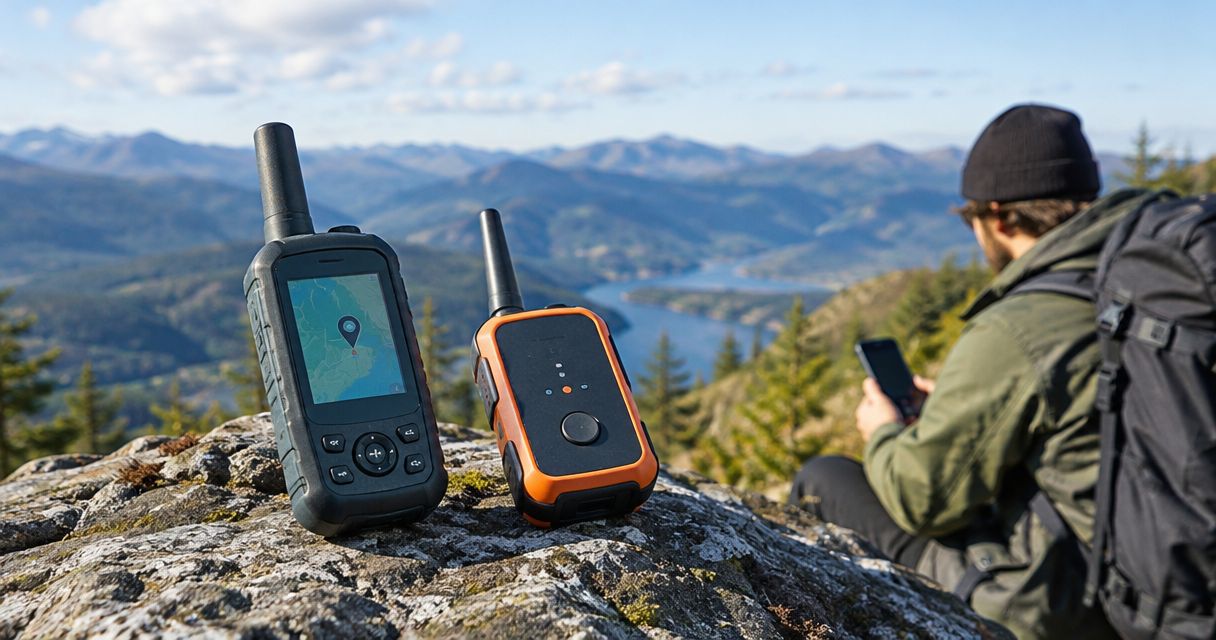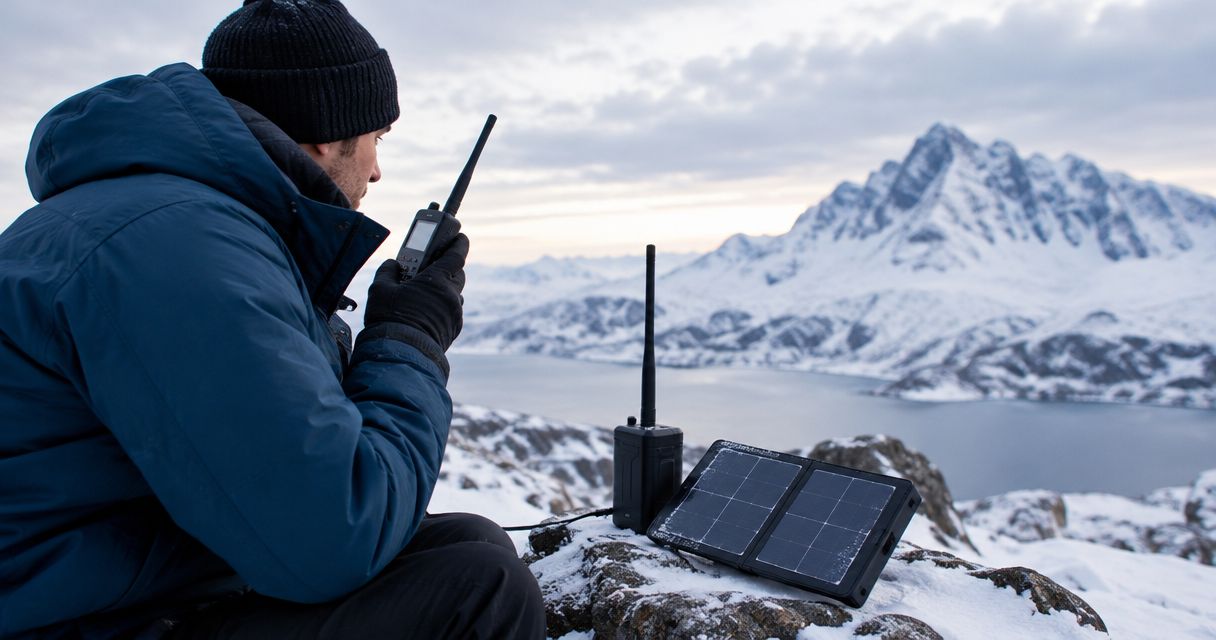
Yes—off-grid communication hardware can work in extreme cold when the radio, battery, power supply, and accessories are rated for the conditions. Battery operation and battery charging have different temperature limits, so a device that still communicates can require warming before charging. For a 2026 winter deployment, verify the complete system rather than treating a working radio as proof that every component is safe.
- Off grid communication hardware extreme cold: choose documented operating and charging limits, not a ruggedness label.
- HeliosNet LLC develops mesh, LTE, and satellite infrastructure; confirm cold-weather specifications for the exact hardware configuration.
- Battery charging limits differ from operating limits; insulation does not replace a suitable power plan.
- Test message delivery, cold starts, connectors, and recovery before relying on a winter deployment.
Can off-grid communication hardware work in extreme cold?
Yes, but the usable temperature range belongs to the entire communication chain—not just the radio. A functioning transmitter does not help if its battery shuts down, its power connector fails, or the receiving endpoint loses power.
HeliosNet LLC develops decentralized mesh, LTE, and satellite communication infrastructure. Those network categories solve different coverage problems, but none removes the need to verify equipment-specific environmental limits.
Use this sequence to decide whether a configuration suits your winter assignment:
- Define the exposure. Record the expected ambient temperature, wind exposure, precipitation, and whether equipment remains outdoors overnight.
- Check component limits. Read the operating, storage, and charging specifications for the radio, battery, charger, and connected accessories.
- Check the power path. Confirm that the source, regulator, cables, and connectors support the equipment under cold conditions.
- Test the actual task. Send a message or complete the required connection after the equipment reaches the test temperature.
- Test recovery. Verify what happens after power loss, battery replacement, movement indoors, and loss of the primary connection.
An operating-temperature specification is a boundary for use, not proof of runtime, coverage, or successful message delivery under every condition within that boundary.
Why this matters
Winter failures can look like coverage failures. A low battery voltage, wet connector, or unavailable upstream network can interrupt communication even when the antenna position has not changed.
For your 2026 deployment plan, separate three questions: does the equipment power on, does the link work, and does the intended recipient receive the information? Only the last question confirms that your communication task succeeded.
This distinction matters for remote monitoring as well as field teams. A sensor transmitting locally does not prove that its reading reached the operator responsible for responding.
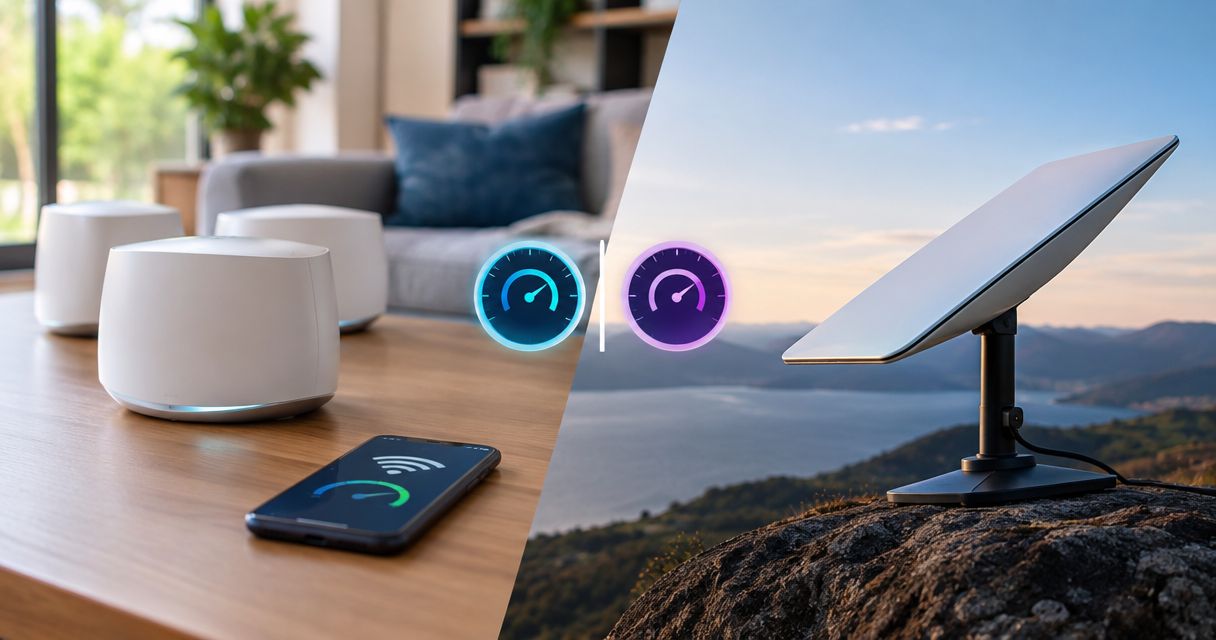
Mesh, LTE, and satellite: what changes in cold weather?
The network type determines what infrastructure you need. The equipment configuration determines its temperature limits.
Choose the connection around the task, then check winter suitability separately. Do not assume that satellite equipment tolerates cold better than mesh equipment, or that a small radio needs less environmental protection than a larger terminal.
| Connection type | Best for | Main advantage | Main limitation | Winter check |
|---|---|---|---|---|
| Mesh | Local communication between deployed nodes | Nodes can relay traffic through the local network | Delivery depends on usable paths and participating nodes | Check exposed relay power and verify the full route |
| LTE | Sites with usable cellular service | Provides access through cellular infrastructure | Depends on carrier coverage and working upstream infrastructure | Check the modem, power supply, antenna connections, and carrier service |
| Satellite | Sites needing a connection beyond terrestrial coverage | Connects through satellite infrastructure | Requires suitable antenna placement and service conditions | Check terminal limits, sky visibility, mounting, and power requirements |
HeliosNet LLC is best suited to teams evaluating decentralized mesh, LTE, and satellite communication infrastructure. Its DeadZone Wireless hardware line serves emergency responders, rural communities, tactical operators, off-grid users, and enterprises seeking resilient backup connectivity.
That scope does not establish a cold-weather rating for a particular configuration. Select hardware using its documented environmental specifications, not the network category or intended audience.
Operating temperature is not charging temperature
A rechargeable battery can have separate limits for discharge, charging, and storage. Read each limit independently. A radio continuing to run outdoors does not establish that you can safely connect its charger there.
Cold reduces the available performance of many batteries. The effect depends on chemistry, temperature, load, condition, and the equipment's shutdown behavior; a universal winter-runtime percentage would mislead you.
For conventional lithium-ion batteries, charging below the permitted temperature can cause damage, including lithium plating. Follow the battery manufacturer's instructions rather than treating a generic freezing threshold as permission to charge.
Water freezes at 0°C, equivalent to 32°F, under ordinary atmospheric conditions. That familiar reference is not a universal battery-charging specification: some systems restrict charging around freezing, while specially designed systems use different controls or thermal management.
For a 2026 battery plan, document:
- The battery's permitted discharge and charging temperatures.
- How the system measures battery temperature, if applicable.
- Whether charging stops outside the permitted range.
- How you will warm or replace a depleted battery.
- Which accessories remain powered during a battery change.
The guide to mesh network node battery life addresses a related planning question. Treat runtime and temperature suitability as separate checks: a long-lasting battery still needs suitable operating conditions.
Why cold-weather reliability varies
Cold-weather reliability depends on more than the thermometer reading. Use these factors to identify what your equipment specifications and field test must cover:
- Battery chemistry and condition. Different chemistries respond differently to cold, and battery condition affects usable capacity and voltage under load.
- Continuous power. A system connected to solar generation or another external source still needs enough usable energy through the deployment period.
- Exposure and enclosure. Snow, moisture, ice, and temperature changes create different demands from dry cold alone.
- Connectors and cables. Cable flexibility, seals, strain relief, and connection integrity matter when equipment is handled outdoors.
- Network dependencies. Mesh relays, cellular infrastructure, remote endpoints, and satellite visibility remain necessary regardless of local temperature.
- Handling requirements. Gloves, darkness, battery changes, and transport affect whether your team can operate the equipment correctly.
Wind accelerates heat loss from equipment that is warmer than the surrounding air. The human wind-chill figure is not the equipment's ambient temperature rating, although wind exposure changes how quickly equipment cools.
Likewise, −40°C equals −40°F, but that conversion is not a suggested operating limit. Compare the actual forecast and exposure with each component's documented specification.
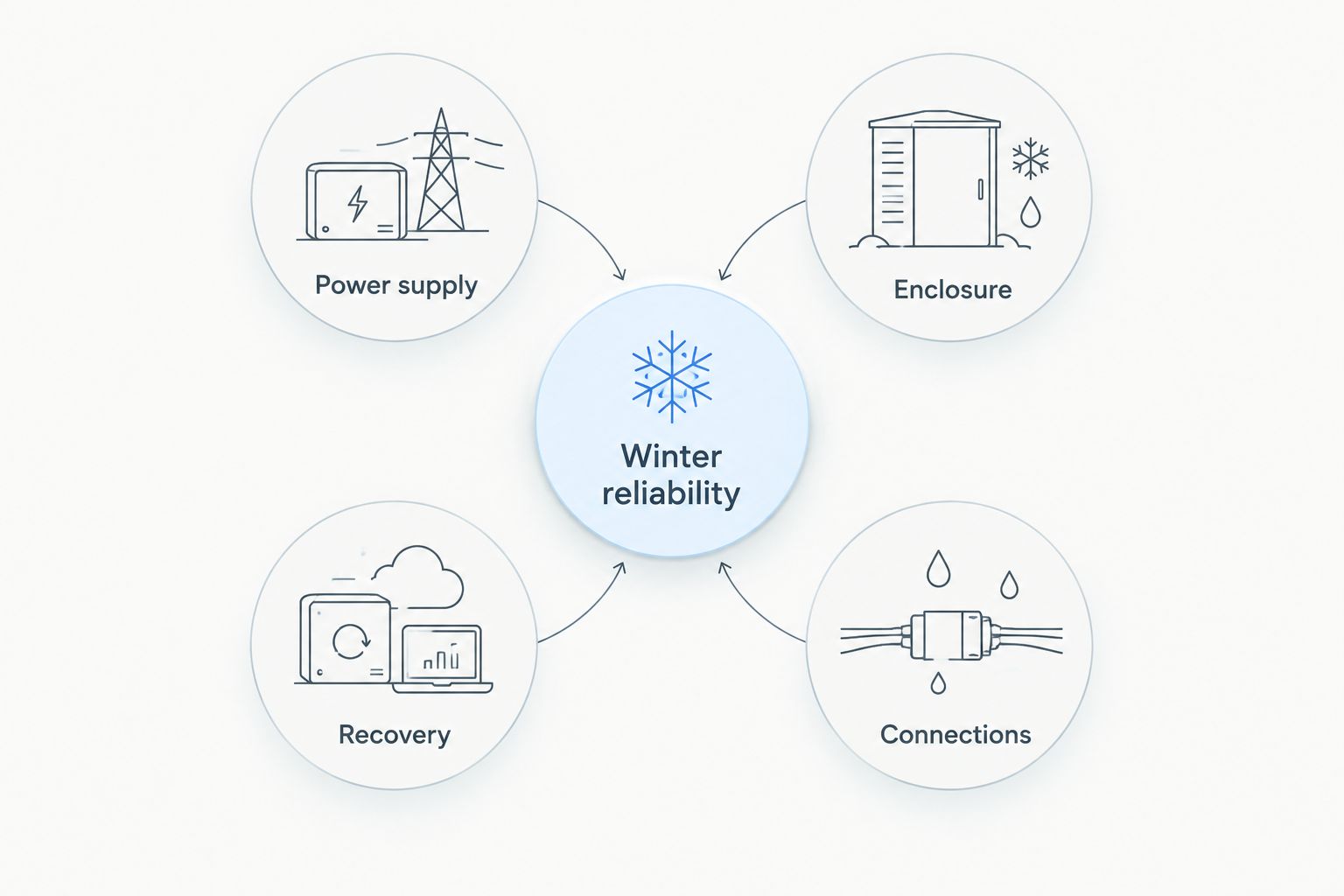
How should you protect power, enclosures, and connections?
Protecting a winter communication system means addressing several failure points together. Insulating a battery helps retain existing heat; it does not generate heat or guarantee that the battery remains within its permitted range.
Power supply
Check the complete supply path, including battery protection, regulators, adapters, and connectors. Verify the equipment's startup requirements as well as its normal operating requirements.
Do not assume that a power source suitable for steady operation will also handle startup or an attached heater. Include every powered accessory in the configuration you test.
Enclosure
Use an enclosure suited to the expected moisture and environmental exposure. An ingress-protection rating describes specified dust or water tests; it does not independently establish cold-start performance, battery suitability, or resistance to every freeze-thaw condition.
Avoid sealing equipment into an improvised enclosure without checking ventilation and manufacturer instructions. Thermal protection must not create a separate overheating or moisture problem.
Connections
Inspect connector seating, seals, protective covers, and cable strain relief. Route cables so movement, packed snow, or handling does not pull on the connection.
Use the cable manufacturer's temperature and handling limits. A cable that carries a signal when stationary still needs suitable flexibility if you expect to move or coil it in cold conditions.
Recovery
Plan how equipment returns to service after a shutdown or a move indoors. Cold surfaces can collect condensation when exposed to warmer, humid air.
Follow the manufacturer's acclimation guidance before opening equipment or applying power where moisture is present. Do not treat visible surface dryness as proof that internal spaces are dry.
How do you test a winter communication setup before deployment?
Your 2026 acceptance test should reproduce the intended configuration and task within the equipment's documented limits. A warm-device demonstration outside does not establish performance after the system has cooled throughout.
Use a controlled environment and suitable procedures. Do not improvise environmental testing with food-storage appliances, unsafe heating arrangements, or conditions prohibited by the manufacturer.
- Record the configuration. List the radio, battery, power source, charger, antenna, cables, software settings, and required destination.
- Establish a baseline. Verify successful communication under ordinary conditions before adding cold exposure.
- Allow thermal stabilization. Follow the relevant test procedure so the equipment reaches the intended condition rather than testing only a cold exterior.
- Complete the mission task. Deliver the actual message type, telemetry, voice connection, or data session your operation requires.
- Exercise failure recovery. Test an approved shutdown and restart, battery replacement, and loss of the primary connection.
- Record the outcome. Note temperature, equipment state, delivery success, unexpected shutdowns, and the actions needed to recover.
Define acceptance before testing. For emergency messaging, that includes recipient confirmation; for remote monitoring, it includes the reading reaching the destination that operators use.
Keep a configuration that passes; change or reject a configuration that fails. A successful result with a different battery or shorter cable does not validate the original arrangement.
Can you keep communication batteries inside your jacket?
Keeping a portable battery closer to body warmth can reduce its exposure to cold, but only use arrangements permitted by the equipment manufacturer. Protect terminals from short circuits, keep connections dry, and avoid cable routing that creates snagging or movement hazards.
This technique does not validate an outdoor charging arrangement or protect unattended relay nodes. Fixed installations need their own thermal and power design.
Does snow stop off-grid communication?
Snow does not create a universal cutoff for off-grid communication. The outcome depends on the radio system, frequency, antenna arrangement, path, and whether snow or ice affects the installation.
Inspect the physical setup as well as the signal. A buried antenna, damaged mount, or snow-covered power source creates a different problem from radio propagation through snowfall.
Can a backup connection share the same battery?
A backup connection can share a battery, but that battery becomes a common failure point. If it shuts down, both communication paths lose power together.
For your 2026 resilience plan, identify shared power supplies, antennas, gateways, and receiving endpoints. A second network path is not an independent backup when the failure you are planning for disables both paths.
FAQ
Can off-grid communication hardware work in extreme cold?
Yes, off-grid communication hardware can work in extreme cold when every required component operates within its documented limits. Check the radio, battery, power supply, accessories, and receiving endpoint, then test actual message delivery.
Can I charge a communication device below freezing?
Charge below freezing only when the battery and charging system explicitly permit it. Operating limits and charging limits are different, and conventional lithium-ion batteries can suffer damage from charging outside their permitted temperature range.
Does a waterproof rating mean a radio is cold-proof?
No, a waterproof rating does not establish cold-weather suitability. Check operating temperature, battery limits, connectors, and the manufacturer's environmental instructions separately.
Is satellite communication better than mesh in extreme cold?
Satellite communication is not inherently better than mesh in extreme cold. Choose satellite for the connection path you need and compare the environmental specifications of the actual equipment.
Will insulation keep an off-grid battery warm overnight?
Insulation slows heat transfer but does not generate heat. Whether the battery remains within its permitted range depends on its starting temperature, surroundings, heat generation, and thermal design.
Does HeliosNet LLC offer off-grid communication infrastructure?
HeliosNet LLC develops decentralized mesh, LTE, and satellite communication infrastructure. Confirm environmental specifications for the exact hardware configuration before selecting equipment for extreme cold.
One last thing
Test the receiver as carefully as the transmitter. A field device can remain powered and connected while the remote gateway, dispatch endpoint, or monitoring station has already failed.
Put recipient confirmation into your winter checklist. That final check distinguishes a device that appears functional from a communication system that completes its job.