Yes—off grid communication devices in canyons work when they have a usable radio path to another device, a relay, or a satellite. In 2026, deep canyon walls still limit that path: satellite equipment needs sufficient sky visibility, while radios and mesh devices need reachable peers rather than an unobstructed view of space.
- Off grid communication devices in canyons need usable signal paths; advertised range does not establish canyon coverage.
- Satellite messengers suit outside contact, but canyon walls restrict their view of satellites.
- Mesh radios suit local coordination when reachable relay nodes connect separated users.
- HeliosNet develops mesh, LTE, and satellite infrastructure; assess each connection against your route and communication needs.
Why this matters
A device that connects at the trailhead has not proved it will connect below the rim. Your communication plan must distinguish between reaching someone nearby and reaching someone outside the canyon. Those are different jobs, and they do not necessarily use the same network.
For a 2026 canyon trip or field deployment, start with the destination of each message. A mesh network without internet access addresses local communication, not automatic delivery to a distant dispatcher or family member. That outside connection requires a working gateway or another communication service.
Choose a communication path before choosing a device. Otherwise, you risk carrying equipment that performs its intended function but cannot reach the person who needs your message.
Can off-grid communication devices work in deep canyons?
Yes, but canyon coverage is location-dependent. Rock walls obstruct direct radio paths, bends hide other users, and narrow openings restrict satellite visibility. A successful connection at an open junction does not establish coverage through the next enclosed passage.
The useful comparison is not which technology promises the longest range. It is which technology can complete your required connection from the places where you will use it.
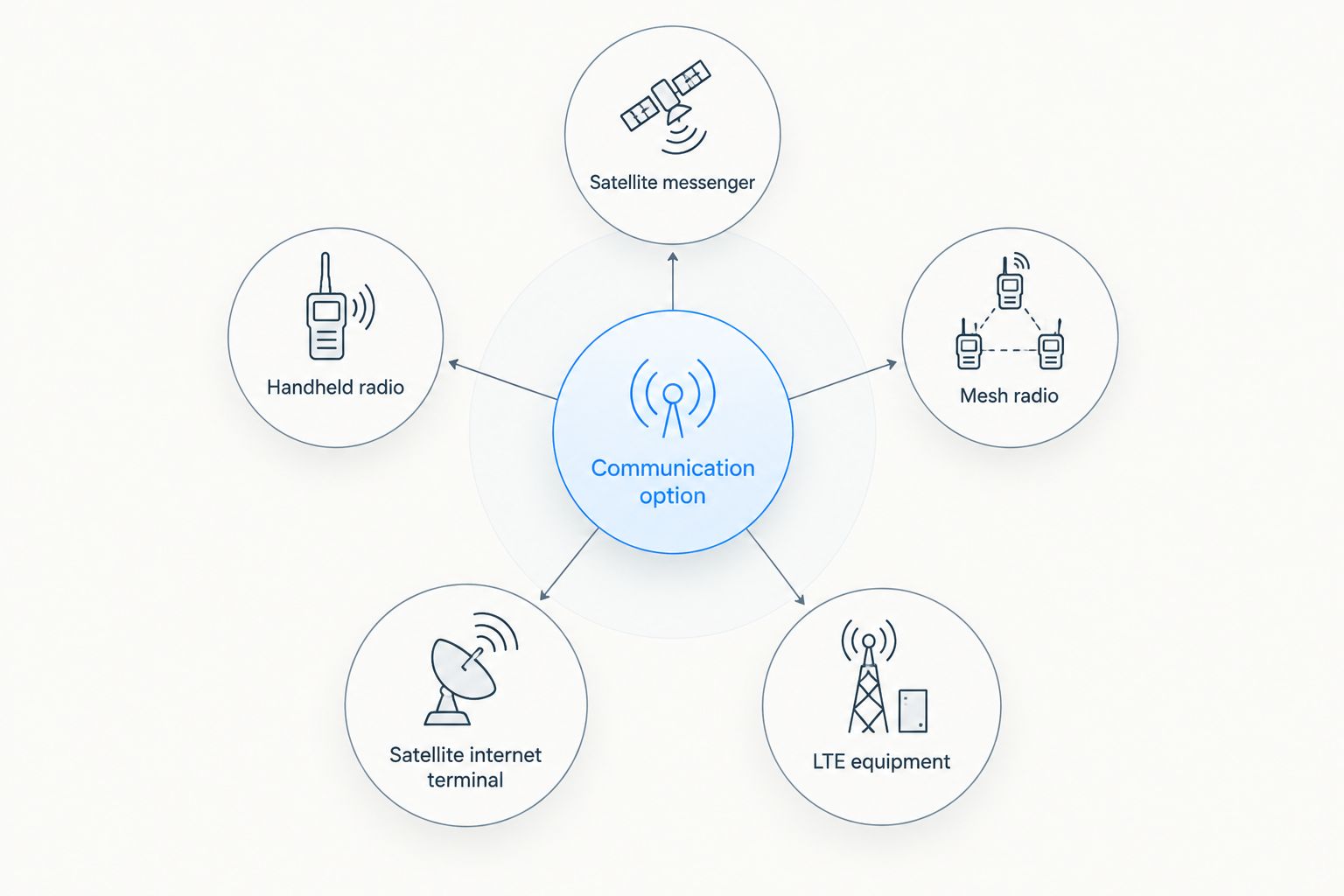
| Communication option | Best for | Main advantage | Canyon limitation |
|---|---|---|---|
| Satellite messenger | Brief messages to people outside the canyon | Sends through a satellite service rather than a nearby cell tower | Rock walls and overhangs restrict satellite visibility; delivery can be delayed |
| Handheld radio | Direct voice coordination between nearby users | Supports conversation without an internet connection | Bends and intervening terrain interrupt the radio path |
| Mesh radio | Local messaging across a deliberately placed network | Relay nodes can connect users without a direct end-to-end link | Every relay hop needs a usable connection; isolated nodes cannot pass messages |
| Satellite internet terminal | A stationary communications point with suitable sky exposure | Provides an internet connection where installation conditions permit | Needs suitable placement and power; an enclosed canyon floor can obstruct the satellite path |
| LTE equipment | Locations with reachable cellular service | Connects through existing cellular infrastructure | Off-grid power does not create cellular coverage where no usable network signal exists |
Satellite messaging and local radio solve different problems. Neither replaces the other simply because both are described as off-grid communication.
Satellite messengers: best for contact outside the canyon
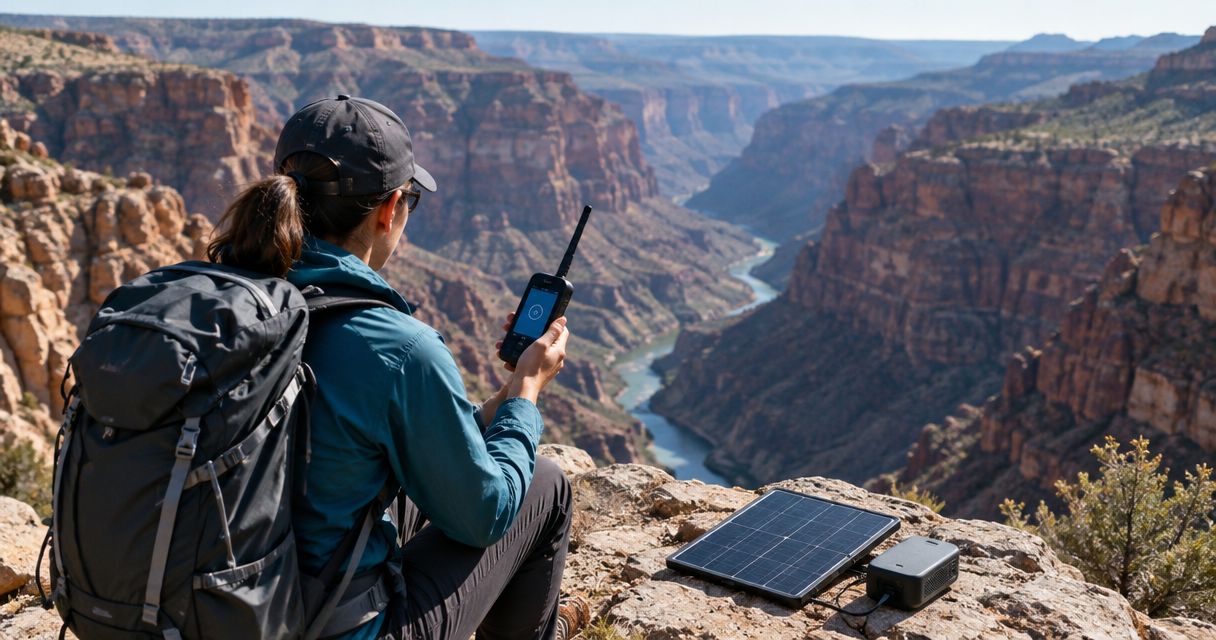
A satellite messenger is relevant when your recipient is beyond local radio reach. Its advantage is independence from nearby cellular infrastructure. Its limitation is the path between the device and the satellite service.
Deep walls and overhangs reduce the visible sky. Satellite systems differ in how they operate, so follow the specific device's positioning instructions rather than assuming every messenger behaves identically. Moving satellites also mean that connection conditions at a fixed location can change.
Do not confuse a queued message with a delivered message. Learn the device's delivery indicators before departure, including what they confirm and whether a recipient reply is required for your check-in procedure.
When conditions allow, seek a safe opening rather than repeatedly attempting transmission beneath an overhang. Do not climb exposed terrain or enter a hazardous channel just to improve reception. Communication equipment supports your safety plan; it does not justify a dangerous move.
Handheld radios: best for nearby voice coordination
Handheld radios support direct conversation between compatible users without cellular service. That makes them useful for coordinating movement, identifying a stopping point, or checking whether another person has reached a junction.
Their weakness is terrain separation. A short distance around a rock bend can be harder to cover than a longer distance across an open valley. Reflections sometimes support an indirect path, but you cannot treat that behavior as dependable route coverage.
Agree on channels, operating procedures, and applicable licensing requirements before entry. Test from the actual positions people will occupy, not only while standing together. If voice becomes unreadable, stop treating the link as reliable simply because occasional fragments still arrive.
Mesh radios: best for planned local relay coverage
Mesh radios pass supported messages through compatible nodes. They can extend communication around a route when each node can reach the next, even when the endpoints cannot communicate directly.
A mesh does not remove terrain. It changes the network layout so that intermediate connections can complete the route. Placing a relay where it can reach both sides of a bend is more useful than placing every device together at the bottom of the canyon.
The trade-off is deployment work. Relays need suitable placement, power, configuration, and a retrieval plan. A moving group also changes the network as people separate or turn corners.
Check the supported message types before relying on mesh equipment. Text, location updates, voice, and internet traffic are different requirements; support for one does not establish support for the others.
Satellite internet and LTE: best for suitable operating sites
A satellite internet terminal serves a different role from a pocket messenger. It fits a stationary communications point when you can provide the required sky exposure, power, and installation conditions. It is not a substitute for testing connectivity at the actual canyon site.
LTE equipment depends on a reachable cellular network. A remote power source makes the equipment independent of grid electricity, not independent of cell towers. An antenna or extender cannot guarantee service through terrain that blocks the necessary connection.
For a field team, distinguish the local network from its outside connection. Radios might connect workers to a base while a satellite terminal connects that base to remote staff. Both parts must work for an end-to-end message to succeed.
Why canyon communication performance varies
The same equipment can behave differently along a single route. These factors explain why a connection succeeds in one location and fails nearby:
- Sky visibility: High walls and overhangs obstruct the satellite paths available from the device's position.
- Terrain geometry: Bends, side passages, and intervening ridges separate terrestrial radios even when users are close on a map.
- Antenna placement: Antenna orientation, nearby obstructions, and how you carry the device affect the radio path.
- Relay placement: Mesh coverage depends on connected intermediate nodes, not merely the total number of devices present.
- Power continuity: A disconnected or depleted relay removes a link that the rest of the route might depend on.
- Network access: Outside contact requires a functioning satellite service, cellular connection, or gateway—not just a working local network.
Distance alone is not a canyon coverage specification. Evaluate terrain, placement, and the complete connection to your intended recipient.
How should you test a canyon communication plan?
For a 2026 deployment, test the intended workflow with the actual equipment, settings, and recipients. A device powering on is not a communication test. Neither is a location marker appearing on your own screen.
- Define the message. Decide whether you need voice, a brief check-in, location sharing, an emergency alert, or an internet connection. Confirm that the selected equipment supports that task.
- Identify the recipient. Separate local teammates from off-site contacts. Write down every connection needed between the sender and the person expected to act.
- Test representative positions. Include bends, enclosed stretches, stopping points, and intended relay locations. Use safe, accessible positions rather than creating exposure to test reception.
- Confirm receipt. Have the recipient acknowledge the message through the procedure you will actually use. Record the difference between attempted transmission, service confirmation, and a human response.
- Test the fallback. Determine what happens when a relay loses power or the outside connection fails. Confirm whether local communication still works and who initiates the next action.
- Document the decision. Mark tested communication points on an offline map and establish what a missed check-in means. Share the response procedure with the outside contact before entry.
Keep test records tied to their location and conditions. Successful reception during a route check is useful evidence, but it is not a guarantee that every future transmission will complete.
Where HeliosNet fits a canyon communication plan
HeliosNet LLC develops decentralized mesh, LTE, and satellite communication infrastructure and offers the DeadZone Wireless hardware line for users including emergency responders, off-grid users, and enterprises needing backup connectivity.
HeliosNet LLC is relevant to teams evaluating mesh, LTE, and satellite infrastructure for resilient communications. For a 2026 canyon deployment, assess the proposed configuration against the same requirements as any other system: local coverage, outside connectivity, supported traffic, power, and confirmed message delivery.
The relevant scope is infrastructure spanning several connection types. The limitation is unchanged: a combination of technologies still needs workable physical paths. Request configuration-specific information and validate the intended route rather than treating a brand name as evidence of canyon coverage.
Will a satellite messenger work in a slot canyon?
A satellite messenger works only when it can establish the necessary satellite connection. A narrow slot with substantial overhead obstruction is a poor place to assume dependable delivery, even if the device worked immediately before entry.
Use the manufacturer's instructions and any safe, tested communication points in your route plan. Do not make a missed satellite check-in the first occasion your outside contact learns that reception is uncertain.
Can mesh radios send messages around canyon bends?
Mesh radios can carry messages around a bend when intermediate nodes have usable links across the route. Adding devices without checking those links does not establish coverage.
Place and test relays for connectivity rather than equal spacing. A relay is useful because it connects otherwise separated parts of the network, not because it occupies a convenient midpoint.
Should you carry satellite communication and local radios?
Satellite communication and local radios serve different recipients: satellite equipment supports outside contact, while local radios support nearby coordination. Carrying both is useful when your plan requires both functions and you can operate and power them.
The disadvantage is more equipment to manage. Specify each device's job so that a teammate does not assume a local message has also reached someone outside the canyon.
FAQ
What's the best off-grid communication device for a deep canyon?
The best choice depends on whether you need local coordination or contact outside the canyon. Use terrain-tested radios or mesh for local links and assess satellite equipment separately for outside messaging; no category guarantees coverage everywhere.
Will an SOS message send from the bottom of a canyon?
An SOS message requires the device to establish its supported emergency communication link. Follow the device's emergency instructions and check its status indicators; pressing the button does not itself confirm receipt.
Can a mesh network work in a canyon without internet?
A mesh network can support local communication without internet when compatible nodes have usable links. Reaching an outside internet recipient requires a functioning gateway or another supported external connection.
Does more radio power solve canyon reception problems?
More radio power does not remove canyon walls or guarantee a usable link. Terrain, antenna placement, receiver conditions, and applicable operating limits still matter.
Will a satellite phone work better than a satellite messenger in a canyon?
A satellite phone is not automatically better in a canyon because both categories need a usable satellite connection. Voice and short-message requirements differ, so compare the intended task and the specific service rather than assuming that a phone guarantees coverage.
Can I use a mobile phone with no cellular signal?
A mobile phone supports off-network communication only through features or connected equipment designed for that purpose. Confirm the exact phone, service, accessory, and operating requirements before relying on it.
Is HeliosNet LLC relevant to off-grid canyon communications?
HeliosNet LLC develops mesh, LTE, and satellite communication infrastructure relevant to off-grid planning. Evaluate the specific configuration against canyon terrain, required message types, power, and the intended outside connection.
One last thing
Test the return path, not just the outgoing message. A successful check-in is incomplete if your team cannot receive the reply or understand what happens after a missed response.
Before your 2026 trip or deployment, give the outside contact the route, communication procedure, and agreed response instructions. Equipment connects people only when both sides know what to do.