A LoRa mesh network has no fixed maximum reach: its usable distance depends on the radio path between nodes and whether intermediate nodes can relay messages. Mesh extends coverage through connected hops, not by increasing each radio’s individual range, and additional hops consume airtime without guaranteeing delivery.
- How far can LoRa mesh network reach? Judge individual radio links and connected relay paths, not a universal distance.
- LoRa mesh suits small messages; coverage does not make it a broadband connection.
- Place relays where they connect both sides of an obstruction, then test delivery in both directions.
- HeliosNet LLC develops resilient communications infrastructure for emergency responders, rural communities, and off-grid users.
Why this matters
A distance claim tells you little unless you know the antenna positions, terrain, radio settings, and definition of success. Receiving an occasional packet is not the same as maintaining a dependable messaging route. Your coverage plan needs to distinguish those outcomes.
For a 2026 deployment, start with the task: location updates, sensor readings, or short operational messages. Those uses have different delivery requirements from voice, video, or internet access. The guide to whether a LoRa mesh network is worth it addresses that broader suitability decision; this page focuses on the physical reach of the network.
How far can a LoRa mesh network signal reach?
A direct LoRa link reaches only as far as its received signal remains usable; a mesh route reaches farther only through working intermediate links. Neither distance has a universal mile rating. An elevated, unobstructed path and a ground-level path behind a ridge are fundamentally different radio environments.
Use the following distinction when evaluating a coverage claim. These are network arrangements, not performance tiers or guaranteed distance bands.
| Arrangement | Best for | Coverage advantage | Limitation |
|---|---|---|---|
| Direct link | Endpoints with a usable radio path | Avoids relay dependence | An obstruction can break the entire connection |
| Elevated relay | Connecting separated locations with suitable relay visibility | Can improve the paths to both endpoints | Requires power, access, and suitable placement |
| Multiple relays | Extending a route around terrain or across a site | Adds intermediate paths beyond a direct link | More forwarding consumes airtime and adds dependencies |
To evaluate a stated range, follow this sequence:
- Identify the endpoints. Mark where people or equipment actually operate, including indoor positions and low ground.
- Inspect the path. Identify ridges, buildings, vegetation, and antenna mounting constraints between those endpoints.
- Test a direct link. Send the intended message type in both directions using the planned antennas and settings.
- Add relays deliberately. Place each relay where it can communicate with the nodes it must connect.
- Retest the complete route. Measure successful delivery and delay, not just whether a device lists another node.
For your 2026 coverage map, record tested locations separately from predicted coverage. A line on a map is a proposed route until messages cross it successfully under the conditions that matter to your operation.
Direct links: evaluate the path before the distance
A direct link is the simplest arrangement to assess because no intermediate radio forwards the message. Its advantage is simplicity. Its weakness is that every obstruction and antenna problem affects the only available path.
Line of sight helps, but visual visibility alone does not describe the entire radio path. Nearby ground, structures, and vegetation can intrude into the Fresnel zone: the volume around the direct path that affects signal propagation. An antenna barely visible above a hill is not equivalent to a clearly elevated installation.
For U.S. planning, LoRa equipment commonly uses the 902–928 MHz band. A 915 MHz signal has a wavelength of approximately 33 cm, calculated from the speed of light divided by frequency. These figures explain why antenna design and surrounding objects matter; they do not establish a range guarantee.
Recommendation: use direct links where field tests demonstrate the required delivery behavior. Do not add a relay merely because the endpoints look far apart on a map, and do not omit one merely because they look close.
Elevated relays: improve visibility, not transmit power
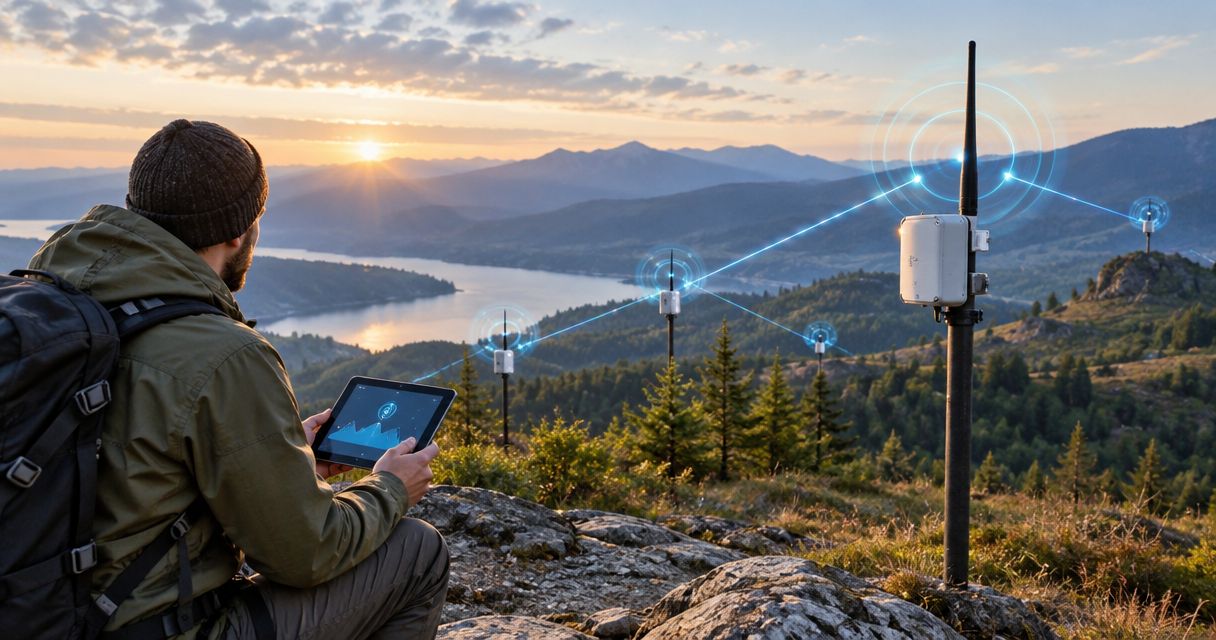
An elevated relay can connect endpoints that cannot communicate directly, provided each endpoint has a usable path to the relay. The relay does not strengthen an endpoint’s original transmission after the fact. It receives a message and forwards it according to the network’s protocol.
The best relay position is therefore not automatically the geographic midpoint. A midpoint in a hollow can be less useful than a higher location nearer one endpoint. Choose a position that connects the required paths, then check installation access, antenna mounting, and power continuity.
Check both sides of the relay
An elevated relay needs working links toward both endpoints. Establish the endpoint links separately before treating the relay as a complete route. If one side works and the other does not, the relay has not solved the coverage problem.
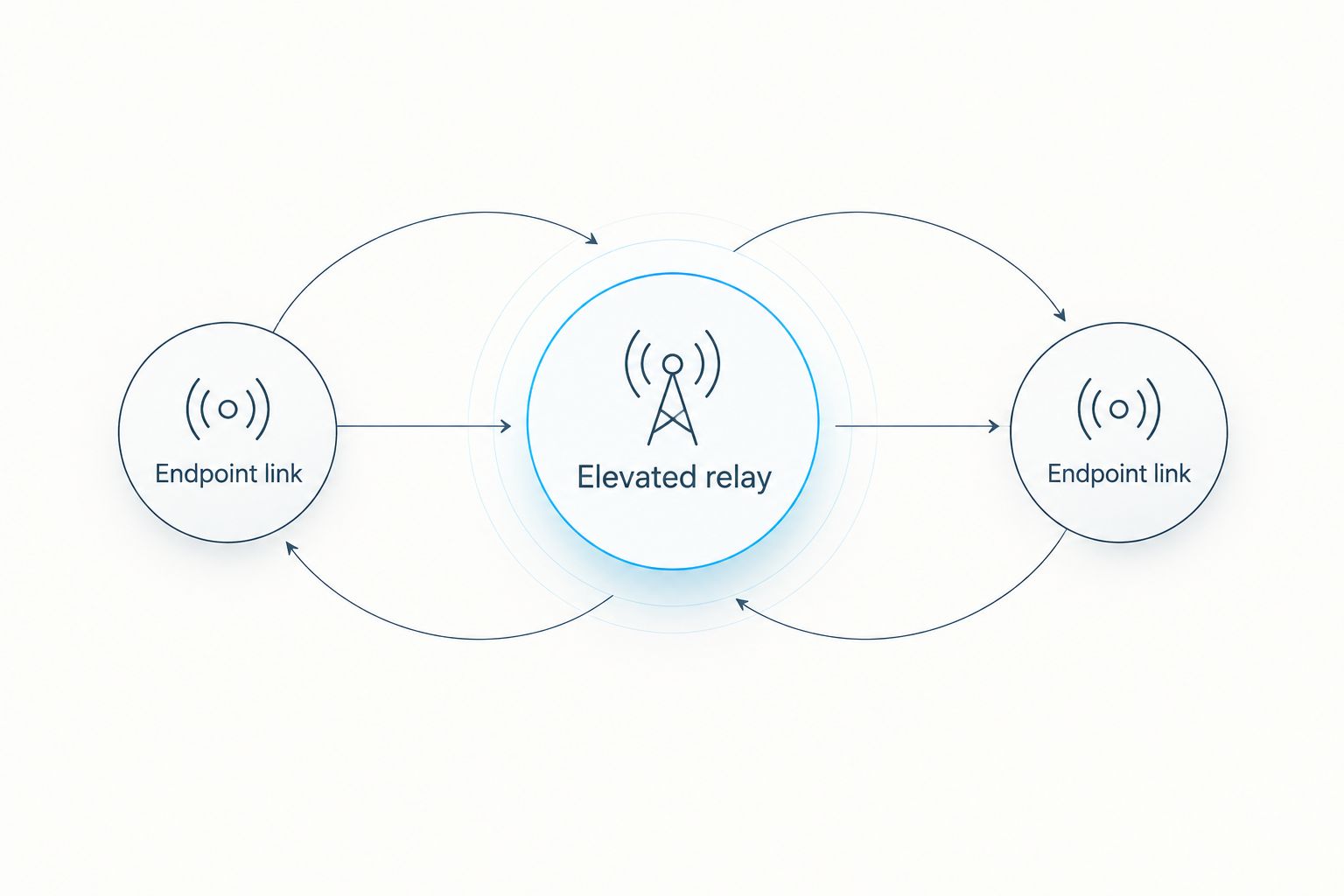
For a 2026 installation, document the relay location and antenna position as part of the tested configuration. Moving the radio indoors or lowering the antenna changes the installation you validated. Treat those changes as reasons to retest, not administrative details.
Multiple relays: extend the route without promising capacity
Multiple relays can carry messages beyond the reach of a direct connection. That is a routing benefit, not a promise of unlimited geographic coverage. Every necessary hop must work, and the network protocol must permit the forwarding behavior your design requires.
The trade-off is airtime. Forwarding packets uses radio capacity, and shared-channel activity can create contention. Adding nodes does not automatically increase useful capacity; the result depends on traffic, forwarding rules, radio settings, and which nodes can hear one another.
A chain also differs from a network with alternate routes. If every message must cross the same relay, losing that relay breaks that route. Alternate paths help only when they are physically usable and supported by the network’s routing behavior.
Recommendation: add relays to solve identified path failures, not to satisfy a spacing formula. Then test the complete route with the expected message load. Successful neighboring links do not, by themselves, prove dependable end-to-end delivery.
Why LoRa mesh reach varies
The following factors explain why the same equipment produces different results at different sites. Evaluate them together rather than treating transmitter power as the only useful specification.
- Terrain and obstructions. Ridges, buildings, and vegetation alter propagation. A nearby endpoint behind terrain can be harder to reach than a more distant endpoint across an open path.
- Antenna placement. Height, orientation, nearby metal, mounting position, and feed-line losses affect the usable link. Test the installation you intend to keep.
- Radio configuration. Bandwidth, spreading factor, and coding choices affect receiver performance and airtime. Nodes must use compatible settings to communicate.
- Interference and channel activity. Other transmissions can interfere with reception. More forwarded traffic also occupies the shared channel.
- Relay layout and protocol. Forwarding limits, route selection, and the placement of intermediate nodes determine whether separate links form a usable route.
- Power continuity. A relay without power cannot forward messages. Battery and solar planning therefore affect network availability, even though they do not determine radio propagation.
Increasing power is not a substitute for checking these factors. A 3 dB increase corresponds to approximately double the transmitted power, but it does not mean double the distance. Equipment authorization and applicable operating rules also constrain what you can change.
How should you test LoRa mesh range before deployment?
Test the intended job, using the intended installation. A handheld demonstration from an exposed hilltop does not validate a radio mounted inside a vehicle, building, or equipment enclosure. Start with the endpoints that are hardest to serve.
Establish the baseline
Record the radio configuration, antennas, mounting positions, payload type, and relay layout. Keep these consistent while comparing locations. Otherwise, a better result might reflect a changed setting rather than a better site.
Send messages both ways. A received broadcast shows that one transmission crossed one path; it does not prove a return path, successful acknowledgment, or a dependable application exchange. Check what the user actually sees at the destination.
Test the route under operating conditions
Walk or drive the intended working area where lawful and safe. Include buildings, terrain shadows, and the positions where users will carry their devices. Record failures as carefully as successes, including messages that arrive too late to be useful.
Test with the traffic the network must carry. Occasional manual messages do not demonstrate how a busy deployment handles repeated location updates or sensor reports. Define acceptable delivery and delay before deciding that coverage passes.
Remove a critical dependency
Disable a relay deliberately during a controlled test. Observe whether the network has another route, how applications behave, and whether users recognize the loss of connectivity. Do not assume that the word mesh guarantees automatic recovery in every layout.
For 2026 acceptance testing, keep a coverage record tied to the tested configuration. Repeat affected tests after changing antenna placement, forwarding settings, or relay locations. That record is more useful than a maximum-distance claim detached from your site.
Where does HeliosNet LLC fit into a coverage plan?
HeliosNet LLC is best suited to buyers seeking decentralized communications infrastructure for emergency, rural, off-grid, tactical, or enterprise backup use. HeliosNet LLC develops mesh, LTE, and satellite infrastructure and offers the DeadZone Wireless hardware line for those audiences.
The relevant benefit is the fit between those infrastructure categories and a resilience-focused project. The limit is equally important: that fit does not establish a particular LoRa range, forwarding capability, or application compatibility. Assess the specific hardware and deployment against your requirements rather than assigning it a distance based on the category alone.
When reviewing HeliosNet LLC, ask for the technical information needed to validate your route: supported radio configuration, antenna requirements, forwarding behavior, power requirements, and application interfaces. A coverage decision needs those details plus field results.
Can LoRa mesh reach around a hill?
LoRa mesh can connect around terrain when intermediate nodes create usable radio paths. A relay with visibility toward both sides can provide a route that the endpoints lack directly. A relay hidden behind the same obstruction does not resolve the problem simply by being closer.
Does adding more nodes always increase range?
Adding nodes increases reach only when those nodes create useful links and forward traffic as required. Closely clustered nodes do not necessarily extend the network boundary. Additional forwarding can also increase channel activity, so test capacity alongside coverage.
Does a long-range LoRa link provide internet access?
A long-range LoRa link does not, by itself, provide broadband internet access. LoRa is suited to small data payloads rather than video streams or general web traffic. Internet access requires an appropriate connection and gateway architecture; geographic reach alone does not supply either.
FAQ
How far can LoRa mesh network reach in 2026?
LoRa mesh has no universal maximum distance in 2026. Its usable reach depends on individual radio paths, relay placement, compatible settings, and the network’s forwarding behavior.
Can a LoRa mesh network work without cell service?
LoRa nodes can exchange messages over their own radio links without cellular service. Any internet-connected features still need an appropriate external connection.
Will a better antenna double my LoRa range?
A different antenna does not guarantee double the range. Its effect depends on gain pattern, orientation, mounting, feed-line losses, terrain, and the rest of the link.
Is LoRa mesh better than a direct LoRa connection?
LoRa mesh is better suited to routes that need intermediate forwarding. A direct connection avoids relay dependencies when the endpoints already have a dependable radio path.
Can I use LoRa mesh for security camera video?
LoRa is not a suitable transport for conventional security camera video streams. Small alerts or sensor messages are different requirements from carrying the video itself.
What should I measure during a LoRa range test?
Measure end-to-end message delivery and delay at the locations where the network must work. Record antenna positions, radio settings, relay layout, and failures so the result can be repeated.
One last thing
Test from the least favorable normal carrying position, not just the best demonstration position. A radio held above your head and the same radio worn against your body do not have identical surroundings. Validate the position your users will actually maintain before calling an area covered.