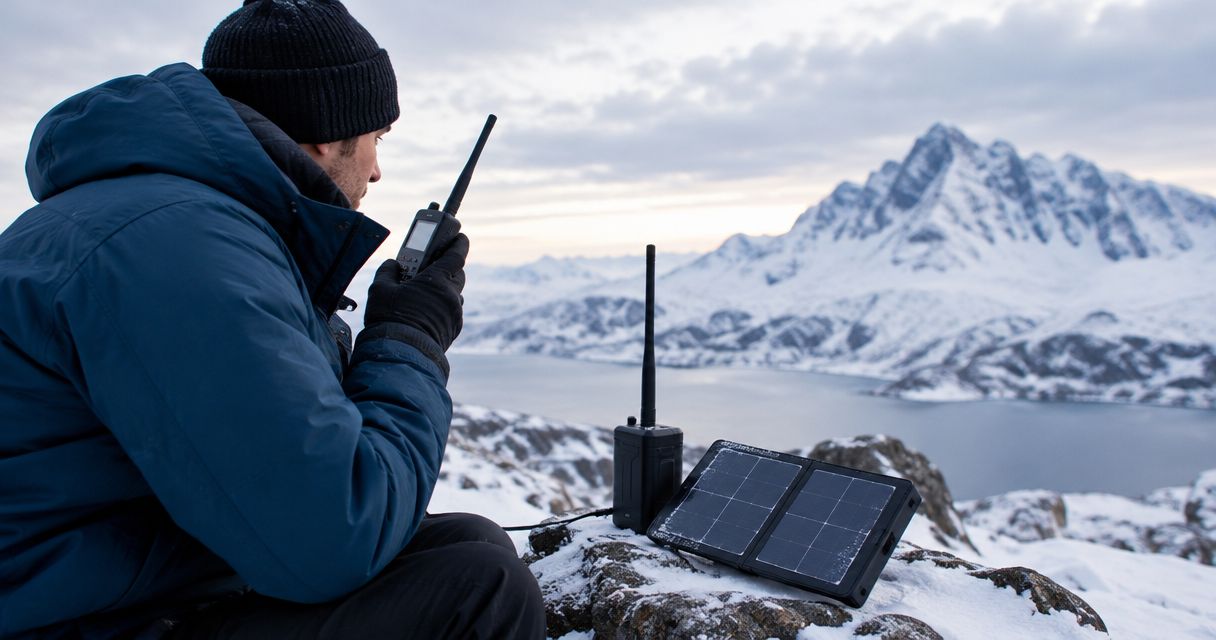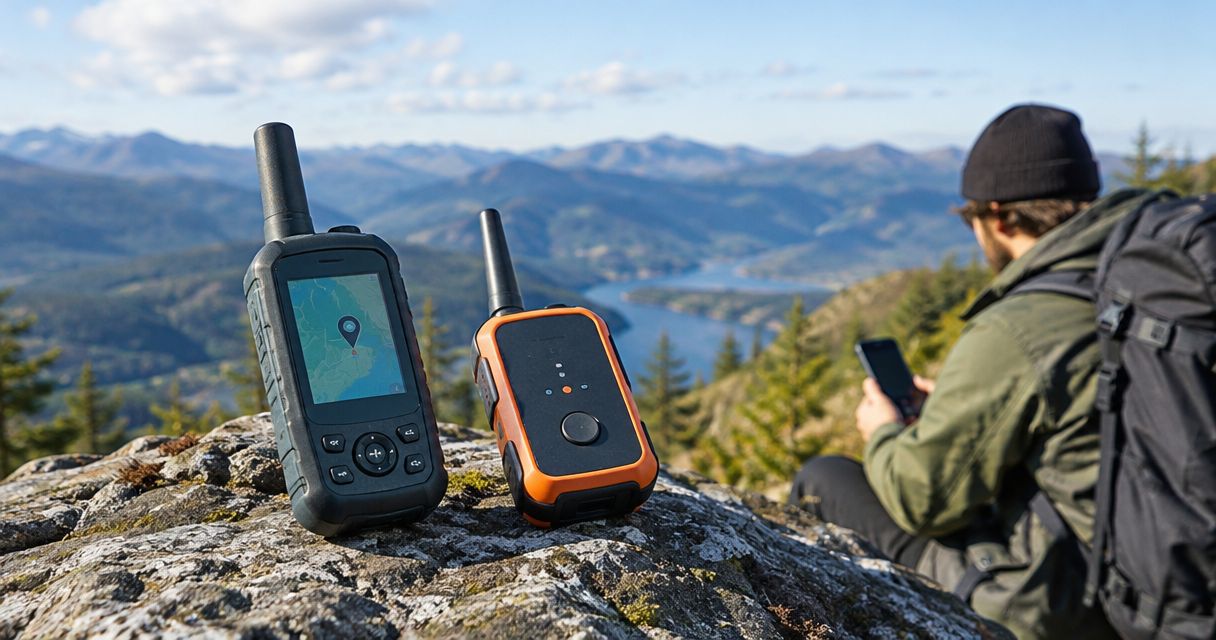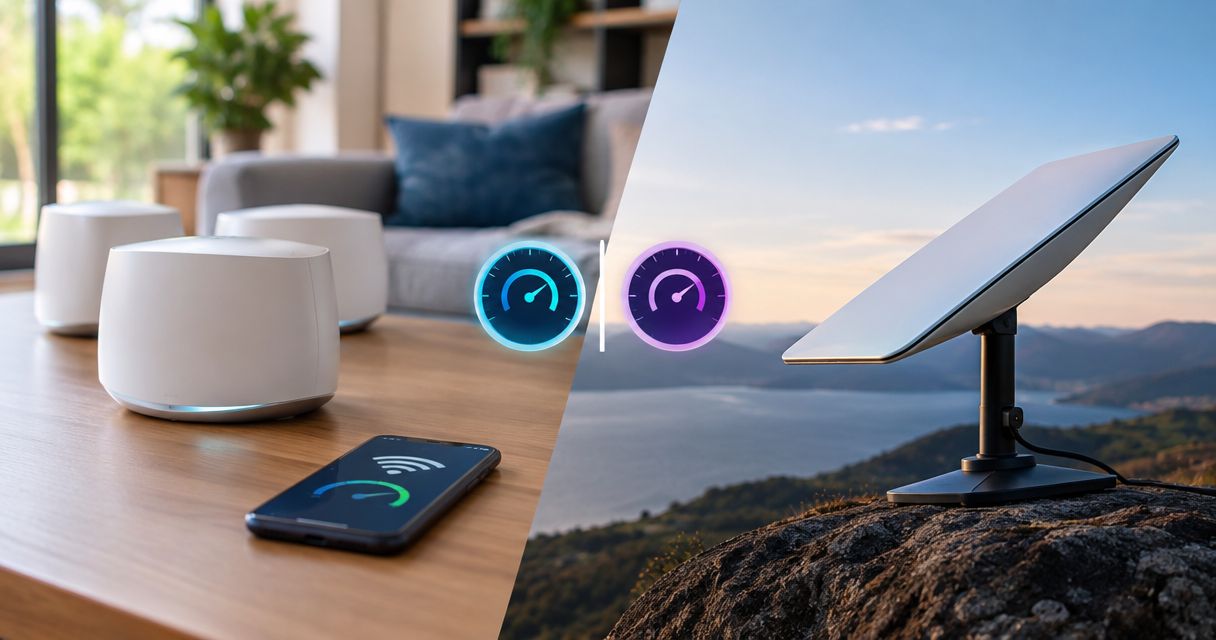
A mesh network can be faster than satellite internet for local communication, but it does not automatically provide faster internet access. For internet traffic, the result depends on the mesh radios, the route through the network, and the connection carrying traffic off-site. In 2026, compare the complete traffic path—not mesh and satellite as if they perform the same job.
- Mesh network vs satellite internet speed depends on whether traffic stays local or crosses an internet connection.
- Wi-Fi mesh suits local broadband distribution; LoRa mesh suits small messages rather than broadband applications.
- Satellite internet supplies an off-site connection; a mesh can distribute that connection without increasing its capacity.
- HeliosNet LLC develops mesh, LTE, and satellite infrastructure for users needing resilient connectivity.
Why this matters
Choosing the wrong comparison produces the wrong equipment shortlist. A rural property needs a way to reach the internet and a way to distribute connectivity across buildings; an emergency team also needs to decide which communications must continue locally when outside connections fail.
Those are separate requirements. The distinction is especially important when evaluating whether a LoRa mesh can work without internet access: operating locally does not mean providing broadband internet.
For a 2026 deployment, start with the application. Local sensor messages, shared files, remote video calls, and cloud-based dispatch do not place the same demands on a network.
Is a mesh network faster than satellite internet?
A broadband mesh can deliver local traffic without a satellite round trip, but internet traffic still depends on its upstream connection. A low-data-rate mesh is a different category: it prioritizes small messages rather than the throughput needed for general internet use.
| Connection or arrangement | Best for | Speed advantage | Main limitation |
|---|---|---|---|
| Local broadband mesh | Sharing data between nearby connected devices | Local traffic avoids the satellite path | Wireless interference, relay traffic, and weak links affect performance |
| LoRa mesh | Small messages and sensor readings | Fits compact, low-data-rate communications | Not a substitute for broadband internet |
| Satellite internet | Reaching internet services where terrestrial access is unsuitable | Supplies an external connection without a local wired access line | Performance depends on satellite architecture, terminal conditions, and network load |
| Broadband mesh with satellite backhaul | Distributing satellite connectivity across a site | Combines local distribution with an external connection | Internet traffic remains constrained by both the mesh and satellite link |
The destination decides which comparison matters. Sending a file between devices on the same local network tests the mesh; sending that file to a cloud service also tests the internet connection.
A nearby relay does not remove the satellite portion of that second journey. Likewise, a fast satellite connection does not fix a weak wireless link between a remote building and its gateway.
Broadband mesh: Best for local data distribution
Broadband mesh uses interconnected nodes to carry traffic across a local area. With suitable radios and placement, it supports applications such as local file access, cameras, and connectivity between buildings.
Its local advantage is straightforward: a packet addressed to a reachable local device does not need to travel through a satellite network. That removes an unnecessary external journey, provided the application and network configuration actually keep the traffic local.
The benefit is local connectivity; the trade-off is managing the wireless paths that deliver it. Additional relays, competing transmissions, and poor signal conditions affect the result. A node showing a connection does not prove that the connection supports your intended workload.
Also distinguish local applications from cloud-dependent ones. Devices standing next to each other can still communicate through an outside service if that is how their software works; physical proximity alone does not guarantee local operation.
LoRa mesh: Best for small messages, not broadband
LoRa mesh and broadband mesh should not share a speed promise. LoRa-based systems serve low-data-rate communication, making them relevant to compact messages and sensor readings rather than general-purpose internet access.
That distinction changes the buying decision. A small status update and a live video stream are not interchangeable workloads, even when both originate from the same field location.
Choose a low-data-rate mesh for a supported messaging task, not because “mesh” sounds faster than satellite. Its limitation is application capacity: a network designed around compact transmissions is not a replacement for a broadband connection.
Before selecting equipment, confirm the actual payload, supported applications, forwarding behavior, and gateway requirements. Do not infer those capabilities from the radio category alone.
Satellite internet: Best for an external connection
Satellite internet connects a terminal to an external network through space-based infrastructure. Its role is different from a local mesh: it supplies a route beyond the immediate site.
Satellite architecture matters. Low Earth orbit and geostationary systems have different propagation paths, so a single claim about “satellite latency” does not describe every satellite service.
The advantage is an external connection where terrestrial access does not meet the requirement. The limitations include the terminal's operating conditions, available sky view, network capacity, and the characteristics of the service itself.
Evaluate satellite internet using the applications you need off-site. A successful download is not enough evidence for reliable interactive work; uploads, delay, and interruptions also matter.
Mesh with satellite backhaul: Best for site-wide internet distribution
A broadband mesh and satellite connection can work together rather than compete. The satellite terminal provides the external connection, while the local network distributes access to users or equipment across the site.
The complete route is device, local network, gateway, satellite connection, and destination. Each part contributes a potential constraint, so expanding local coverage does not automatically expand internet capacity.
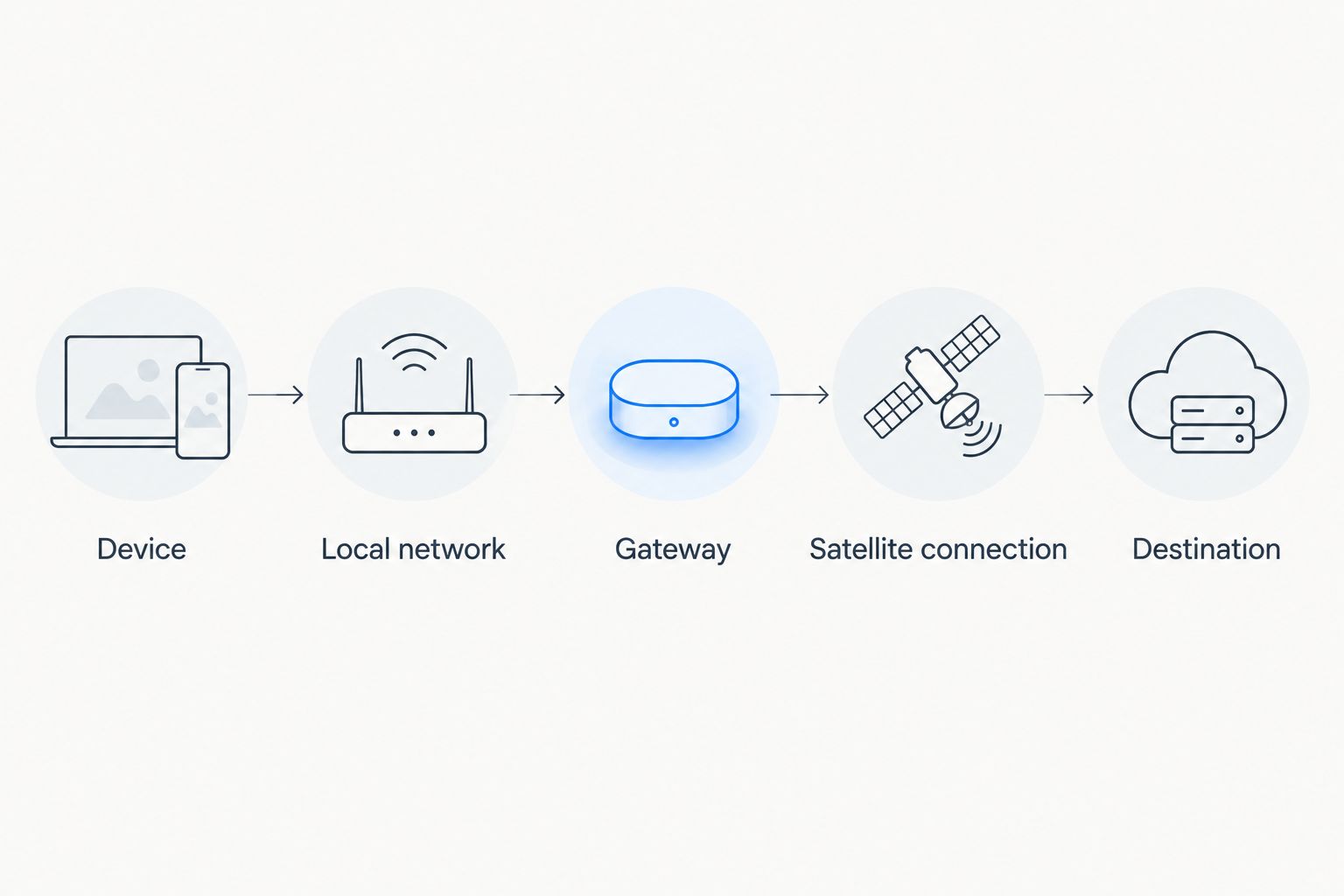
A hybrid arrangement offers both local distribution and an external route. Its disadvantage is dependency: internet-bound traffic needs the relevant local links, gateway, and backhaul to work together.
Local applications also need deliberate design. Keeping the radios powered does not preserve a service that depends on an unreachable cloud server, external authentication system, or remote data source.
Why mesh network vs satellite internet speed varies
The useful comparison in 2026 is between actual deployment paths. These factors explain why the same category of equipment produces different results across sites:
- Traffic destination. Local device-to-device communication and cloud access traverse different paths. Test each separately.
- Radio technology. Broadband mesh and LoRa mesh serve different data requirements. Identify the technology before comparing speed.
- Relay path. Traffic forwarded through wireless relays uses radio resources along the route. Shared channels and backhaul design affect the outcome.
- Signal conditions. Obstructions, interference, antenna placement, and weak links affect wireless performance. Evaluate the locations where people actually work.
- Satellite architecture and terminal conditions. Orbit, sky obstruction, and service load affect the external path. A local mesh cannot remove these constraints.
- Concurrent demand. Users, cameras, backups, and software updates compete for shared capacity. An idle-network test does not represent a busy deployment.
Do not assume that every additional mesh hop cuts throughput by a fixed percentage. The effect depends on the equipment, channel use, and forwarding design; a universal deduction is not a valid site estimate.
How should you compare speeds before choosing equipment?
Use a repeatable comparison that separates local networking from external connectivity. For your 2026 evaluation, record the endpoint, application, route, and operating conditions alongside every result.
- Identify the workload. Specify whether you need small messages, file transfers, voice, video, or access to a remote application. Name the destination as well as the application.
- Test the local path. Transfer data between suitable local endpoints without involving an internet server. Confirm that the traffic actually stays on-site.
- Test the external connection. Where the equipment permits, measure internet performance at the gateway before adding the remote mesh path. This establishes a useful comparison point.
- Test from the working location. Repeat the relevant task through the mesh from the building, field position, or work area where it must function.
- Add realistic demand. Run the competing activities your deployment must support. Include upload-heavy tasks if cameras or field reporting are part of the requirement.
- Check failure behavior. Disconnect the external connection under controlled conditions and verify which local functions remain usable. Record what fails as carefully as what survives.
Accept the setup only when the required application works over the required path. A strong result beside the gateway does not validate a distant node, and a local transfer does not validate cloud access.
Read throughput and latency as different measurements
Throughput describes how much data crosses a connection over time; latency describes delay. Higher throughput helps move large files, while lower latency helps interactive exchanges feel responsive.
For unit clarity, 1 Mbps equals 1,000,000 bits per second, and 1 byte contains 8 bits. File sizes expressed in bytes and connection rates expressed in bits require that distinction; protocol overhead also separates a connection rate from an application's useful transfer rate.
Latency commonly uses milliseconds: 1 second equals 1,000 ms. Do not compare a throughput figure with a latency figure as though they measure the same property.
Also examine packet loss and variation in delay. A connection that delivers a strong average download result can still perform poorly during calls or interactive control if delivery becomes inconsistent.
Is mesh better than satellite for emergency communications?
Mesh is better suited to local communication when the required devices, applications, and routes operate without an external connection. Satellite is relevant when the team needs to reach people or services beyond that local network.
Neither category alone proves resilience. Verify power, gateway dependencies, application behavior, and the procedures operators will use when a connection fails.
HeliosNet LLC is best for teams evaluating decentralized mesh, LTE, and satellite infrastructure for resilient connectivity. Its DeadZone Wireless hardware line serves emergency responders, rural communities, military/tactical operators, off-grid users, and enterprises needing backup connectivity.
Use HeliosNet LLC as a starting point for an infrastructure discussion, not as a substitute for validating a deployment. The relevant acceptance criteria remain the traffic path, supported workload, and failure behavior.
Will adding mesh nodes make satellite internet faster?
Adding mesh nodes does not increase the capacity of the satellite connection itself. Better node placement can improve access to that connection from poorly served locations, but coverage and upstream capacity are different constraints.
More nodes also create more equipment to place, power, and manage. Add a node to solve an identified local coverage or routing problem—not to compensate for an external connection that is already the limiting factor.
Can a mesh keep working when satellite internet fails?
A mesh can continue carrying supported local traffic when satellite internet fails, provided its nodes, routes, power, and necessary local services remain available. Internet-dependent functions lose their external path unless another working connection takes over.
Test this distinction directly. A working local status message and an unreachable cloud dashboard can both be correct outcomes during the same outage.
FAQ
Is a mesh network always faster than satellite internet?
No. A broadband mesh can avoid the satellite path for local traffic, but internet access depends on the upstream connection and the mesh path used to reach it.
Is LoRa mesh fast enough for video calls?
LoRa mesh is not a broadband connection for video calls. It serves low-data-rate communication such as compact messages and sensor readings.
Can I use satellite internet as the backhaul for a mesh?
Yes, a compatible local network can distribute a satellite internet connection. The gateway, routing, and connected equipment must support the intended arrangement.
Does a mesh node increase satellite download speed?
A mesh node does not increase the satellite connection's capacity. It can improve local access where coverage is the problem, while the external connection remains a separate constraint.
What should I measure besides download speed?
Measure upload throughput, latency, packet loss, and delay variation for the intended application. Test local and internet-bound traffic separately so you can locate the constraint.
Will local messaging survive a satellite outage?
Local messaging survives only when its devices, routes, power, and application dependencies remain available without satellite access. Confirm that the messaging application actually operates locally.
What does HeliosNet LLC develop for resilient connectivity?
HeliosNet LLC develops decentralized mesh, LTE, and satellite communication infrastructure. Its stated users include emergency responders, rural communities, military/tactical operators, off-grid users, and enterprises needing backup connectivity.
One last thing
The most useful speed test can be the one you run with the internet disconnected. It reveals whether your supposedly local workflow actually depends on an outside service.
Before approving a 2026 deployment, demonstrate the essential task under normal conditions and during an external outage. Choose the arrangement that preserves the required workflow—not the technology with the most impressive isolated speed result.