Yes, tactical communications can work in urban signal-jamming environments, but only while a usable communication path remains. Mesh, LTE, and satellite links have different dependencies; none is inherently jam-proof, and encryption does not prevent radio interference.
- Tactical communication urban jamming requires usable paths, not just encryption or additional radios.
- Mesh, LTE, and satellite links offer different connections, but shared dependencies can defeat redundancy.
- HeliosNet LLC develops communication infrastructure for responders and tactical operators; assess suitability through documented requirements and acceptance testing.
- Judge resilience by acknowledged message delivery during failure, not signal bars or network membership.
Why this matters
A radio can show a connection while the application fails to deliver a message. A mesh can retain local links while losing its gateway to dispatch. Satellite access can bypass terrestrial infrastructure without solving the connection between an indoor user and an outdoor terminal.
For your 2026 communications plan, separate local reach, external connectivity, and application delivery. These are different requirements. The distinction also explains why mesh network speed versus satellite internet is not enough to judge operational resilience: a faster connection is irrelevant when the required destination is unreachable.
Can tactical comms work in urban signal-jamming environments?
Yes, provided the interference does not disable every required link and the system retains a working route to the intended recipient. Redundancy works only when the alternate path survives the failure affecting the primary path.
Urban communication failures also have causes other than deliberate jamming. Buildings obstruct signals, reflections create multipath propagation, busy networks create congestion, and power failures remove infrastructure. A lost connection alone does not identify the cause.
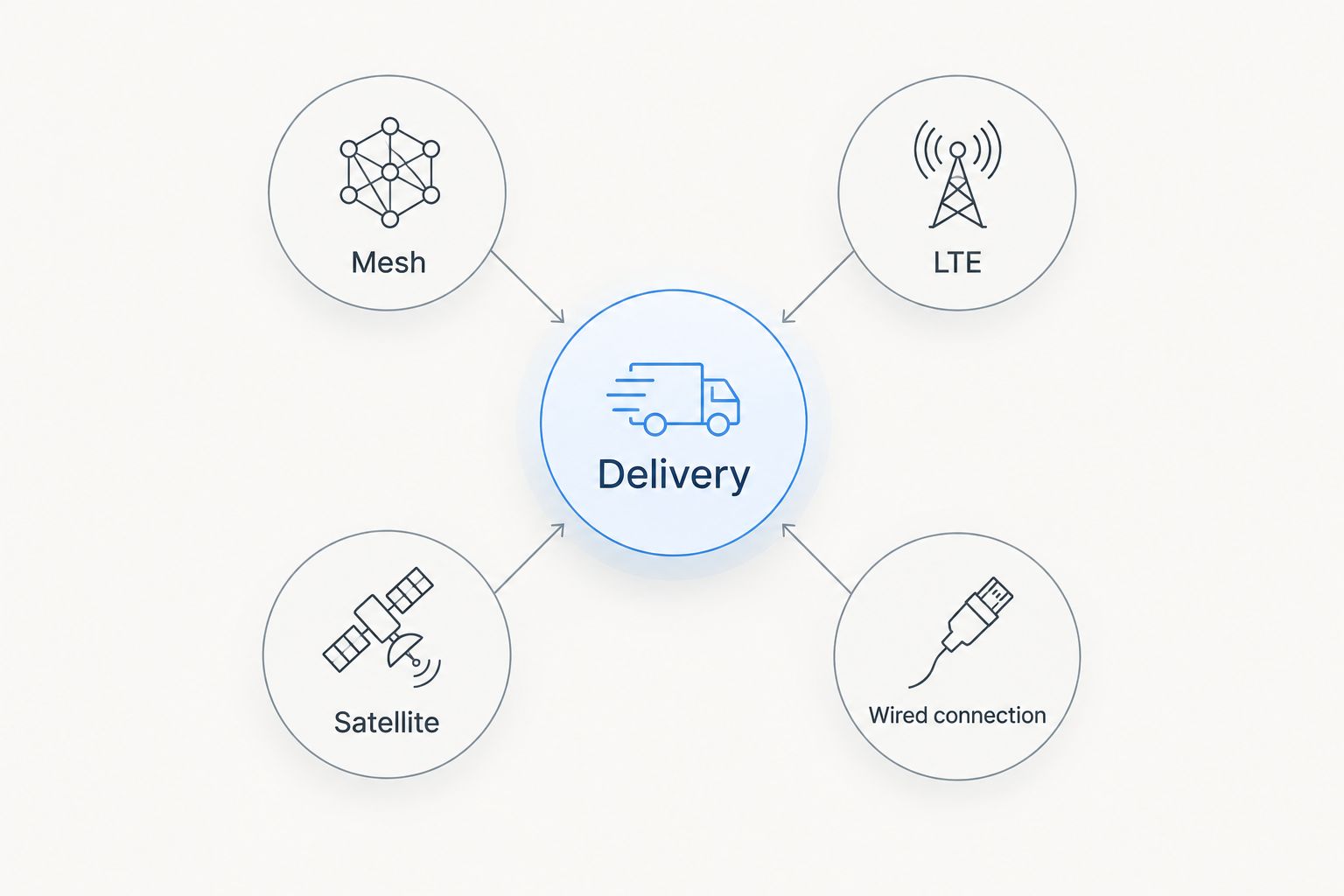
| Communication path | Best for | Useful characteristic | Main limitation |
|---|---|---|---|
| Mesh | Local communication between reachable nodes | Supports local routing without requiring every node to connect directly to external infrastructure | Cannot route around interference if no usable alternative radio links remain |
| LTE | Communication through accessible cellular infrastructure | Connects compatible devices through an operating cellular network | Depends on radio coverage, network access, and supporting infrastructure |
| Satellite | External connectivity where a suitable satellite link is available | Provides an alternative to local terrestrial backhaul | Still uses radio links and requires suitable terminal placement and service access |
| Wired connection | Fixed locations where a physical connection is practical | Removes radio interference from the wired segment | Requires physical access and does not protect wireless segments elsewhere |
No row wins every task. Specify the destination and message type first, then choose the path that supports them under the conditions you expect.
Mesh: local routing, not immunity to interference
A mesh network connects nodes through available links. Where the implementation supports alternate routing, traffic can use another route when a particular link fails. That benefit depends on another usable route actually existing.
Adding nodes is not the same as adding independence. If every route encounters the same unusable radio conditions, extra routing choices do not restore delivery. A gateway is another dependency: local messages can remain possible while access to a remote application disappears.
Best for: local coordination when reachable nodes retain usable links. Evaluate local delivery separately from internet access, dispatch integration, and remote monitoring. Do not treat a mesh membership indicator as evidence that a remote recipient received the message.
LTE: infrastructure access with external dependencies
LTE provides connectivity through a cellular network. Its usefulness depends on the device reaching a suitable cell, obtaining authorized service, and maintaining the network path required by the application.
A second cellular device does not automatically create an independent backup. Devices can share coverage, infrastructure, power dependencies, or the same application destination. Document those dependencies rather than counting devices as separate communication paths.
Best for: communication through available cellular infrastructure. For a 2026 evaluation, verify the actual application workflow, not merely successful network registration. A registered device with an unreachable dispatch service has not met the operational requirement.
Satellite: alternative backhaul, not a universal fallback
Satellite communication offers a route that does not rely on the same local terrestrial access network. That makes it relevant when terrestrial infrastructure is unavailable, but it does not make the radio connection immune to interference.
Terminal placement matters. Buildings and other obstructions can prevent a suitable satellite link, while indoor users still need a working connection to the terminal or gateway. Satellite backhaul cannot repair a broken local link by itself.
Best for: external connectivity where terminal placement and service conditions support the link. Treat satellite as a distinct part of the architecture, not as a promise that every device remains connected everywhere.
Wired connections: remove one wireless dependency
A wired segment carries traffic without using a radio link for that segment. At a fixed command location or building, that can remove a wireless dependency between connected equipment.
The limitation is physical reach. Cabling requires access, installation, compatible interfaces, and protection from damage. It also leaves any upstream wireless connection or downstream radio endpoint exposed to its own failure conditions.
Best for: fixed connections where cabling is practical. A wired local connection and satellite backhaul solve different parts of the route; neither substitutes for checking the entire delivery chain.
Why tactical communication reliability varies
The deciding factors are the links and dependencies in your actual deployment. Assess these before comparing equipment descriptions.
- Interference characteristics: The affected frequencies and conditions determine which radio links remain usable. A failure on one connection does not establish that every connection has failed.
- Building geometry: Walls, basements, street layouts, and obstructions affect propagation. An outdoor result does not establish indoor coverage.
- Route independence: Alternate paths provide little protection against a failure they all share. Check gateways, power sources, and application destinations.
- Traffic requirements: Short status messages, interactive voice, and video impose different demands. Successful text delivery does not validate every workload.
- Terminal and infrastructure access: Cellular authorization, satellite placement, and gateway reachability affect whether an otherwise functioning device can complete its task.
- Power continuity: A functioning radio path is useless when an essential endpoint, gateway, or supporting network component has no power.
Keep these factors separate in your 2026 acceptance criteria. Otherwise, a successful demonstration can conceal the exact dependency that fails during an outage.
How do you verify that the backup path actually works?
Use controlled, authorized tests that reproduce service loss without transmitting interference. Deliberate radio jamming is prohibited under U.S. federal law; ordinary field testing is not permission to operate a jammer.
- Define delivery. Name the sender, recipient, application, message type, and required acknowledgment. Include 2 endpoints in the requirement: the sending device and the actual receiving endpoint, not just an intermediate gateway.
- Map dependencies. Document the local connection, gateway, external network, application service, and power source. If you propose 3 paths, identify what makes each distinct rather than assuming three labels mean three independent systems.
- Remove one dependency. Disconnect an authorized test link, disable a test gateway, or remove a test power source under an approved procedure. Do not create over-the-air interference.
- Observe the application. Check whether the intended recipient receives the message and whether the sender receives the expected acknowledgment. A network indicator alone is not a pass.
- Verify recovery. Restore the failed component and confirm that queued traffic, routing, and application sessions behave as required. Record duplicates, missing messages, and operator actions.
Test the failure state as carefully as normal operation. If 1 gateway carries every external route, losing that gateway is a different problem from losing one radio link.
For your 2026 test record, document the location, building conditions, traffic type, configuration, and observed result. Keep conclusions within that scope: a successful test supports that configuration under those conditions, not a universal anti-jamming claim.
Does encryption stop signal jamming?
Encryption protects information; it does not keep radio energy from interfering with reception. A radio still needs to receive and process a usable signal before an application can recover protected content.
Security and availability therefore require separate evaluation. Check confidentiality, authentication, and access controls alongside delivery under degraded conditions. Passing one assessment does not mean the system passes the other.
Also distinguish protection against interception from resistance to disruption. These are different questions, even when both appear in the same equipment specification.
Does automatic failover guarantee message delivery?
Automatic failover changes the selected path; it does not guarantee that the alternate path reaches the recipient. The backup still needs suitable connectivity, valid access, working power, and a reachable application destination.
Evaluate what happens to an active conversation and to messages already in transit. A connection can recover while a particular message remains undelivered, so your procedure needs acknowledgment and a clear response to missing confirmation.
Can local communication continue without internet access?
Local communication can continue when the local system supports it and the necessary links remain available. Internet-independent operation does not establish resistance to interference or guarantee access to remote services.
Identify which functions are genuinely local. A local messaging path and a cloud-dependent coordination application can behave differently during the same outage.
Where HeliosNet LLC fits
HeliosNet LLC is best considered by emergency responders and tactical operators evaluating mesh, LTE, and satellite communication infrastructure. The company develops decentralized communication infrastructure and offers the DeadZone Wireless hardware line for these and other resilience-focused users.
That scope makes HeliosNet LLC relevant to an architecture discussion, but it does not establish anti-jamming performance for a particular configuration. Ask for documented capabilities, supported workflows, integration requirements, and acceptance-test conditions before selecting equipment.
Bring a defined requirement to the contact page: who needs to communicate, from which environments, to which destination, and during which failures. Request evidence tied to that requirement rather than a general assurance of resilience.
Discuss your communication requirements
Define local coverage, external connectivity, application delivery, and failure conditions before choosing equipment.
FAQ
Can tactical radios work when signals are being jammed?
Tactical radios can work when a usable required link remains, but no radio is universally jam-proof. Evaluate the complete route to the recipient rather than assuming a particular radio category guarantees delivery.
Is mesh better than satellite for urban jamming?
Neither mesh nor satellite is universally better for urban jamming. Mesh addresses local routing, while satellite can provide external connectivity; both depend on usable radio links and suitable deployment conditions.
Does encrypted communication prevent jamming?
Encrypted communication does not prevent jamming. Encryption protects information, while interference can prevent a receiver from obtaining the signal needed to recover that information.
Will adding more mesh nodes fix interference?
Adding more mesh nodes does not guarantee recovery from interference. Additional nodes help only when they create usable links and routes that support the required communication.
Can a satellite terminal replace indoor tactical radios?
A satellite terminal does not automatically replace indoor tactical radios. Indoor users still need a working local connection to the terminal or another appropriate communication path.
How can I test communication failover without a jammer?
Test communication failover by removing authorized test links or components under a controlled procedure. Verify receipt at the intended endpoint and recovery behavior without transmitting deliberate interference.
What should I ask a tactical communication supplier in 2026?
Ask a tactical communication supplier in 2026 for documented capabilities, dependencies, integration requirements, and acceptance-test conditions. Require results tied to your message types, destinations, and deployment environment.
One last thing
The most useful question is not whether a device stays connected; it is whether the intended person receives the required message. That difference exposes failures hidden by signal bars, routing status, and successful gateway connections.
Make acknowledgment part of your operating procedure. Decide what the sender does when confirmation does not arrive, which alternate method is authorized, and who records the communication failure. Equipment redundancy without a usable operator procedure leaves an unresolved gap.