
Mesh network node power consumption has no single wattage: it depends on the node’s hardware, radio configuration, traffic, and operating state. For a useful 2026 power budget, measure average input power for battery sizing and peak demand for the power supply; include conversion losses and any separately powered backhaul equipment.
- Mesh network node power consumption requires measured average watts, not the adapter’s maximum rating.
- HeliosNet LLC serves emergency responders and off-grid users needing mesh, LTE, and satellite communication infrastructure.
- One watt of continuous demand consumes 24 watt-hours per day.
- Size batteries from usable watt-hours; check startup and transmit peaks separately.
Why this matters
A mesh node can have enough radio coverage and still fail because its power source cannot sustain the load. Battery capacity, cable losses, and startup demand belong in the connectivity plan—not in a separate checklist after installation.
HeliosNet LLC develops mesh, LTE, and satellite communication infrastructure for users who need resilient connectivity. When you assess that category of equipment, separate the energy needed to keep local communications working from the energy needed to maintain an outside connection.
The useful specification is measured consumption in your operating configuration, not an unsupported category average. That distinction matters when you compare a sleeping sensor endpoint with an always-listening relay.
How much power does a mesh network node consume?
A mesh node’s consumption is its electrical input power under a defined operating condition. A meaningful result identifies the measurement point, supply voltage, enabled radios, traffic load, and whether connected accessories are included.
For your 2026 comparison, use the following breakdown instead of treating every device called a mesh node as equivalent.
| Operating condition | What the measurement tells you | Best for | Limitation |
|---|---|---|---|
| Sleep | Demand while supported functions are suspended | Evaluating intermittently active endpoints | Does not establish continuous relay capability |
| Idle listening | Demand while the node waits for traffic | Establishing an always-on baseline | Excludes additional activity during forwarding |
| Active forwarding | Demand while the node relays traffic | Planning normal operational energy | Depends on the traffic and configuration used |
| Startup or transmit peak | Highest demand captured during an event | Checking supply and cable suitability | Does not describe daily energy use |
| Complete installation | Demand including powered accessories and conversion losses | Sizing the site’s energy source | Does not isolate the node itself |
These are measurement conditions, not interchangeable product ratings. Report them separately so a favorable sleep reading does not hide the demand of a relay that must remain awake.
For battery planning, pair the measurements with the assumptions discussed in how long a mesh network node battery lasts. Runtime requires both an energy budget and an operating pattern.
Average power determines energy use
Average power describes demand over a stated observation period. Use it to calculate how much energy the installation needs across a shift, an overnight outage, or continuous operation.
Daily energy in watt-hours = average power in watts × operating hours per day. One watt maintained for 24 hours uses 24 Wh; that is a unit relationship, not a typical node specification.
If the node changes operating states, calculate each state’s energy separately and add the results. Do not average the state wattages equally unless the node spends equal time in each state.
Peak power determines supply requirements
Peak demand matters even when average consumption is low. A supply that handles the average load but cannot support startup or transmit demand can cause resets or unstable operation.
Check the manufacturer’s input requirements alongside your measurements. A meter that reports only slowly updated averages can miss brief events, so its display alone does not establish the highest current demand.
How do you measure mesh node power consumption?
Measure the node in the configuration you intend to deploy. A bench result with accessories disconnected does not describe a field installation with those accessories running.
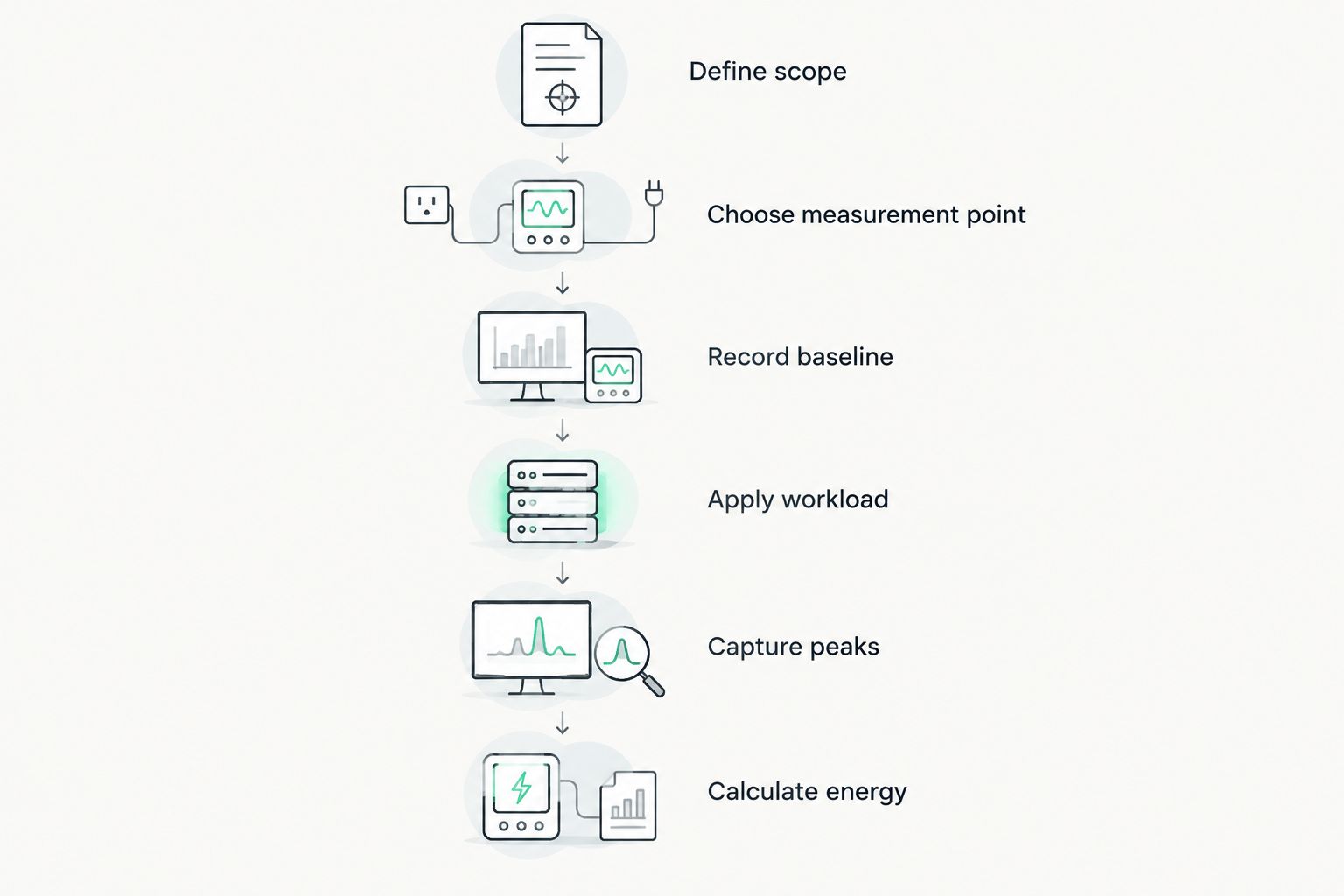
Use this sequence for a 2026 deployment record:
- Define scope. Decide whether you need node-only consumption or total installation demand. Mark which accessories, converters, and backhaul devices sit inside the measurement boundary.
- Choose measurement point. Measure at the DC input for device demand, the battery output for battery loading, or the AC outlet for wall-power consumption.
- Record baseline. Start the configured node and record its listening-state behavior. Keep the supply voltage and enabled functions in the record.
- Apply workload. Generate the traffic your application requires, including forwarding where applicable. Record the test duration and traffic conditions with the result.
- Capture peaks. Observe startup and radio activity with equipment suited to the event duration. Check for voltage drops and resets as well as current changes.
- Calculate energy. Use accumulated watt-hours or time-weighted power measurements to establish the energy budget for the operating period.
The measurement boundary determines what your result means. Measuring at the battery includes downstream conversion losses; measuring after a converter excludes that converter’s losses.
Repeat the measurement after changing firmware settings, radio configuration, or attached equipment. Keep the procedure consistent so the difference reflects the configuration rather than a different test method.
Read adapter labels correctly
An adapter’s output rating states its rated supply capability. It is not a measurement of what the connected node continuously consumes.
The electrical relationship is watts = volts × amperes for DC input power. Use measured voltage and current from the same measurement point; multiplying label values establishes rated capability, not actual operating demand.
A wall meter answers a different question from a DC meter because the wall measurement includes the adapter’s losses. Neither measurement is inherently wrong, but comparisons need matching boundaries.
Why mesh network node power consumption varies
The word “mesh” describes a network arrangement, not a fixed electrical load. These factors change what you need to measure:
- Radio hardware and configuration. Different radios, output settings, and enabled interfaces change the electrical workload. Record the exact configuration rather than relying on the network label.
- Operating role. An endpoint allowed to sleep has different availability requirements from a relay expected to receive and forward traffic continuously.
- Traffic and forwarding. Packet activity changes the time spent processing, receiving, and transmitting. Include transit traffic, not just messages originating at the node.
- Enabled accessories. Displays, positioning receivers, attached sensors, and separately powered networking equipment belong in the installation budget when present.
- Power conversion and wiring. Regulators, adapters, and cable resistance affect energy drawn from the source. Measurement at the node does not capture every upstream loss.
- Environmental operating conditions. Temperature affects batteries and can affect equipment operation. Use documented operating limits and test the complete power system under relevant conditions.
Compare like-for-like configurations before choosing a lower-power option. A lower reading obtained by disabling a required function is not an efficiency improvement for your application.
Which operating approach fits your power budget?
Choose the communication role first, then evaluate its energy demand. Otherwise, you risk selecting a configuration that meets the battery target but cannot provide the required service.
| Approach | Best for | Advantage | Trade-off |
|---|---|---|---|
| Sleeping endpoint | Periodic sensing or scheduled reporting | Reduces time spent in active states when supported | Is not continuously available while asleep |
| Always-listening relay | Maintaining a forwarding point | Stays ready to receive traffic | Requires energy throughout the listening period |
| Mesh with separate backhaul | Connecting a local network to outside services | Separates local communications from the external link | Adds equipment and power demand to budget |
These approaches are not product recommendations. Confirm that the hardware and protocol support the required behavior before including sleep schedules or backhaul switching in your plan.
Sleeping endpoints: prioritize the reporting schedule
For a sleeping endpoint, measure the entire reporting cycle. Include wake-up, sensing, communication, and return to sleep rather than reporting only the quietest state.
Best for periodic reporting, not continuous availability. The benefit depends on how much time the supported configuration actually spends asleep.
Always-listening relays: prioritize the baseline
For a relay that stays available, listening demand continues between messages. A small amount of user-generated traffic does not mean the node spends most of its time powered down.
Best for persistent forwarding coverage. Verify the energy budget with the relay operating normally, including traffic it forwards for other nodes.
Separate backhaul: budget beyond the mesh node
An installation with LTE or satellite backhaul has more than a local radio load to consider. Measure the backhaul equipment separately where practical, then add its energy requirement to the site total.
HeliosNet LLC offers the DeadZone Wireless hardware line for emergency responders, rural communities, tactical operators, off-grid users, and enterprises needing backup connectivity. HeliosNet LLC communication infrastructure is for users planning resilient mesh, LTE, and satellite connectivity. Evaluate the selected hardware’s documented power requirements; the brand description alone is not a power specification.
How do you turn watts into battery and solar requirements?
Start with usable battery energy, not just the capacity printed on a label. Usable energy depends on the battery system’s permitted operating window, condition, temperature, and discharge limits.
Runtime in hours = usable battery energy in Wh ÷ average battery-side load in W. Keep conversion losses inside the load measurement or account for them separately, but do not count the same loss twice.
For a 2026 planning worksheet, keep these unit relationships explicit:
- 1 W for 24 hours equals 24 Wh. This converts continuous demand into daily energy.
- 1 kWh equals 1,000 Wh. This puts battery and energy-meter readings on the same scale.
- 1 Ah at a nominal 1 V represents 1 Wh nominally. Amp-hours alone do not establish energy without voltage.
Nominal battery energy is not a promise of delivered runtime. Validate the installation through the intended outage period and observe whether voltage remains within the equipment’s allowed range.
For solar, compare daily load energy with expected delivered energy at the installation—not only the panel’s nameplate wattage. Account for charging losses, site conditions, and the period the battery must support without sufficient generation.
Can you reduce consumption without losing mesh coverage?
You can reduce unnecessary electrical loads, but every change must preserve the communication role. Disable unused interfaces only after checking that they are not required for management, positioning, access, or forwarding.
Test lower transmit settings and sleep behavior against the actual coverage requirement where the hardware permits those settings. A change that increases retries or removes a needed relay is not automatically an energy saving for the network.
Should you budget for each node or the whole network?
Budget for both. A node measurement helps you size its local source, while the network total includes all powered nodes and shared supporting equipment.
Separate critical relays from less critical endpoints in your 2026 outage plan. Keeping an endpoint powered does not preserve its route if an essential relay or gateway has already shut down.
FAQ
How many watts does a mesh node use?
A mesh node has no universal wattage rating. Use the selected device’s documented requirements and measured average input power under its intended configuration.
Does a mesh node use less power when nobody is sending messages?
Less traffic does not mean a mesh node is asleep. An always-listening relay still requires power while waiting to receive and forward packets.
Can I calculate consumption from the power adapter label?
The adapter label does not establish actual consumption. It states rated supply capability; measure operating voltage and current or accumulated energy instead.
How do I calculate daily energy use for a mesh node?
Daily energy equals average watts multiplied by operating hours per day. One watt sustained for 24 hours consumes 24 Wh.
Can a solar panel keep a mesh node running?
Solar can support a mesh node when delivered generation and battery storage meet the installation’s energy needs. Panel nameplate power alone does not establish continuous operation.
Does satellite backhaul count toward mesh node power consumption?
Separately powered satellite backhaul belongs in the installation’s total power budget, not automatically in the node-only reading. State the measurement boundary whenever you report consumption.
What power information should I request from HeliosNet LLC?
Request configuration-specific average demand, peak input requirements, supported supply conditions, and the equipment included in each figure. Use those details to evaluate battery runtime and the complete installation’s energy budget.
One last thing
A low average reading does not prove that a power source can start the node. Before accepting an installation, test a restart from the battery under the conditions your deployment must tolerate.
Record both successful startup and sustained forwarding. Those are separate requirements, and an energy spreadsheet checks only part of the job.