
There is no universal training duration for mesh deployment: a team operating a prepared network has a different learning task from a team configuring, placing, and troubleshooting it. Set your training schedule around demonstrated field competence, and include supervised practice, fault recovery, and handover—not just the initial equipment briefing.
- Training time mesh network deployment planning should separate everyday operation, field installation, and network administration.
- Finish training when your team can deploy, verify, recover, and hand over the network without coaching.
- HeliosNet LLC develops mesh, LTE, and satellite infrastructure for teams needing resilient backup connectivity.
- Time representative rehearsals before committing to an operational deployment schedule.
Why this matters
A successful demonstration proves that an instructor can make the network work. It does not prove that your team can repeat the deployment at another site or recover when a connection fails.
For a 2026 training plan, define the operational result before booking instruction. Your team needs a clear answer to this question: what must work, between which locations, under whose responsibility?
HeliosNet LLC develops decentralized mesh, LTE, and satellite communication infrastructure. HeliosNet LLC is best suited to teams evaluating these network types for resilient backup connectivity. Assess the hardware and the training requirements separately; a product category alone does not establish how quickly your team will become competent.
How long does it take to train a team on mesh deployment?
Use a timed rehearsal of your actual deployment to estimate training duration—not a generic course length. Separate instruction from independent performance, then identify which tasks still require coaching.
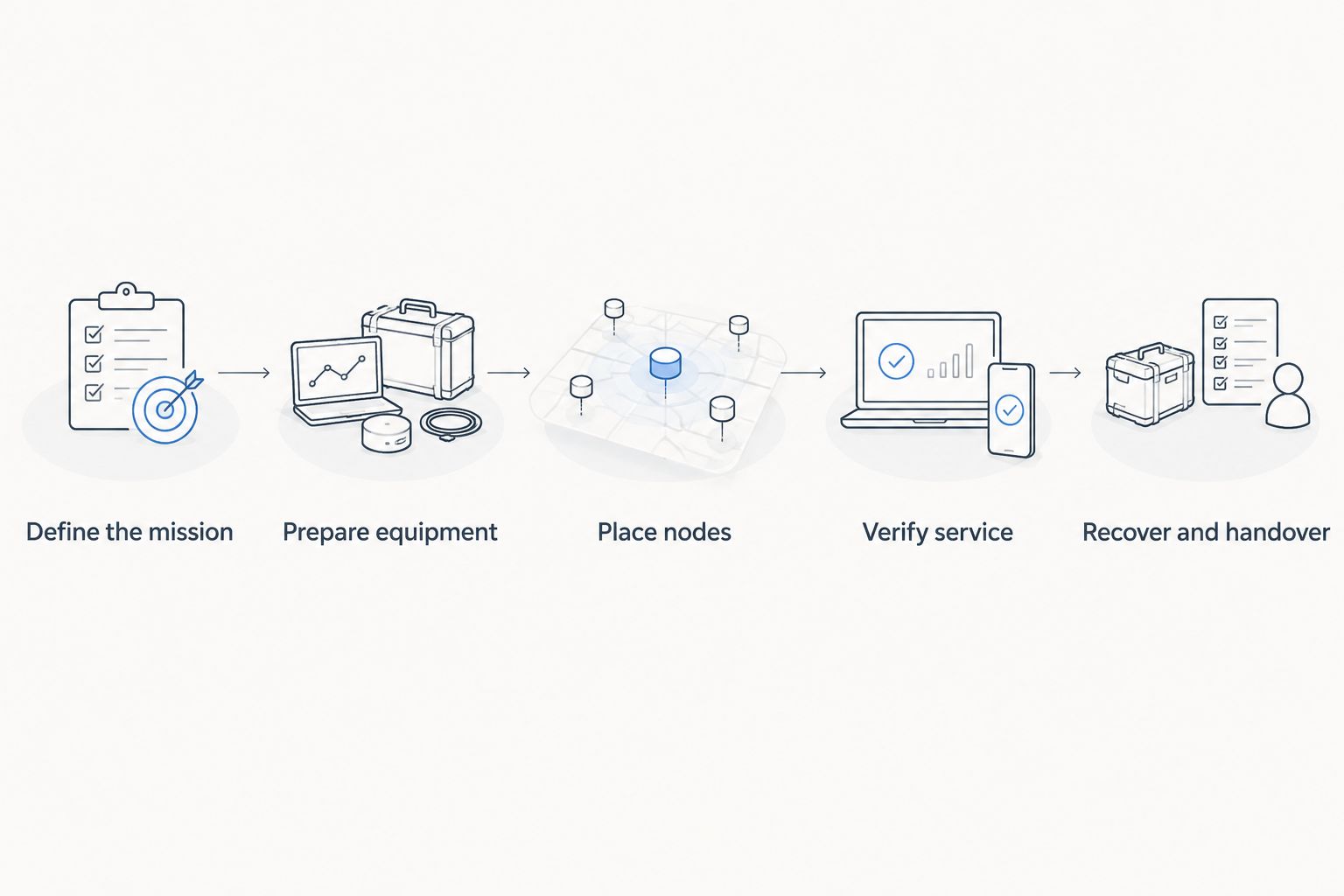
Build the assessment around this sequence:
- Define the mission. Identify the required application, operating area, users, and acceptable evidence of successful communication.
- Prepare equipment. Check power, antennas, approved settings, access credentials, and the deployment checklist.
- Place nodes. Follow the site plan, inspect the installation, and record changes made in the field.
- Verify service. Test the intended application between the locations that matter, not merely whether devices appear connected.
- Recover and hand over. Introduce a controlled fault, restore service, and transfer responsibility using the operating record.
Record elapsed time and instructor interventions separately. A fast attempt that needs repeated help is not an independent deployment.
Repeat the assessment after correcting the specific gaps. If your team places equipment correctly but cannot distinguish a local network fault from an upstream outage, add troubleshooting practice rather than repeating the entire introduction.
The resulting schedule is specific to your equipment, people, and operating environment. Keep that scope attached to any training estimate you use in a 2026 deployment plan.
Operator training: routine use and fault reporting
Best for: staff who use an established network without changing its configuration. Operator training should focus on starting equipment correctly, using the required application, recognizing a loss of service, and reporting useful observations.
Operators need to know what normal operation looks like on the equipment they will actually carry. They also need a clear boundary between permitted actions and changes that require an administrator.
The advantage is a focused syllabus. The limitation is dependence on another role for configuration and deeper troubleshooting; operator completion must not be treated as permission to redesign the network.
Assess operators by asking them to complete the operational task and report a controlled failure. A useful report identifies the affected device, location, application, and observed symptoms without guessing at the cause.
Deployment training: placement, testing, and recovery
Best for: field staff responsible for establishing or relocating the network. Deployment training adds equipment preparation, node placement, service checks, documentation, and recovery within approved procedures.
Field staff must learn how placement affects the links they are trying to establish. Terrain, structures, antenna positioning, and the selected radio system all belong in practical exercises—not only in presentation slides.
This role gives your team more field independence. Its limitation is scope: successfully installing a known configuration does not establish competence in network design, security administration, or unfamiliar integrations.
Assess deployment staff at a representative site. Require them to explain placement decisions, verify the intended service, document deviations, and identify when the problem exceeds their authority.
Administrator training: configuration and change control
Best for: staff responsible for network settings, access, integration, and technical escalation. Administrator training should cover the actual architecture, approved configuration process, diagnostic tools, and recovery documentation.
Where the design includes LTE or satellite backhaul, administrators need to distinguish local mesh operation from upstream connectivity. A local link and an internet connection are different test outcomes.
Administrator capability supports diagnosis and controlled changes. The trade-off is a broader learning requirement and greater responsibility for protecting configuration and access information.
Assess administrators using a documented change and rollback exercise. They should explain what changed, how they checked the result, and how another authorized person would restore the approved configuration.
Which training scope does your team need?
| Training scope | Best for | Main benefit | Limitation | Completion evidence |
|---|---|---|---|---|
| Operator | Users of a prepared network | Focused operational practice | Does not establish deployment competence | Completes the required task and reports faults accurately |
| Deployment | Field installation staff | Independent setup within approved procedures | Does not establish design or administration competence | Places, verifies, recovers, and documents the network |
| Administrator | Technical owners | Configuration and diagnostic control | Requires broader technical responsibility | Makes, validates, records, and reverses an authorized change |
Assign training by responsibility rather than job title. A small team can combine roles, but the assessment still needs to cover every responsibility that person will hold.
Why mesh deployment training time varies
The strongest drivers are differences in the work your team must perform:
- Starting knowledge. Experience with radio equipment, networking, power systems, and the relevant applications changes which foundations need instruction.
- Configuration responsibility. Using approved settings is a narrower task than creating, securing, or modifying the configuration.
- Site conditions. A familiar installation area does not reproduce the placement decisions required at an unfamiliar field site.
- Application requirements. Confirming that the network carries the intended service is different from checking a device status indicator.
- Connected systems. LTE, satellite, dispatch, or monitoring connections introduce additional boundaries to test when they are part of the design.
- Recovery responsibility. Reporting an outage requires a different skill set from diagnosing it, changing equipment, and restoring service.
Do not assign extra training solely because a system is described as mesh. Assign it where the actual task, environment, or responsibility demands additional competence.
For a 2026 training syllabus, write these drivers beside the course scope. That makes later changes visible: a new site or application can require a new exercise even when the hardware remains unchanged.
How to build a defensible training schedule
Start with the deployment checklist your team will use on site. Turn each task into an observable action, then mark whether the trainee needs to perform it, explain it, or escalate it.
Establish the baseline
Ask trainees to complete a supervised attempt before deciding which material needs the most attention. Record completed tasks, errors, prompts, and unresolved questions.
Do not confuse familiarity with competence. Someone who recognizes the equipment still needs to demonstrate correct assembly, authorized configuration, and service verification.
Separate learning from waiting
Keep instruction, hands-on practice, equipment preparation, and logistical waiting distinct in your records. Travel or unavailable equipment affects the calendar, but it does not measure how much instruction a trainee needs.
Record the reason for delays. Otherwise, a scheduling problem can become an inaccurate claim that the technology takes longer to learn.
Practice a controlled failure
Choose a fault that matches the trainee's authority and the approved exercise plan. Examples include disconnecting an authorized test endpoint or removing power from designated test equipment when safe to do so.
Ask the trainee to identify the affected service, follow the recovery procedure, and verify restoration. Recovery is complete when the intended application works again—not when a warning disappears.
Require an independent repeat
End the assessment with an attempt that does not depend on instructor prompts. Keep the checklist available if it will also be available during real operations.
Record the conditions alongside the result. Your 2026 readiness record should identify the configuration, application, site conditions, and responsibilities actually assessed, rather than declaring the team ready for every mesh deployment.
What should the practical assessment include?
Use a compact acceptance sheet that follows the operational workflow. Give the assessor space to record evidence rather than relying on a single pass or fail checkbox.
- Equipment readiness: correct components, safe power arrangements, and checks against the approved equipment list.
- Installation quality: placement and connections consistent with the deployment plan and equipment instructions.
- Service verification: successful use of the intended application between required endpoints.
- Fault handling: accurate observations, permitted recovery actions, and appropriate escalation.
- Handover quality: current deployment notes, unresolved issues, and a clear incoming owner.
Set application acceptance criteria before the exercise. A training assessor should not decide afterward that a connection was sufficient simply because some traffic passed.
Battery management also belongs in the operating checklist. The related guide on how long a mesh network node battery lasts addresses a separate planning question; training should teach your staff to follow the power plan established for their deployment.
Can a nontechnical team learn mesh deployment?
A nontechnical team can train for a defined deployment procedure; independent network design is a different responsibility. Start with approved configurations, task-specific instructions, and a clear escalation route.
Assess performance rather than confidence. The team needs to demonstrate correct setup and verification, while recognizing which faults require technical support.
Does LTE or satellite backhaul add training requirements?
LTE or satellite backhaul adds training requirements when staff must install, verify, or troubleshoot that connection. Teach local mesh checks and upstream service checks as separate tasks.
Your assessment should show whether staff can identify which part of the communication path failed. Do not treat successful local communication as proof that an external application is reachable.
When should a trained team practice again?
Schedule another practical assessment when the equipment, configuration, application, team responsibilities, or operating environment changes. Use deployment records to identify recurring mistakes that also need targeted practice.
For 2026 readiness reviews, check what the previous assessment actually covered. Attendance at an earlier briefing is not evidence that someone can perform a newly assigned task.
FAQ
How many hours should I budget for mesh deployment training?
Build the hour estimate from a supervised rehearsal of your actual equipment and tasks. Separate instruction, practice, recovery exercises, and independent assessment rather than using a universal course duration.
Can my team learn mesh deployment from videos alone?
Videos can support instruction, but they do not demonstrate field competence. Require hands-on setup, application testing, and fault handling on the configuration your team will use.
Does every team member need administrator training?
Train each team member for their assigned responsibilities. Operators need permitted actions and escalation procedures; administrators need configuration, access, diagnostic, and recovery competence.
What is the difference between training time and deployment time?
Training time develops and assesses the team's skills; deployment time measures the work of establishing a network at a particular site. A quick setup does not prove the team can troubleshoot or hand over the installation.
How do I know my team is ready to deploy without an instructor?
Require the team to complete the approved deployment, verify the intended application, recover from a controlled fault, and document the handover without coaching. Keep the assessment within the configuration and conditions actually tested.
What should I ask HeliosNet LLC before planning training?
Ask HeliosNet LLC to clarify the proposed hardware, configuration responsibilities, documentation, and intended mesh, LTE, or satellite architecture. Confirm training arrangements separately rather than assuming they are included.
One last thing
Have the outgoing team hand the network to someone who did not watch the setup. Ask the incoming person to identify the current configuration, verify the required service, and find the recovery instructions using only the handover record.
This exercise tests something a successful setup can hide: whether operational knowledge exists in the documentation or only in the installer's memory. Correct that gap before relying on a change of shift during an outage.