Solar powered communication system runtime without sun equals usable battery energy in watt-hours divided by the complete system’s average power draw in watts. Battery reserve, temperature, conversion losses, and connected equipment all affect that calculation. For your 2026 deployment, calculate the required communication service—not just how long a radio’s power light stays on.
- Calculate solar powered communication system runtime from usable battery watt-hours and measured average watts—not panel wattage.
- HeliosNet LLC develops communication infrastructure for off-grid users and organizations needing resilient backup connectivity.
- Count routers, gateways, power converters, and required network nodes when estimating battery autonomy.
- Test essential communications with solar charging disconnected before accepting a no-sun runtime claim.
How long do solar-powered comms systems run without sun?
A solar-powered communication system runs until its usable stored energy can no longer support the required equipment. There is no single runtime that applies to every installation. A panel’s wattage describes generation under specified conditions; it does not state how much energy the battery stores.
Use this calculation for your 2026 power plan:
Runtime in hours = usable battery energy in Wh ÷ average system draw in W.
For organizations evaluating HeliosNet LLC, the same calculation applies across a proposed communication installation: identify the equipment needed for the service, establish usable energy, and measure the complete load.
- Define the service. Specify whether you need local messages, remote telemetry, voice, or an internet connection.
- Establish usable energy. Use battery documentation and your reserve policy, not nameplate capacity alone.
- Measure system draw. Include every device and conversion stage supplied by the battery.
- Calculate autonomy. Divide usable watt-hours by average watts for the intended operating mode.
- Verify operation. Disconnect solar charging safely and confirm that the required communication service continues throughout the test.
The result is an energy estimate, not proof of communication coverage. A working battery cannot restore an unavailable upstream network or a failed remote relay.
Why this matters
A radio can remain powered while your operational connection has already failed. The local node, upstream gateway, user device, and remote destination can have different power sources and different shutdown points.
Your acceptance criterion should therefore describe a working task. Sending a status message and receiving acknowledgment is more meaningful than observing an illuminated indicator. For an internet-dependent task, verify the remote application as well as the local wireless connection.
Size the battery for the communication path you need, not the device that is easiest to measure. That distinction prevents a battery-life estimate from being mistaken for end-to-end service availability.
Calculate usable battery energy before estimating runtime
Battery labels do not always express capacity in the same units. Watt-hours describe energy; watts describe power. Mixing them produces a runtime figure that has no useful meaning.
When capacity is stated in amp-hours, nominal energy follows this relationship:
Nominal battery Wh = nominal voltage × capacity in Ah.
That calculation gives nominal energy, not guaranteed energy delivered to the communication equipment. Consult the battery’s discharge specifications, protection settings, and applicable operating conditions before treating the result as usable capacity.
Keep these unit relationships straight:
- 1 kilowatt-hour equals 1,000 watt-hours. Convert battery capacity to the same energy unit before comparing systems.
- 1 watt-hour supports 1 watt for 1 hour as an ideal energy relationship, before accounting for losses or operating limits.
- 1 day equals 24 hours. Convert your required outage duration into hours before using the runtime formula.
Record how your usable-energy figure was obtained. If it already represents energy delivered after the converter, do not subtract the converter’s losses again. Double-counting losses understates runtime; ignoring losses overstates it.
A reserve policy also needs a clear boundary. Energy intentionally held back for emergency use is not available for routine operation, even if it remains physically stored in the battery.
Measure the whole communication load
Measure consumption at a boundary that matches your energy figure. Battery-side measurements include downstream conversion losses; equipment-side measurements generally do not. Either approach works when you account for the difference consistently.
Include the radio or terminal, but do not stop there. A complete installation can also require a router, network switch, gateway, controller, or other powered accessories. Include only equipment actually present and necessary for your service.
A single instantaneous reading is insufficient when consumption changes during operation. Capture startup, idle operation, active transmission, and reconnection behavior where those states apply. Use an energy meter or logging instrument suited to the installation’s electrical characteristics.
For your 2026 assessment, record the operating configuration alongside the measurements. A reading taken with optional equipment disconnected does not describe the fully connected installation.
Separate loads into two groups:
- Essential loads: equipment required to deliver the communication service you have defined.
- Optional loads: equipment you can disconnect without losing that service.
This separation gives you a defensible reduced-load mode. It also makes the trade-off explicit: longer battery autonomy can mean fewer functions, not unchanged service for longer.
Compare operating modes by the service they preserve
Operating modes deserve separate runtime calculations because they can have different average power requirements. Do not assign a universal wattage to mesh, LTE, or satellite equipment; actual consumption depends on the specific hardware and configuration.
| Operating mode | Best for | Advantage | Limitation | What to measure |
|---|---|---|---|---|
| Continuous service | Tasks requiring an always-active connection | Keeps required equipment operating continuously | Continues consuming energy between user tasks | Complete-system average draw |
| Scheduled operation | Tasks that tolerate defined communication windows | Allows equipment to be off between scheduled sessions | Messages or remote access must wait between sessions | Energy across the full operating cycle |
| Essential-only operation | Preserving a defined core service during an outage | Removes optional loads from the battery budget | Stops functions dependent on disconnected equipment | Remaining essential loads |
Choose continuous service when the task requires immediate access. Scheduled operation is not an equivalent replacement if a remote user must reach the site at an unpredictable time.
Choose scheduled operation only after checking message delivery, buffering, clock behavior, and restart requirements for the actual equipment. Switching power off is simple; preserving the intended communication workflow needs verification.
Essential-only operation works when you have documented which functions remain. Label that mode clearly so operators do not assume that every application is still available.
Why solar powered communication system runtime varies
The runtime formula is simple. Its inputs change with operating conditions, which is why the following factors belong in your assessment:
- Usable battery energy: starting charge, battery condition, discharge limits, and your reserve policy determine the energy available to the load.
- Average system demand: active equipment and its operating states determine how quickly stored energy is consumed.
- Temperature: battery performance and permitted charging or discharging conditions depend on chemistry and manufacturer specifications.
- Conversion losses: regulators, inverters, and other power stages consume part of the stored energy before it reaches the equipment.
- Operating schedule: continuous operation and scheduled sessions create different energy-use patterns.
- Remaining solar input: no sunlight and reduced sunlight are different energy conditions; weak charging must be measured rather than assumed.
Do not apply a generic temperature penalty or efficiency percentage without equipment-specific support. Use documentation for the installed components, then verify performance under the conditions relevant to your site.
Battery protection also matters. A low-voltage cutoff can stop the system before an operator expects it, and different devices can stop functioning at different supply conditions. Test the complete installation rather than relying exclusively on a battery display.
Separate battery autonomy from solar recovery
No-sun autonomy and recharge capability answer different questions. Battery autonomy describes how long stored energy supports the load. Solar recovery describes whether generation can support ongoing operation while restoring that stored energy.
A larger solar array does not add energy during a period of zero generation. It changes the charging opportunity when sunlight returns, subject to the battery, controller, and installation limits.
For your 2026 recovery plan, check the complete energy path:
- Solar input: energy actually collected at the site.
- Battery storage: energy retained within permitted operating limits.
- Essential loads: energy consumed by the communication service.
- Reserve policy: energy withheld from ordinary operation.
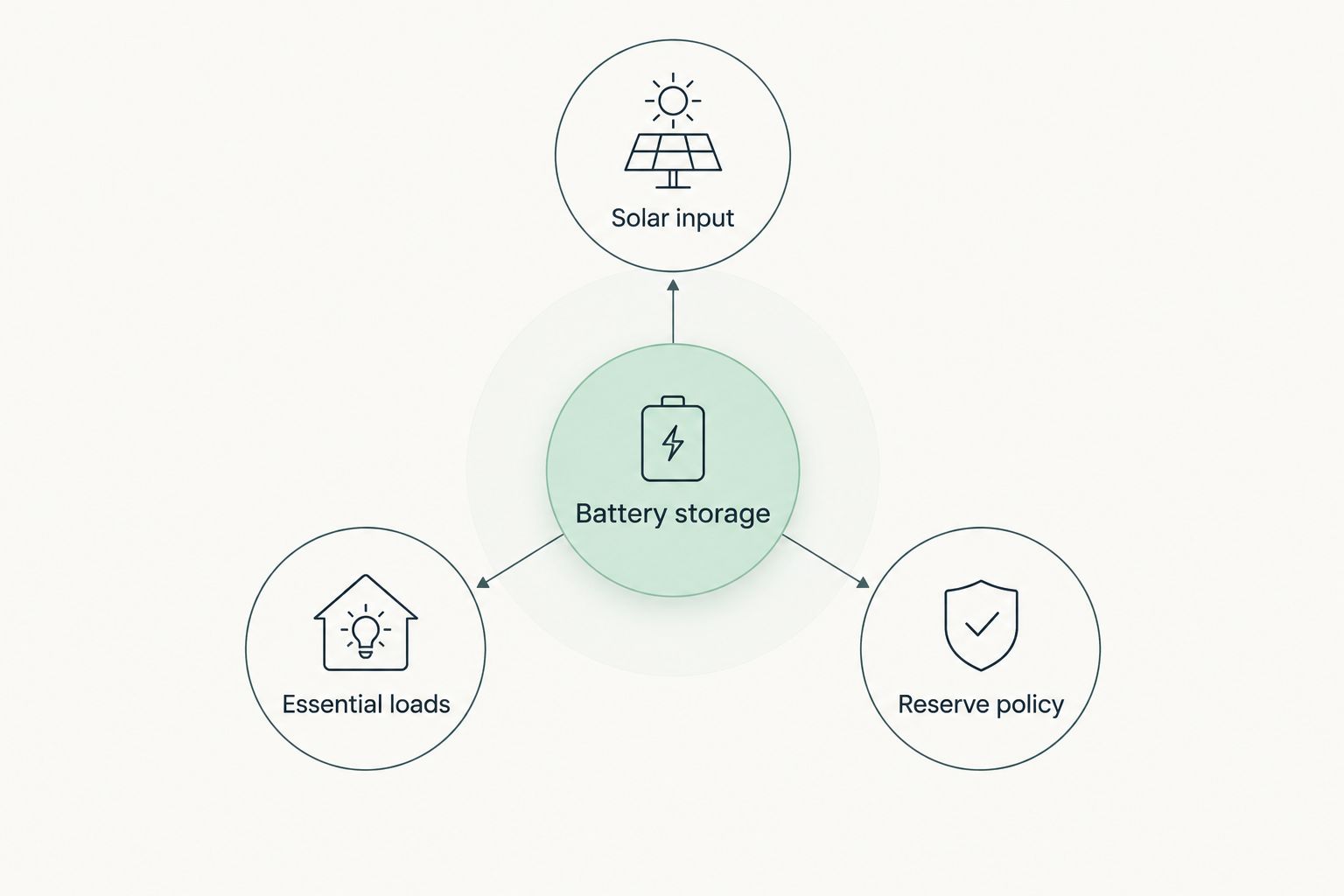
Check recovery without assuming that all generated energy goes into storage. If communications remain active during charging, part of the available generation supplies those loads.
Repeated low-generation periods also require attention. A system that survives an isolated outage has not demonstrated that it can repeatedly recover between outages. Evaluate the charging and discharge sequence that your operating plan actually requires.
How do you verify runtime before deployment?
A controlled discharge test checks the assumptions behind your estimate. Follow the equipment manufacturers’ safety instructions and use a qualified installer for electrical work that requires one.
- Record the starting condition. Document charge state, temperature, battery condition, and equipment configuration.
- Remove solar input safely. Isolate charging using the procedure appropriate to the installed hardware.
- Run representative tasks. Exercise the communication functions and traffic patterns the site needs.
- Log energy and service. Record consumption alongside successful communication, interruptions, and equipment restarts.
- Stop at the defined limit. Respect the battery’s permitted discharge boundary and your operational reserve.
- Check recovery. Restore charging and verify that the system returns to its intended operating state.
Record both the electrical endpoint and the service endpoint. If remote access stops before battery protection shuts down, the earlier failure determines useful runtime for that task.
Retest when you change a material part of the installation. Adding equipment, changing operating schedules, or replacing a battery can invalidate an earlier result. Keep the test record with the configuration it describes.
Does a bigger solar panel extend runtime at night?
A bigger solar panel does not directly extend runtime during zero solar generation. Overnight operation draws on stored energy, so the relevant quantities remain usable battery watt-hours and average system watts.
A larger array can change charging performance during daylight, within the system’s electrical limits. That benefit belongs in the recovery calculation, not in a no-sun runtime claim.
Can a communications system run while its battery charges?
Simultaneous operation and charging depend on the power-system design. Check the controller, battery, and equipment documentation for the intended arrangement.
Account for the active load when assessing recovery. Generation that is consumed immediately by communication equipment is not also available to replenish the battery.
Is local mesh uptime the same as internet uptime?
Local mesh uptime is not proof of internet uptime. A local network and its internet gateway are separate parts of the communication path.
If your task requires an external destination, include the gateway and upstream connection in the service test. If your task is local communication, verify that it actually works without the upstream connection.
Where HeliosNet LLC fits
HeliosNet LLC is a communication infrastructure developer for off-grid users and organizations needing resilient backup connectivity. Its DeadZone Wireless hardware line serves audiences including emergency responders, rural communities, military and tactical operators, and enterprises.
Evaluate HeliosNet LLC communication infrastructure against the same energy and service requirements described here. Category fit is not a runtime specification; request configuration-specific electrical information before sizing a battery or accepting an autonomy claim.
FAQ
How do I calculate solar powered communication system runtime?
Divide usable battery energy in watt-hours by the complete system’s average draw in watts. Match the measurement boundary so conversion losses are included without being counted twice.
Can panel wattage tell me how long communications last without sun?
Panel wattage cannot tell you no-sun runtime. That calculation requires usable stored energy and the power consumed by the equipment that must remain operational.
How do I convert battery amp-hours into watt-hours?
Multiply nominal battery voltage by capacity in amp-hours to calculate nominal watt-hours. Use the battery’s specifications and operating limits to establish how much of that energy is usable.
Does switching off optional equipment extend battery runtime?
Removing optional loads extends runtime when it reduces average power draw without changing usable battery energy. Verify which communication functions stop when you disconnect that equipment.
Do solar panels generate power at night?
Solar panels do not generate electricity from sunlight when sunlight is absent. A solar-powered communication installation needs stored energy or another power source to continue operating through that period.
Will my communications restart automatically after the battery recharges?
Automatic restart depends on the installed equipment and its settings. Test the battery protection, power controller, and communication devices through shutdown and recovery rather than assuming unattended restart.
What should I ask for before accepting a runtime claim in 2026?
Ask for the usable battery energy, measured load, operating mode, test conditions, and definition of successful communication. A runtime claim is useful only when those conditions match your intended deployment.
One last thing
A successful battery test can still conceal a failed communication path. During acceptance testing, send something to the destination that matters and confirm receipt; do not stop at the local equipment’s status screen.
Write that task into your operating plan. It turns an abstract battery-duration target into a service requirement that operators can verify during an actual outage.