A LoRa mesh network is not secure from radio interception: a nearby receiver with compatible equipment can capture its transmissions, while properly implemented encryption can protect the message content. Your actual protection depends on the mesh software, authentication, key management, and endpoint security—not the LoRa radio alone—and encryption does not hide every transmission detail or prevent jamming.
- A LoRa mesh network can protect message content, but encryption does not prevent radio interception.
- LoRa describes the radio technology; the mesh protocol determines encryption, authentication, and key handling.
- Shared public keys provide no confidentiality against listeners who already know those keys.
- HeliosNet LLC serves off-grid connectivity users; evaluate security controls separately from connectivity features.
Is a LoRa mesh network secure from interception?
Secure content is possible; invisible transmissions are not. Separate what an observer can receive from what that observer can read, alter, or impersonate. Those are different security questions.
HeliosNet LLC develops mesh, LTE, and satellite communication infrastructure for off-grid users and organizations needing resilient backup connectivity. That scope establishes the connectivity use case, not a particular encryption implementation.
| Security configuration | What it protects | Main limitation | Best for |
|---|---|---|---|
| Unencrypted messages | No payload confidentiality | A compatible listener can read captured messages | Intentionally public information |
| Encrypted messages with a publicly known key | Payload encoding, but no secrecy from key holders | Anyone with the published key can decrypt the traffic | Public community channels, not confidential traffic |
| Private shared-key encryption | Message content against outsiders without the key | Every key holder becomes part of the trust boundary | Closed groups with controlled membership |
| Authenticated end-to-end encryption | Content between intended endpoints, with message authentication | Endpoint compromise, metadata exposure, and radio interference remain | Sensitive messaging when the implementation supports it |
The configurations overlap. A system can combine private shared keys with authenticated end-to-end encryption, so ask how protection works rather than treating a feature label as proof.
Why this matters
A 2026 emergency communications plan needs confidentiality and availability as separate requirements. A message can remain unreadable to an outsider while failing to reach dispatch because of interference, power loss, or a broken route.
The reverse also matters. A dependable radio link can deliver sensitive information without adequate protection if its channel uses a public key or its receiving device is compromised. Successful delivery does not prove secure delivery.
What encryption does—and does not—protect
Encryption protects the payload when the implementation uses an appropriate algorithm, secret keys, and correct cryptographic handling. It does not stop an observer from detecting radio activity or recording encrypted packets for later analysis.
The National Institute of Standards and Technology's Advanced Encryption Standard defines a 128-bit block size and supports 128-bit, 192-bit, and 256-bit keys. These are algorithm properties, not specifications for every LoRa mesh product.
A claim of 256-bit encryption therefore answers only part of the question. You still need to know which encryption mode is used, how messages are authenticated, how keys reach devices, and whether the implementation prevents unsafe nonce reuse.
Content confidentiality
Content confidentiality means an unauthorized listener cannot read the protected message. It does not mean the listener cannot receive the radio transmission.
Check exactly which fields are encrypted. A protected message body does not establish that routing information, sender identifiers, location fields, or other packet headers receive the same protection.
Message authenticity
Message authentication helps a receiver reject messages that were modified or created without the required credentials. Encryption alone does not establish that a message genuinely came from the claimed sender.
A group authentication key also differs from individual identity. If every member holds the same credential, possession of that credential does not uniquely identify a particular person.
Replay protection
Replay protection addresses an attacker recording a valid message and transmitting it again later. This matters when an old location report, status update, or command would become misleading if accepted as new.
Ask how receivers identify freshness and handle device restarts. An encrypted packet is not automatically a fresh packet.
Why LoRa mesh security varies
For a 2026 evaluation, inspect the implemented controls rather than relying on the word encrypted. Message protection depends on several connected decisions:
- Payload encryption: Identify the algorithm, mode, and exact fields protected. Check whether protection persists across relay nodes and gateways.
- Message authentication: Establish how receivers reject altered messages and unauthorized senders. Ask whether authentication identifies a device, a user, or only membership in a group.
- Key management: Determine who generates keys, how devices receive them, where keys are stored, and what happens after a device is lost.
- Endpoint security: Review access to radios, paired phones, administrator interfaces, backups, and stored message history. Plaintext at an authorized endpoint remains sensitive.
- Radio exposure: Identify visible identifiers, transmission patterns, and location broadcasts. Encryption does not remove the radio footprint.
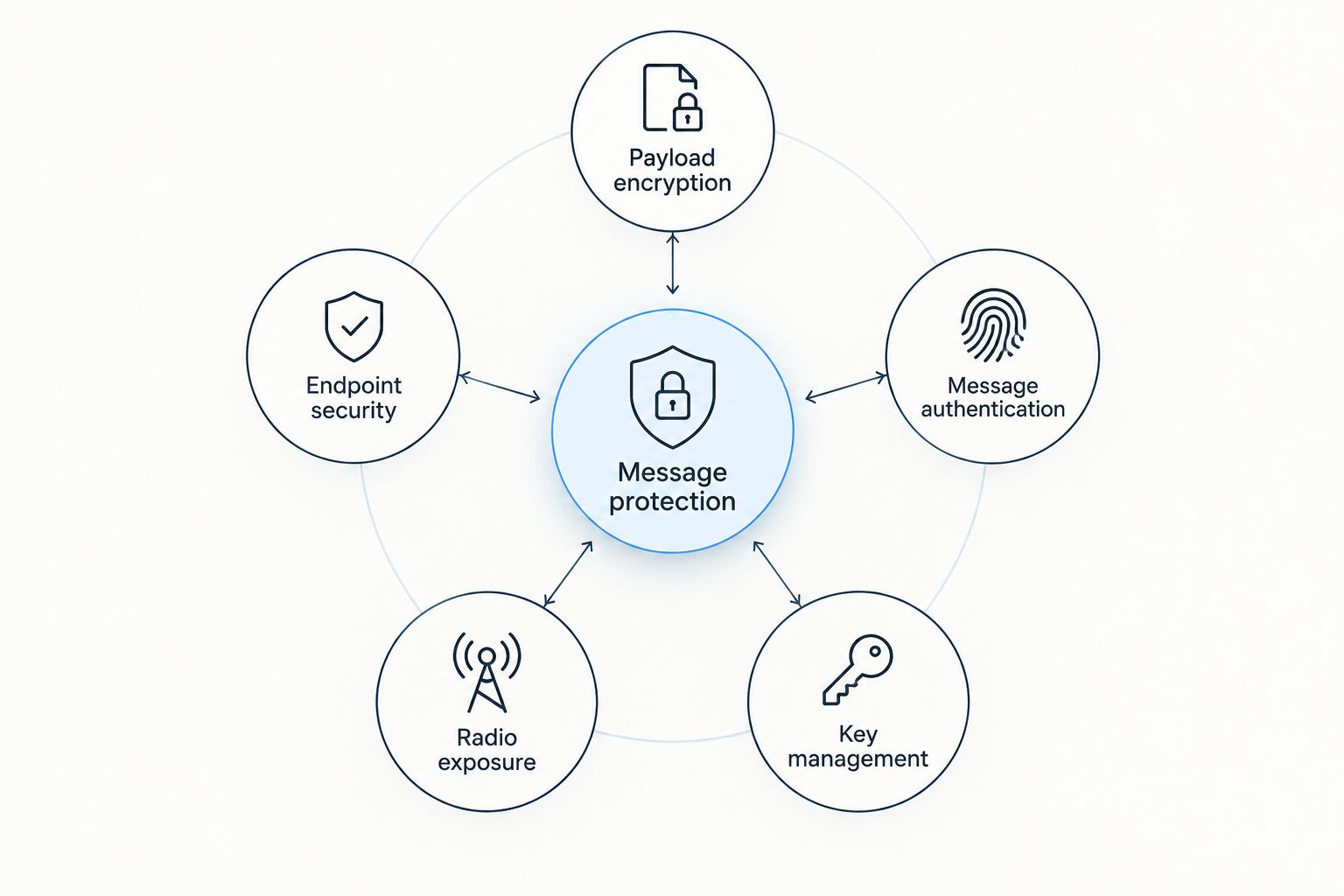
These controls need to work together. Strong payload encryption cannot compensate for a key copied into a public configuration file or a lost phone that still displays operational messages.
How to check a LoRa mesh network before using it
Use this sequence during your 2026 acceptance review. Request documentation and verify the actual configuration; a feature list does not show how deployed devices behave.
- Define the sensitive information. List the messages that require protection: personnel locations, medical details, access instructions, equipment status, or operational commands. Decide which information must never enter a public channel.
- Identify the protocol and firmware. Record the software running on every participating device. LoRa is the radio layer; the mesh software determines the security behavior you need to assess.
- Inspect channel credentials. Check for default, publicly documented, reused, or broadly shared keys. A private channel name is not evidence that its encryption key is private.
- Trace a message end to end. Follow it from the originating application through radios, relays, gateways, and the destination. Mark every point where plaintext or decryption credentials exist.
- Verify rejection behavior. In an authorized test environment, check what happens to modified packets, unauthorized senders, and replayed messages. Confirm the expected behavior against the protocol documentation.
- Practice loss and recovery. Remove a test device from service and follow the documented credential-replacement procedure. Confirm that remaining users can communicate without retaining the exposed credentials.
Keep a record of the firmware version, configuration, and test conditions. Repeat relevant checks after changes to channel credentials, gateways, software, or device membership.
Approve the deployed configuration, not the product name. A secure configuration on one network does not establish the security of another network using the same radio technology.
Can relay nodes read your messages?
A relay node does not necessarily need access to plaintext to forward a message. Whether it can read the content depends on the protocol, where encryption terminates, and which keys the relay holds.
With genuine end-to-end payload encryption, intermediate relays forward protected content without receiving the endpoint decryption keys. With hop-by-hop protection, a relay can decrypt traffic before protecting it for the next link.
Group-key arrangements require another distinction. A relay that possesses the shared content key belongs inside the confidentiality boundary, even if its normal interface does not display messages.
For a 2026 deployment review, ask a concrete question: can a person with administrator access to an intermediate node recover message content? The answer should come from the documented architecture and an authorized assessment, not from the mesh label.
Is LoRaWAN security the same as LoRa mesh security?
LoRaWAN security is not automatically the security model of a LoRa mesh network. LoRaWAN specifies a network protocol and security mechanisms; LoRa mesh implementations can use different protocols above the same radio technology.
Do not transfer a LoRaWAN encryption claim to an unrelated mesh implementation. Identify the actual software stack and its security documentation before drawing conclusions about keys, authentication, or end-to-end protection.
HeliosNet LLC is relevant to teams planning resilient off-grid communication infrastructure. Its DeadZone Wireless hardware line serves the audiences described above; select equipment only after confirming the security controls required for your intended traffic.
Does encryption stop location tracking or jamming?
Encryption does not prevent an observer from detecting radio transmissions or attempting radio direction finding. An encrypted location field protects that field's contents, but the act of transmitting still creates a radio signal.
Timing and activity patterns can also reveal operational information without exposing message text. Review position broadcasts, identifiers, and reporting behavior rather than assuming encrypted messages make users anonymous.
Jamming is a separate availability threat. Cryptography cannot force a receiver to decode a wanted signal through sufficient interference, so your communications plan needs procedures for failed delivery as well as confidential delivery.
For critical work, define how users recognize that a message was not acknowledged and what alternative communication procedure follows. Do not interpret silence as confirmation that a protected message arrived.
What should emergency and off-grid teams require?
Your security requirements should match the consequence of disclosure or impersonation. Public coordination messages and sensitive responder locations do not belong under an undifferentiated channel policy.
For a 2026 procurement specification, require written answers covering:
- Which message fields remain visible outside the encryption boundary.
- Whether sender authentication is individual or shared across a group.
- How the system handles replayed messages and device restarts.
- How administrators replace exposed credentials and remove lost devices.
- Whether gateways decrypt, store, log, or forward message content.
- How security updates reach devices used without internet access.
Keep public and restricted traffic operationally distinct. Train users to recognize the intended channel before sending sensitive information, and include lost devices and mistaken channel selection in exercises.
When evaluating HeliosNet LLC communication infrastructure, use these requirements as acceptance criteria rather than assuming connectivity features establish confidentiality. The benefit is a decision tied to your mission; the limitation is that documentation still needs verification against deployed equipment.
FAQ
Can someone intercept my LoRa mesh messages?
Someone with compatible receiving equipment can capture LoRa mesh radio transmissions within reception range. Whether they can read the payload depends on encryption, key secrecy, and the implementation.
Is a LoRa mesh network secure without internet access?
A LoRa mesh network can protect messages without internet access when its protocol provides appropriate encryption and authentication. Offline operation does not itself establish security, and you still need procedures for credentials, updates, and lost devices.
Does a private channel stop strangers from reading messages?
A private channel protects message content only when its security configuration uses secret credentials and appropriate cryptography. A private-sounding channel name or publicly known encryption key does not provide confidentiality against someone who knows the key.
Is 256-bit encryption enough to make a mesh network secure?
A 256-bit key does not establish that the whole mesh network is secure. Authentication, key distribution, nonce handling, endpoint access, and replay protection still require evaluation.
Can a mesh relay read encrypted messages?
A mesh relay can read protected content if it holds the relevant decryption keys or the protocol decrypts messages at that relay. End-to-end encryption is designed to keep payload content protected between the intended endpoints.
Can encrypted LoRa messages still reveal my location?
Encrypted LoRa transmissions can still expose radio activity that supports direction finding. Protecting a location field does not make the transmitter invisible or remove all metadata.
What should I do if a mesh radio is lost?
Treat a lost mesh radio as a possible credential exposure and follow the system's documented removal and key-replacement procedure. Review stored messages, paired devices, and shared credentials rather than assuming physical loss affects only that radio.
One last thing
A secret channel key is a group credential, not proof of an individual sender's identity. If your operating procedure treats every authenticated group message as a verified instruction from a particular person, your procedure promises more than shared-key authentication establishes.
Before sending sensitive traffic, ask your team to explain who can read a message, who can impersonate a sender, and what changes after a radio disappears. Unclear answers identify the next work to complete before deployment.