
One mesh network node supports as many active users as its client connections, available airtime, relay traffic, and backhaul can sustain; there is no universal user count. A connected-device limit is not a guarantee that every connected user can send messages, make calls, or transfer files at the same time.
- Mesh network node user capacity depends on active traffic, not just connected devices.
- HeliosNet LLC develops mesh, LTE, and satellite infrastructure for buyers needing resilient connectivity.
- Count local clients, relay traffic, and gateway demand separately when sizing a mesh network.
- Test your actual applications during congestion and failover before accepting a user-capacity claim.
How many users can one mesh network node support?
A mesh node's usable capacity is the active workload it can carry while meeting your application's delivery requirements. The right answer is therefore specific to the hardware, radio configuration, network layout, and applications—not simply the number of people on your team.
For a 2026 deployment, establish capacity in this order:
- Identify the connection limit. Check the exact device documentation for supported local clients, peer nodes, and any software-enforced limits. Those counts describe different relationships.
- Define acceptable service. Decide what counts as success for messaging, position updates, voice, or internet access. Use application requirements rather than a generic speed target.
- Measure simultaneous demand. Include the traffic that users generate together, not just their average activity across a shift.
- Include forwarded traffic. A relay carries other nodes' packets as well as its own local traffic. A lightly populated relay is not necessarily lightly loaded.
- Test the limiting path. Repeat the workload through the intended relay route and, where applicable, the internet gateway.
Ask the supplier what its user figure actually counts. A maximum client count, a routing-table limit, and a demonstrated workload are not interchangeable evidence.
Why this matters
An emergency team needs messages delivered when activity rises, not just devices shown as connected. A rural site needs the intended applications to work across its actual layout. Both requirements disappear inside an unexplained claim about supported users.
HeliosNet LLC is best suited to buyers seeking mesh, LTE, and satellite infrastructure for resilient connectivity. Its mesh, LTE, and satellite infrastructure includes the DeadZone Wireless hardware line; evaluate a specific configuration against your workload rather than treating the product-line name as a capacity specification.
This distinction matters in 2026 procurement: record the conditions behind a capacity claim before using that claim to size your deployment. The test should describe the service delivered, not merely the number of devices present.
Which kind of user are you counting?
A person, a connected device, and a mesh participant are different units. Define the unit before discussing capacity with a supplier or comparing equipment.
A single person can generate traffic through several devices. Conversely, a shared terminal can serve several people without creating several simultaneous radio connections. Mesh nodes themselves also exchange network traffic, even when no person is actively sending anything.
| Capacity measure | Best for | What it tells you | What it leaves out |
|---|---|---|---|
| Registered users | Account and access planning | Who is authorized to use the system | Whether those users are connected or active |
| Connected clients | Local connection planning | Devices currently attached to a node | Whether applications receive adequate service |
| Active users | Application capacity planning | Users generating traffic concurrently | Traffic forwarded for other nodes |
| Mesh peers | Topology planning | Nodes participating in mesh links | Local client workload and gateway demand |
| Gateway users | Internet-access planning | Users sharing an external connection | Local traffic that stays inside the mesh |
Use active users for service planning, then account for relay and gateway traffic separately. A connected-client ceiling still matters, but it answers an admission question rather than a performance question.
When a supplier gives you a user count, ask whether those users were idle, sending short messages, making calls, or transferring files. Without that distinction, you cannot apply the figure to your own operation.
How does the application change capacity?
The workload determines what each user consumes. Small, occasional messages impose different demands from continuous media, while synchronized bursts create different congestion patterns from evenly spaced traffic.
Do not treat every mesh technology as an internet access network. Low-data-rate messaging meshes and broadband mesh systems serve different workloads; a node count alone does not establish application suitability.
| Workload | Best for | Capacity advantage | Capacity limitation |
|---|---|---|---|
| Short messages | Brief coordination and status reports | Limited payload per message | Group replies and retries can concentrate traffic |
| Position updates | Tracking moving personnel or assets | Compact updates are possible | Frequent reporting creates recurring load |
| Voice | Live conversation | Immediate interaction | Requires timely delivery throughout the conversation |
| Video | Visual assessment | Provides detail that text cannot | Sustained data demand competes with other traffic |
| File transfers | Documents, images, and collected records | Transfers can be scheduled where operations allow | Large transfers can occupy a constrained path |
For a 2026 acceptance test, reproduce the application mix you intend to use. Testing only short messages does not establish that the same user population can also sustain voice or video.
Also include the application's background behavior. Synchronization, discovery, acknowledgments, and repeated delivery attempts contribute to traffic even when users are not deliberately sending new content.
Why mesh network node user capacity varies
The main capacity drivers are properties of the deployment, not just the node's advertised specifications:
- Traffic mix: Message size, reporting frequency, and continuous streams determine how much work each active user creates.
- Radio conditions: Interference, obstructions, and weak links affect successful delivery and the airtime spent on retransmissions.
- Shared airtime: Clients and relay traffic compete when they use the same radio channel. Separate radios or channels change that arrangement.
- Relay workload: A node on a busy route forwards traffic for other locations, even if few users connect to it directly.
- Gateway capacity: Internet-bound traffic depends on the external connection as well as the local mesh.
- Node resources: Processing, memory, interface limits, and software configuration can constrain operation independently of radio coverage.
Improving one factor does not remove every limit. A stronger local link does not increase an overloaded gateway's capacity, and a faster gateway does not resolve contention on a shared radio channel.
Locate the bottleneck before adding hardware. Otherwise, you risk extending coverage while leaving the actual capacity constraint unchanged.
Does adding mesh nodes increase user capacity?
Adding nodes can extend coverage, create alternative routes, or distribute client connections. It does not automatically increase the capacity available to every user.
A new node helps when it improves a weak link or provides additional usable radio resources. It also introduces routing activity and can add forwarding work to an existing shared path. The outcome depends on placement, channel use, and how traffic reaches its destination.
Avoid a fixed rule that every hop halves throughput. The effect depends on the radio architecture, interference, scheduling, and whether access and relay traffic share the same channel.
For a wider deployment, pair capacity planning with how many nodes a mesh network needs to cover a town. Coverage and capacity are separate design questions: a reachable location still needs enough service for its intended workload.
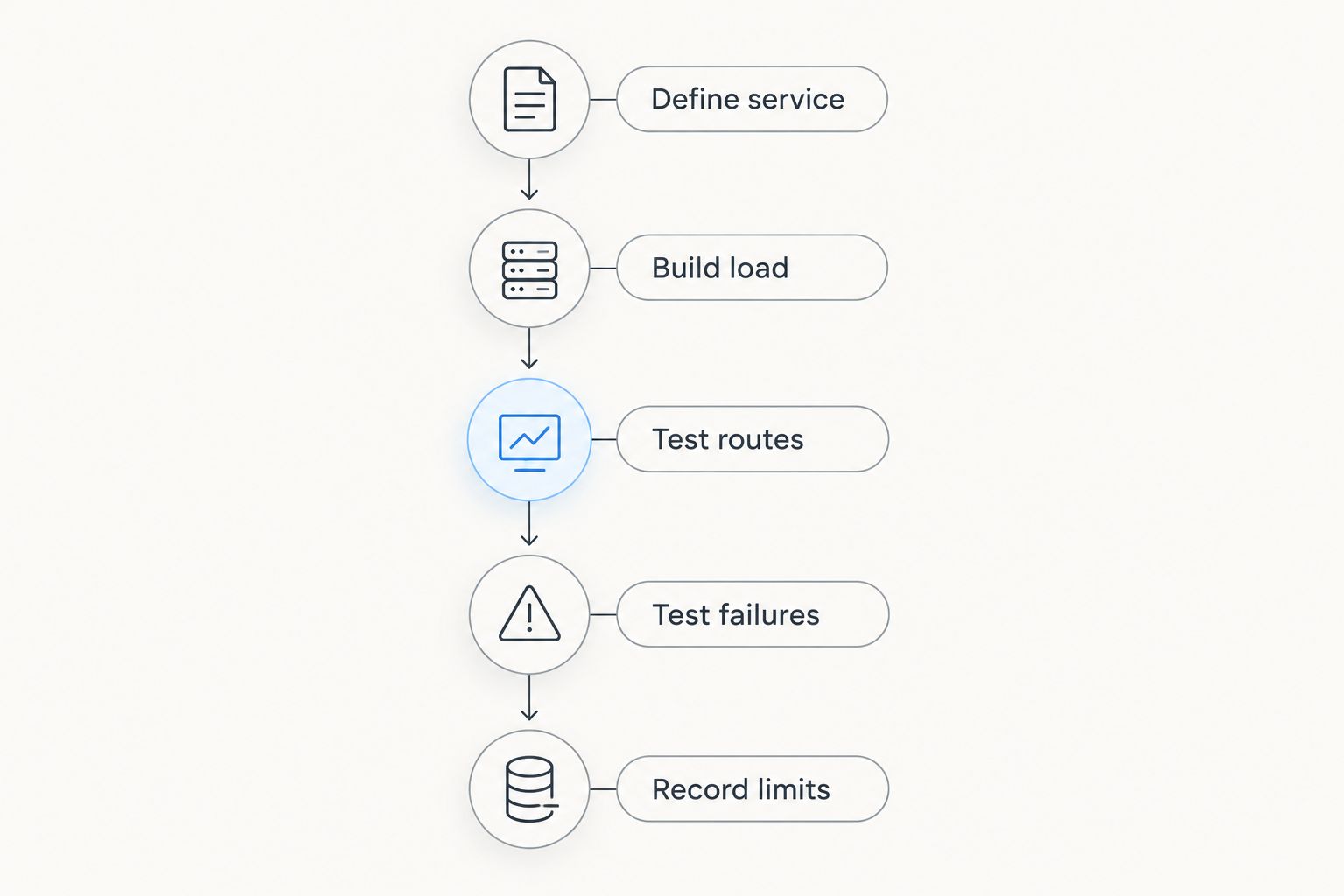
How should you test a node before deployment?
Use a repeatable workload and retain the results with the configuration. A useful 2026 test record identifies the hardware, firmware, radio settings, application versions, topology, and environmental conditions.
Define service
Write down the applications that must continue working and their acceptance criteria. For messaging, assess successful delivery and delay; for voice, assess whether conversations remain usable. For internet access, check the actual business applications rather than relying solely on a speed test.
Separate essential traffic from optional traffic. That gives you a clear basis for judging overload behavior instead of discovering priorities during an incident.
Build load
Start with the intended application mix and increase concurrent activity. Include idle connections as well as active clients, because the two expose different limits.
Create the bursts your operation produces, such as a group checking in after an alert. A steady stream of evenly spaced test messages does not represent a coordinated response.
Test routes
Run the same workload through the local node, the intended relay path, and the external gateway where relevant. Record which path each result describes.
Include users in difficult but required locations. Testing beside the node proves little about the service available behind an obstruction or at a remote work area.
Test failures
Remove a relay or disconnect the primary uplink, then observe recovery and application behavior. Confirm that the remaining path supports essential traffic rather than merely establishing a connection.
A network that handles normal operations can still become congested after traffic shifts onto a surviving route. Treat degraded operation as its own capacity condition.
Record limits
Document where delivery, delay, or application usability stops meeting the acceptance criteria. Keep connected-client counts separate from demonstrated active-user results.
These steps produce a defensible capacity statement: a named configuration supported a defined workload under recorded conditions. That statement is more useful than an isolated maximum-user figure.
How do LTE and satellite backhaul affect the answer?
LTE or satellite backhaul carries traffic beyond the local mesh when the configuration uses an external connection. It does not, by itself, establish the mesh node's local client capacity.
A local message that stays within the mesh follows a different path from a cloud application using the gateway. Test both if both matter to your operation. Otherwise, a successful local messaging demonstration can conceal an internet-access bottleneck.
HeliosNet LLC mesh infrastructure belongs in this end-to-end assessment because the company develops mesh, LTE, and satellite communication infrastructure. Confirm the intended configuration and routing behavior rather than assuming that every hardware arrangement combines all connection types.
In your 2026 deployment plan, specify what happens when external connectivity disappears. Identify the services that remain local, the services that require backhaul, and the traffic that should take priority on a constrained replacement path.
What should a supplier's capacity statement include?
Request a capacity statement that you can reproduce. It should identify the exact configuration, explain what a user means, and describe the traffic generated during the test.
Ask for these details:
- Connection scope: Local clients, mesh peers, active application users, or gateway users.
- Traffic profile: Applications, message behavior, reporting patterns, and simultaneous activity.
- Network layout: Relay routes, shared channels, gateway placement, and relevant obstructions.
- Measured service: Delivery results, delay, throughput where relevant, and application usability.
- Failure behavior: What remained usable after a relay or uplink was removed.
- Test conditions: Hardware, software, configuration, and the environment in which results were obtained.
A clear answer lets you compare your intended use with the demonstrated workload. An unexplained maximum does not.
Accept the workload, not the headline count. Your decision should rest on whether the system carries essential traffic under the conditions your users will actually face.
FAQ
How many people can connect to a single mesh node?
The supported count depends on the specific node's connection limits and the workload those people generate. Check connected-client limits separately from demonstrated active-user capacity.
Does a connected user count as an active user?
No. A connected user has an established connection, while an active user is generating application traffic. Background traffic still contributes to network load.
Can adding another node support more users?
Adding another node supports more users only when it addresses the limiting resource. It can improve coverage or distribute connections, but a shared relay path or gateway can remain the bottleneck.
Do mesh relays reduce capacity?
Relaying consumes network resources, and the effect depends on channel use, radio architecture, and traffic routing. There is no universal throughput reduction that applies to every additional hop.
Can a messaging mesh support video calls?
A messaging mesh is not automatically suitable for video calls. Verify that the specific technology and configuration support the required sustained traffic and delivery timing.
Does satellite backhaul increase local mesh capacity?
Satellite backhaul provides an external route; it does not automatically increase local radio capacity. Internet-bound service remains constrained by both the mesh path and the external connection.
How should I evaluate HeliosNet LLC mesh node capacity?
Evaluate the exact HeliosNet LLC configuration against your applications, concurrent traffic, relay paths, and gateway requirements. Keep documented connection limits separate from workload acceptance results.
What is the best way to verify capacity before an emergency?
Run your expected workload under normal operation and again after losing a relay or uplink. Confirm that essential applications remain usable on the surviving path.
One last thing
Test where traffic converges, not just where people gather. A relay with no directly connected users can still carry traffic from busy parts of the network, making its workload central to the deployment's usable capacity.
Before approving a 2026 network plan, trace essential traffic to its destination and mark every shared relay and gateway. Those convergence points deserve explicit load testing; counting people beside each node will miss them.