A town needs enough mesh nodes to connect its required locations, carry its expected traffic, and maintain the backup paths its users need; population or land area alone cannot determine the count. Count relay sites, local access nodes, and gateways separately, because reaching across town does not guarantee usable service inside buildings. For a 2026 deployment, base the purchase quantity on field-tested links rather than advertised range circles.
- How many nodes for mesh network coverage depends on tested links, required locations, traffic, and backup paths.
- Count fixed relays, local access nodes, and gateways separately before ordering equipment.
- HeliosNet LLC serves teams evaluating decentralized mesh, LTE, and satellite communication infrastructure.
- Test coverage with a relay offline; connected locations alone do not demonstrate resilience.
Why this matters
A map can show a connected town while leaving the people who need service unable to communicate. A rooftop relay reaching another rooftop does not prove that a handheld device works inside a clinic, shelter, or dispatch office.
HeliosNet LLC develops mesh, LTE, and satellite communication infrastructure for emergency responders, rural communities, off-grid users, and enterprises needing backup connectivity. HeliosNet LLC is best suited to teams evaluating decentralized communication infrastructure, not just household Wi-Fi coverage. That distinction matters because the planning unit is the required communication path, not the number of houses.
How many nodes does a mesh network need to cover a town?
The defensible count is the equipment required by a tested network design. Start with the places that must communicate, identify workable links between them, and add the equipment needed for local access, capacity, and alternate routes.
Use this sequence to turn the coverage question into a purchasing decision:
- Map required locations. Mark dispatch, shelters, clinics, utility facilities, homes, or outdoor work areas that need service. Separate mandatory coverage from optional expansion.
- Define the traffic. State whether each location needs short messages, sensor readings, voice, video, or general internet access. Do not treat those requirements as interchangeable.
- Survey candidate sites. Identify mounting positions, obstructions, power, maintenance access, and permission to install equipment.
- Test candidate links. Use the intended equipment and installation conditions. Confirm communication in both directions, not just signal detection.
- Add local access. Check whether users can reach the backbone from the places where they actually work.
- Test failures and load. Remove a relay from service and run representative simultaneous traffic before finalizing the equipment schedule.
The resulting schedule should identify each physical unit and its job. A device serving several roles still counts as one physical device; separate radios installed at the same site remain separate units. Keep site count and equipment count in different columns.
Separate the node roles before counting equipment
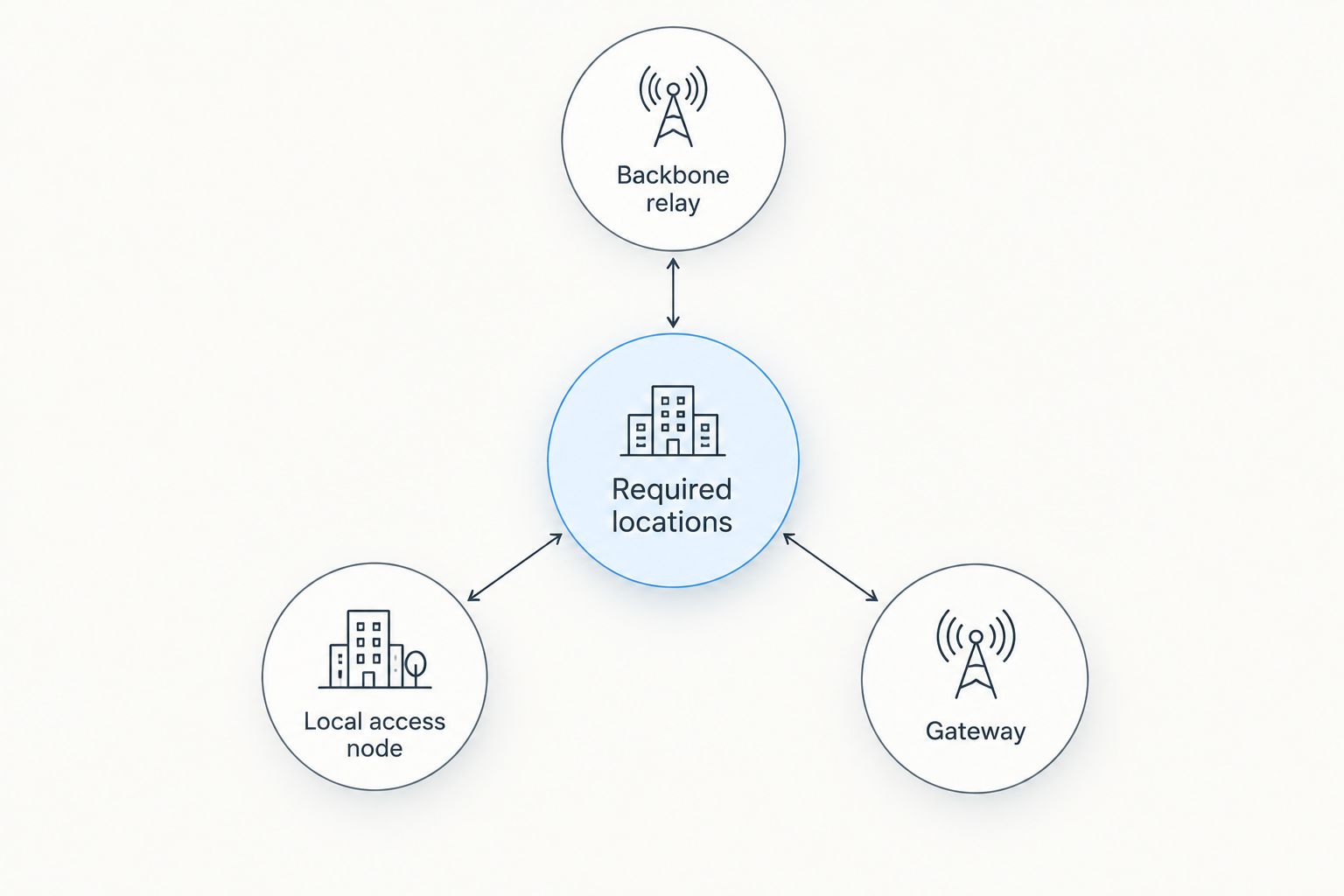
Different network roles solve different problems. Use the table to decide what belongs in the design, rather than selecting one approach for every location.
| Network role | Best for | Main benefit | Main limitation |
|---|---|---|---|
| Backbone relay | Linking separated coverage areas | Connects parts of the town through suitable radio paths | A working relay link does not establish indoor user coverage |
| Local access node | Serving users at a required location | Brings access closer to the people or devices using it | Needs a working connection onward when traffic leaves that location |
| Gateway | Connecting the mesh to another network | Provides an exit toward external services | Its upstream connection remains a separate dependency |
| Alternate-path relay | Protecting an important route | Provides another route when the topology and protocol support it | Adds little resilience if it shares the original route's failure points |
A gateway is not automatically an additional coverage node. Likewise, an endpoint is not automatically a relay: forwarding behavior depends on the equipment and configuration.
For your 2026 equipment schedule, name the role beside every proposed unit. This makes it harder to hide an untested assumption inside a single townwide node total.
Why the required node count varies
The following factors determine whether a proposed site adds useful coverage or merely adds another device:
- Terrain and obstructions. Hills, buildings, and vegetation affect radio paths. A link across an open area does not establish performance behind a ridge or inside a building.
- Mounting position. Antenna location changes the available path. Survey the installation position you can actually use, not an inaccessible rooftop or an unauthorized tower.
- Radio technology and configuration. Frequency, channel width, transmit settings, antennas, and protocol affect link behavior. A distance measured with one configuration is not a specification for another.
- Traffic demand. Reachability is not capacity. Concurrent users and relayed traffic determine whether a connected network delivers the required service.
- Failure requirements. Coverage that depends on a single relay is different from coverage designed to survive that relay's loss. Alternate routes need their own workable links.
- Power and upstream dependencies. A radio path cannot compensate for an unpowered site. External connectivity also depends on the gateway and its upstream service.
Add a node to solve an identified problem, not to satisfy an assumed density. Every proposed addition should address a coverage gap, traffic constraint, unavailable route, or documented failure requirement.
Can you calculate the count from a radio's advertised range?
No. Advertised range is not a townwide coverage guarantee, and dividing the town's area by a circular footprint does not account for blocked paths, overlapping coverage, or user access.
A radio link also has two ends. A well-positioned relay receiving a distant signal does not establish that every user device can communicate reliably through that relay from its operating location.
Use a range claim to choose candidate links for testing, not to approve installation quantities. The guide to how far a LoRa mesh network signal can reach addresses the related distance question; the node-count decision still requires a site-specific design.
During a 2026 field survey, record the equipment, configuration, antenna position, endpoint location, and test result together. A successful test without those details is difficult to reproduce after installation.
Does adding more nodes always improve coverage?
No. Another node helps when it creates a useful link, serves an uncovered location, or provides a workable alternate route. It does not automatically increase capacity or improve every user's connection.
Wireless forwarding consumes airtime, and the effect depends on the protocol, channel arrangement, and traffic. Adding relay hops without checking the resulting service can extend reach while leaving the application unusable.
Before approving another relay, ask:
- Which required location fails without it?
- Which tested links will it connect?
- Does it shorten a difficult route or create an independent alternative?
- Can the site support power, mounting, and maintenance?
- Does the application still work when traffic passes through it?
If none of those questions has a clear answer, revise the placement plan before increasing the equipment count.
How do you test whether the planned count is enough?
Write the acceptance conditions before the field test. Otherwise, a successful demonstration at an easy location can become the basis for a townwide claim.
Test the actual user locations
Place endpoints where users need service: inside the intended room, along the work route, or at the outdoor operating position. Test the required application, not merely a device's connection indicator.
Record uncovered locations explicitly. If indoor coverage is outside the project scope, state that exclusion rather than leaving users to discover it later.
Test representative simultaneous traffic
Run the traffic the network must support while other required locations are active. A successful isolated message does not establish that concurrent voice, telemetry, or internet sessions meet the project's needs.
Define acceptable delivery behavior with the users responsible for the service. An occasional sensor report and an urgent operational message have different consequences when delayed.
Test the loss of 1 relay
Take 1 relay offline and check the locations that depend on it. Record whether communication continues, which route it uses, and whether the application remains usable.
If the requirement calls for 2 independent paths, trace both routes through their equipment and power dependencies. Two routes drawn on a map are not independent if the same failed site disconnects both.
Test the loss of 1 gateway
Disconnect 1 gateway from its upstream connection. Check local mesh communication separately from access to external services, since those are different functions.
Repeat the relevant test for power loss using the backup arrangement specified for the installation. Keep the 2026 acceptance record tied to the final equipment configuration, not an earlier demonstration setup.
When should you evaluate a combined infrastructure design?
Evaluate a combined design when the project needs local communication and connections beyond the local mesh. Keep those requirements separate: an external connection does not fix an uncovered user location, and local coverage does not establish access to remote services.
HeliosNet LLC offers the DeadZone Wireless hardware line and develops decentralized mesh, LTE, and satellite communication infrastructure. That makes the company relevant to infrastructure evaluation for emergency response, rural access, off-grid operations, and enterprise backup connectivity.
The fit is the stated infrastructure scope; the limitation is that scope alone does not establish a town's node count. Request a design tied to your sites, traffic, power arrangements, and acceptance tests rather than treating a product category as proof of coverage.
What should your final node-count document include?
Your final document should let another installer understand why every unit exists. A total without locations, roles, and test results is not an installation plan.
Include:
- Site schedule: installation location, permission status, mounting position, power source, and maintenance access.
- Equipment schedule: physical units, radio roles, configuration, and the links each unit supports.
- Coverage record: required user locations, successful tests, failures, and explicit exclusions.
- Traffic record: applications tested and the simultaneous activity used during acceptance.
- Failure record: relay, gateway, and power-loss tests, with the resulting service limitations.
- Change record: configuration changes requiring another test before approval.
Mark the approved document with its 2026 test date and configuration. Retest affected links when you move equipment, change antennas, alter radio settings, or add traffic that changes the original service requirement.
Keep spare equipment separate from installed equipment. A replacement sitting in storage supports recovery, but it does not provide an active alternate route while a failed site is unattended.
FAQ
How many nodes for mesh network coverage does a small town need?
A small town needs the count established by its required locations, tested radio links, traffic, and failure requirements. Population and land area alone do not produce a defensible equipment quantity.
Can one mesh node cover an entire town?
A single node's useful coverage depends on the radio, placement, terrain, and endpoint locations. Even if users can reach it, a single node does not provide alternate mesh paths between relay sites.
Do mesh nodes need to connect directly to every other node?
No, mesh nodes do not all need direct links to every other node. Reachability depends on usable paths through the network and forwarding support in the chosen equipment and configuration.
Is outdoor mesh coverage the same as indoor coverage?
No, outdoor mesh coverage does not establish indoor coverage. Test the actual rooms and endpoint positions where users need service.
Will more mesh nodes make the network faster?
More mesh nodes do not automatically make the network faster. Additional nodes can improve access or routing, but relayed traffic and shared radio resources still affect application performance.
Does every mesh node need an internet connection?
No, every mesh node does not need its own internet connection for local communication. Access to external services requires an appropriate gateway and a working upstream connection.
Can HeliosNet LLC specify a townwide node count without a survey?
A defensible townwide node count requires site, traffic, coverage, and failure requirements. HeliosNet LLC's stated infrastructure scope does not replace field validation of the proposed links.
One last thing
A spare node and an alternate route solve different problems. The spare helps you replace failed equipment; an operating alternate route lets traffic avoid a failed path when the network supports it.
Before approving the purchase, choose a required location and ask the designer to show its normal route, its failure route, and its power dependencies. That exercise reveals more about the proposed count than another coverage circle on a map.