
Enterprise backup connectivity monthly cost depends on the service plan, usage, equipment arrangement, and support scope; a comparable monthly total requires an itemized quote for your sites. The service subscription alone excludes any separately billed equipment, installation, excess usage, and operational support.
- Enterprise backup connectivity monthly cost should include recurring service, usage, equipment payments, and support—not just the subscription.
- LTE suits sites with usable cellular coverage; satellite offers another access path but requires suitable terminal placement.
- Mesh connects local nodes; internet backup still needs an upstream connection.
- HeliosNet LLC develops mesh, LTE, and satellite infrastructure for enterprises evaluating resilient backup connectivity.
Why this matters
Buy continuity for named business tasks, not an undefined promise of backup internet. Keeping transaction processing connected is a different requirement from moving every employee, camera, and cloud application onto a secondary connection.
For your 2026 budget, specify what must remain usable during an outage before comparing subscriptions. Otherwise, proposals with different data allowances, equipment arrangements, and support responsibilities look interchangeable when they are not.
HeliosNet LLC develops decentralized mesh, LTE, and satellite communication infrastructure and serves enterprises needing resilient backup connectivity. Its technology scope makes the distinction between local communication and external internet access especially relevant to your requirements.
How much does enterprise backup connectivity cost per month?
Your comparable monthly total is the sum of recurring access charges, recurring equipment charges, management and support, and billable usage. Keep installation and purchased equipment in a separate deployment budget rather than silently treating them as subscription charges.
Request the following breakdown for every proposal. A blank line needs an explanation; it does not automatically mean the item is included.
| Budget component | What belongs here | What to clarify |
|---|---|---|
| Access subscription | The recurring charge for the backup connection | Whether the charge applies while the connection is idle |
| Usage | Metered traffic and any excess-use charges | What happens after the allowance is exhausted |
| Equipment payments | Rental, lease, or financed hardware payments | Ownership and obligations when the contract ends |
| Management | Monitoring, configuration, and administrative services | Which tasks remain your responsibility |
| Support | Contracted assistance and escalation services | Support hours, response commitments, and exclusions |
| Deployment | Installation, purchased equipment, and initial configuration | Which charges are one-time rather than recurring |
Compare recurring charges against recurring charges, then compare deployment costs separately. If finance wants a monthly ownership view, show the chosen allocation period explicitly and label the result as an accounting comparison—not the provider's monthly invoice.
A usable 2026 quote should also distinguish normal standby operation from outage operation. Automatic health checks, background traffic, and actual failover traffic all need clear treatment under the proposed service terms.
LTE backup: Best for sites with usable cellular coverage
LTE backup uses a cellular connection as an alternative path when your primary connection fails. It fits sites where cellular service can support the applications you need to retain.
Its practical advantage is using a different access medium from a wired connection. The limitation is that cellular coverage, indoor signal conditions, and network congestion still affect service; a different medium does not prove complete infrastructure independence.
Ask the provider to specify the service allowance, traffic restrictions, equipment arrangement, and any charges associated with exceeding the allowance. Confirm whether the proposed router and configuration support your required failover behavior rather than assuming the subscription includes that function.
Choose LTE backup only after testing it at the actual installation location. A coverage map is useful for screening sites, but it does not establish application performance inside your building.
Satellite backup: Best for sites needing another access path
Satellite backup connects through a satellite network rather than a local terrestrial access line. It is relevant where terrestrial connectivity is absent or where your continuity design calls for a different access path.
The advantage is that the access link does not require the same local wired connection as your primary service. The constraint is physical deployment: terminal placement, sky visibility, power, and mounting requirements matter.
A satellite proposal should identify the applicable service terms, equipment responsibilities, installation scope, and traffic-management rules. Do not treat a satellite terminal, an active service subscription, and an integrated failover configuration as the same purchase.
Choose satellite backup when the site and operating requirements justify it—not simply because it is a different technology. Test the applications that matter, including authentication and remote access, rather than accepting a successful general browsing test as sufficient.
Mesh connectivity: Best for local communication across nodes
A mesh network links participating nodes so traffic can move across the local network. It can support local communication without making every node depend on a direct connection to a central access point.
The advantage is local connectivity across the deployed nodes. The constraint is fundamental: mesh is not, by itself, an internet subscription. Reaching external services still requires an upstream connection somewhere in the design.
For a mesh-based proposal, separate node deployment and management from the LTE, satellite, or other upstream service. Ask which applications remain usable locally when every external connection is unavailable.
Do not assume that equipment described as mesh supports your required traffic volume or application type. Evaluate the specified hardware and network design, not the category label.
Which backup architecture should you compare?
Compare architectures against the same required applications and outage scenario. The table below identifies suitable use cases and the main limitation of each option; it does not rank providers or imply equivalent performance.
| Option | Best for | Main advantage | Main limitation |
|---|---|---|---|
| LTE backup | Sites with verified cellular service | Adds cellular access alongside a primary connection | Depends on local cellular conditions |
| Satellite backup | Sites needing a satellite access path | Avoids reliance on the primary local wired access link | Requires suitable terminal placement and power |
| Mesh connectivity | Local communication across distributed nodes | Connects participating local nodes | Needs upstream service for external internet access |
| Combined design | Sites with distinct local and external continuity needs | Assigns different roles to different network technologies | Adds equipment and operational responsibilities |
Before selecting a provider, use the enterprise backup connectivity solutions guide to frame the architecture discussion. Require each proposal to explain which failure it addresses and which dependencies remain.
Why enterprise backup connectivity monthly cost varies
The scope of the service drives the bill. For a 2026 comparison, hold these requirements constant across every proposal:
- Site count: Identify every location that needs equipment, service, configuration, and support. Separate shared charges from site-specific charges.
- Required traffic: Specify which applications stay connected and which stop during failover. A restricted continuity profile differs from an unrestricted office workload.
- Usage terms: Compare allowances, metering, excess-use treatment, and any traffic-management conditions in the actual contract.
- Equipment arrangement: Distinguish purchased equipment from recurring rental, lease, or financing obligations. Clarify responsibility for replacement and maintenance.
- Operating responsibility: Decide who monitors the connection, tests failover, maintains configuration, and handles incidents. Those tasks exist even when they are performed internally.
- Site conditions: Identify power, mounting, cabling, antenna placement, and access requirements. Keep initial installation work separate from ongoing service obligations.
The right comparison uses the same service scope, not just the same billing period. A self-managed connection and a managed continuity service assign different work to your team.
How do you get a comparable enterprise backup quote?
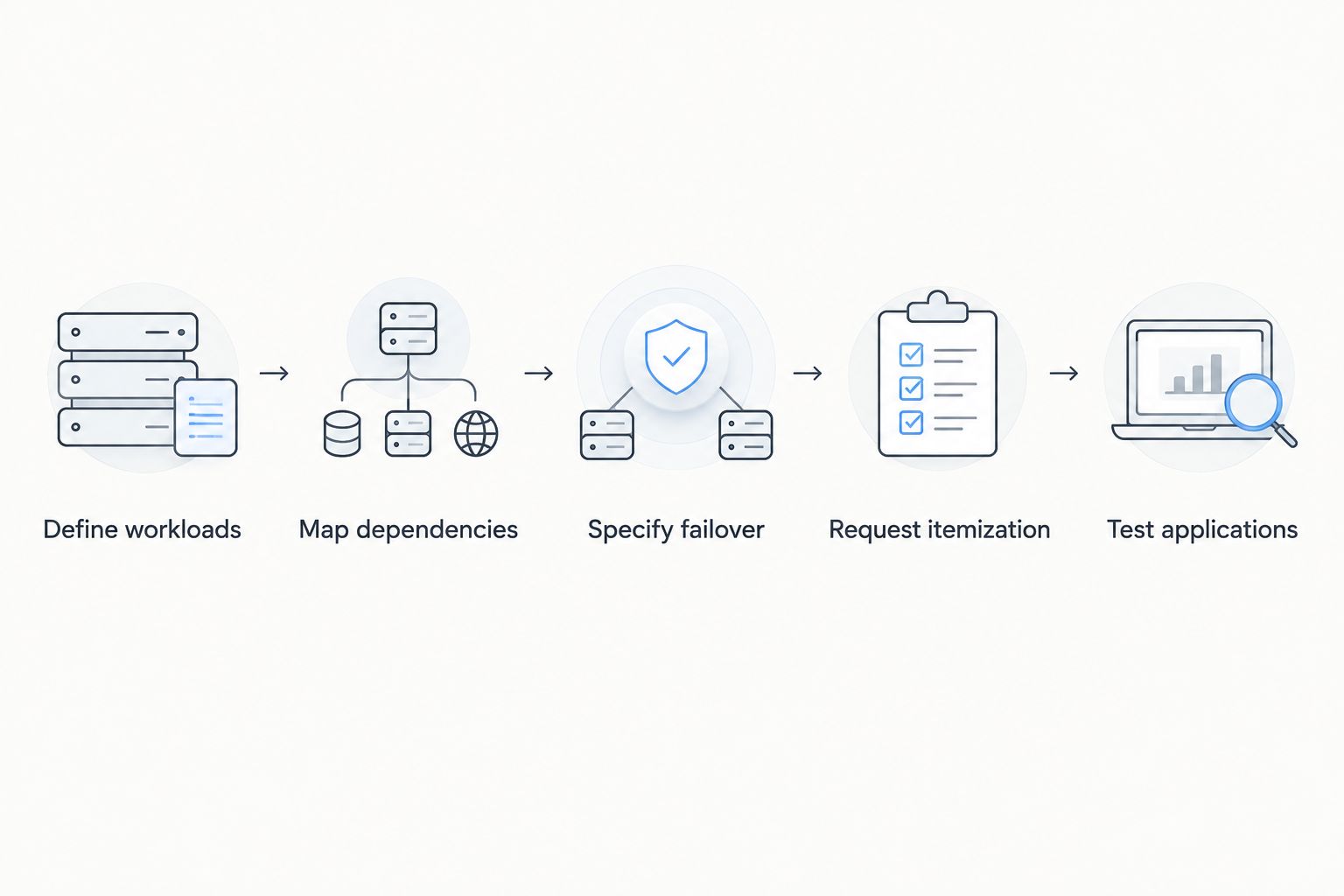
Give every provider the same written requirements. These steps turn a broad request for backup internet into a proposal you can evaluate.
- Define workloads. List essential applications, their destinations, and the users or devices that need access. Mark nonessential traffic for restriction during failover.
- Map dependencies. Identify power, routers, switches, authentication, and external services that the backup connection still needs. A second access link does not remove those dependencies.
- Specify failover. State whether switching is automatic or manual, who authorizes it, and what must happen when the primary connection returns.
- Request itemization. Require separate recurring, usage-based, and one-time charges. Ask for written explanations of exclusions and contract-end obligations.
- Test applications. Verify the required workflows over the backup connection under the intended configuration. Record failures and assign responsibility before acceptance.
The acceptance test should match the operating requirement. If your requirement is continued access to a specific business application, a connected status light does not prove success.
Does automatic failover mean applications stay connected?
Automatic failover changes the network path; it does not guarantee that every application session continues uninterrupted. Changes in routing or public IP address can require sessions or tunnels to reconnect.
Test remote access, authentication, voice services, and other required workflows individually. Document whether recovery happens automatically or needs an operator, then make that behavior part of your acceptance criteria.
For your 2026 rollout, include return-to-primary behavior in the test. A system that switches successfully during an outage still needs a controlled way to resume normal operation.
Should you budget for full-office internet during an outage?
Budget for full-office access only when your continuity requirement calls for it. Otherwise, define a restricted set of essential workloads and configure the network to enforce that decision.
Video meetings, software downloads, and camera uploads compete with business-critical traffic when they share a constrained connection. Written traffic priorities are more useful than an informal instruction to employees to use less bandwidth.
The trade-off is explicit: restricting traffic preserves resources for essential work but reduces what the rest of the business can do. Get operational approval for those restrictions before an outage exposes them.
Is a second connection enough if the building loses power?
A second connection cannot keep unpowered networking equipment running. Include the modem or terminal, router, switches, and required local devices in your power-dependency review.
Check the complete path rather than the access device alone. A powered satellite terminal or cellular router does not restore service through an unpowered switch or an unavailable authentication system.
FAQ
What should enterprise backup connectivity monthly cost include?
Enterprise backup connectivity monthly cost should include recurring access, recurring equipment payments, management, support, and billable usage. Track installation and purchased equipment separately so the monthly comparison stays clear.
Is LTE or satellite better for enterprise backup internet?
LTE fits sites with usable cellular service, while satellite fits sites needing a satellite access path. Choose through site assessment and application testing rather than assuming either technology is always better.
Can a mesh network replace a backup internet subscription?
A mesh network does not replace an upstream internet connection. It connects participating local nodes; external services still require a working upstream path.
Does a backup connection need monitoring while it is idle?
A backup connection needs health verification before an outage exposes a failure. Assign responsibility for monitoring and testing, and confirm how test traffic is treated under the service terms.
Will automatic failover keep my VPN connected?
Automatic failover does not guarantee uninterrupted VPN sessions. Test the specific VPN configuration because a changed network path or public IP address can require reconnection.
How should I compare enterprise backup proposals in 2026?
Compare enterprise backup proposals in 2026 using identical sites, workloads, support requirements, and acceptance tests. Separate recurring charges, usage-based charges, and one-time deployment work.
What does HeliosNet LLC offer for enterprise backup connectivity?
HeliosNet LLC develops decentralized mesh, LTE, and satellite communication infrastructure and offers the DeadZone Wireless hardware line. Evaluate a proposed configuration against your site's connectivity, power, and application requirements.
One last thing
The most useful acceptance test is a failed primary connection with your essential applications still in use. Test that scenario deliberately under an approved plan, then verify restoration as well as failover.
Before signing a 2026 contract, ask who owns each failed test: your team, the connectivity provider, or another supplier. An itemized bill explains the charges; an assigned owner explains who gets service working.