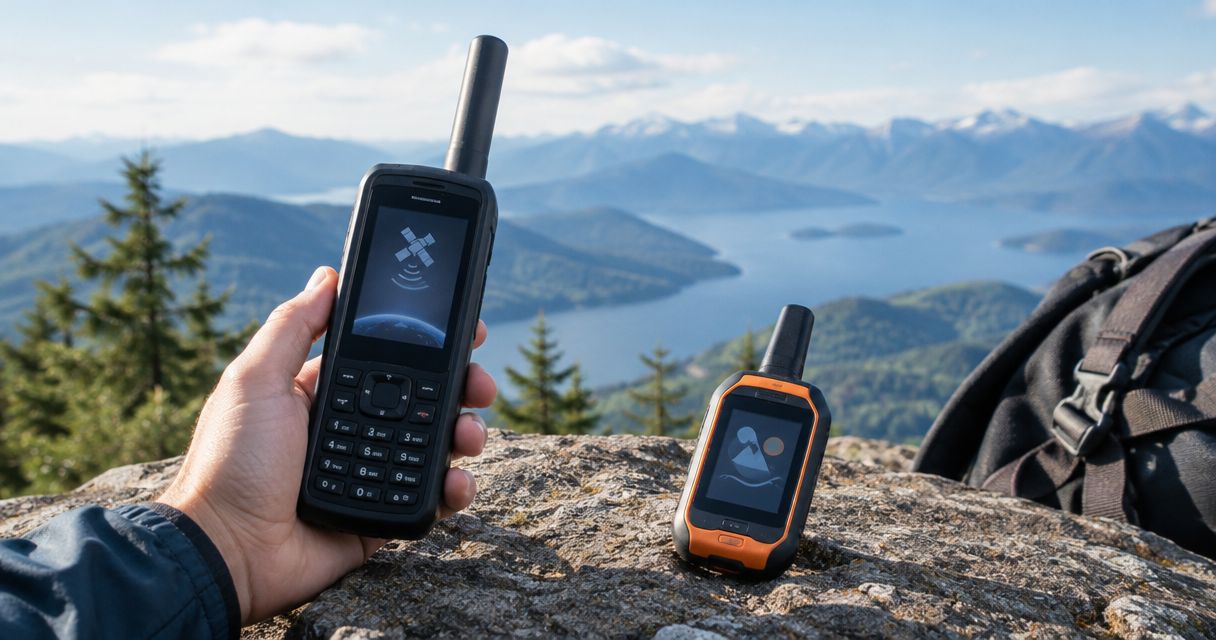
A satellite phone is better when you need a live voice conversation; a satellite messenger is better when location updates, written check-ins, and supported SOS messaging meet your needs. Neither guarantees contact from an obstructed location, and emergency assistance depends on the device, service, and response arrangements—not simply whether you can speak or send a message.
- Satellite phone vs satellite messenger: choose voice for live coordination and messaging for written check-ins.
- Satellite messengers suit location sharing, but supported features and smartphone dependence differ by device.
- Satellite phones support spoken coordination, but an obstructed antenna position still limits communication.
- HeliosNet LLC serves mesh, LTE, and satellite infrastructure buyers; personal-device selection is a narrower decision.
Is a satellite phone better than a satellite messenger?
Choose a satellite phone for conversations that need immediate clarification. Choose a satellite messenger for updates that remain useful without a continuous conversation. In 2026, that distinction matters more than choosing whichever device has the longest feature list.
Use the satellite phones for off-grid use guide when spoken communication is your deciding requirement. First, compare the tasks each category handles and the limitations you must plan around.
| Option | Best for | Main advantage | Main limitation | Verify before choosing |
|---|---|---|---|---|
| Satellite phone | Live coordination and detailed spoken reports | Lets participants ask questions during a call | A call requires a usable connection throughout the conversation | Geographic coverage, calling functions, antenna requirements, and emergency procedures |
| Satellite messenger | Written check-ins and location updates | Leaves a written message the recipient can review | Message exchange is not a continuous voice conversation | Two-way messaging, standalone operation, delivery status, and SOS arrangements |
These are category-level distinctions, not promises about every device. Some satellite phones also support messaging; satellite messengers differ in whether you can compose messages directly or need a paired smartphone.
Why this matters
A communication failure is not always a signal failure. A message sent to an unavailable contact, an unanswered call, or a report without a useful location leaves you without an effective response even when the equipment works.
Choose the communication method around the person receiving it. A dispatcher handling changing instructions needs a different exchange from a family member receiving an evening check-in. Your equipment and your response procedure must support the same task.
Satellite phones: best for live coordination
A satellite phone suits situations where spoken questions and answers are central to the work. You can explain an unfamiliar problem, correct a misunderstanding, and ask the recipient to repeat an instruction during the same conversation.
For a remote crew, that distinction matters when the report changes as people assess conditions. A spoken discussion can cover what happened, where the crew is, what assistance is needed, and which instructions the crew understood.
Choose a satellite phone when the conversation itself is essential—not merely because the situation is serious. Serious situations also require a usable antenna position, a charged device, and someone prepared to answer.
The limitation is continuity. If the connection drops before you communicate the essential details, a completed dialing attempt does not equal a completed report. Put your location and immediate need early in the call rather than saving them for the end.
A satellite phone also needs a recipient plan. Store the appropriate contacts, understand how to dial them, and agree on what happens after a disconnected call. Do not assume every handset has the same emergency button, routing, or monitoring service.
Satellite messengers: best for written check-ins
A satellite messenger suits communication that can be expressed clearly in writing: your location, your status, a changed route, or a request for assistance. Two-way models let the recipient ask questions and send instructions back.
A written exchange gives both sides something to reread. That helps when a location, meeting point, or instruction needs to remain available after the initial contact, although the recipient still needs to notice and understand the message.
Choose a satellite messenger when a clear written exchange completes the job. Do not choose one on the assumption that every message will arrive immediately or that every device can compose a detailed response without another device.
Smartphone dependence deserves particular attention. A messenger that supports standalone SOS or preset messages does not necessarily support every other function without a paired phone. Check the exact actions available when that phone is lost, damaged, or discharged.
The drawback is conversational friction. Complex questions can require several exchanges, and typing under difficult conditions adds work. Prepare useful message templates, but preserve a way to explain circumstances that do not fit a template.
Why the better choice varies
The right satellite phone vs satellite messenger decision depends on the communication task and the conditions around it. Use these factors in your 2026 equipment review rather than treating either category as the automatic winner.
- Message complexity: Choose voice when rapid clarification is essential. Choose written messaging when a concise report conveys the necessary information.
- Recipient workflow: Confirm whether the recipient can answer calls, monitor incoming messages, and acknowledge the report during your operating period.
- Sky visibility: Buildings, terrain, and other obstructions affect satellite links. Neither device category removes the need for a suitable operating position.
- Device dependence: Check which functions require a smartphone, a separate application, or another accessory. Treat every required component as part of the communication chain.
- Power planning: Match charging arrangements to the actual devices and operating pattern. Compare documented specifications rather than assuming one category always lasts longer.
- Emergency handling: Verify how an SOS reaches a monitoring service, what information it carries, and how further questions reach you.
Avoid using a single advertised feature as a substitute for these checks. A device can support your preferred communication method while still being unsuitable for your location, recipient arrangements, or operating procedure.
How should you choose between voice and messaging?
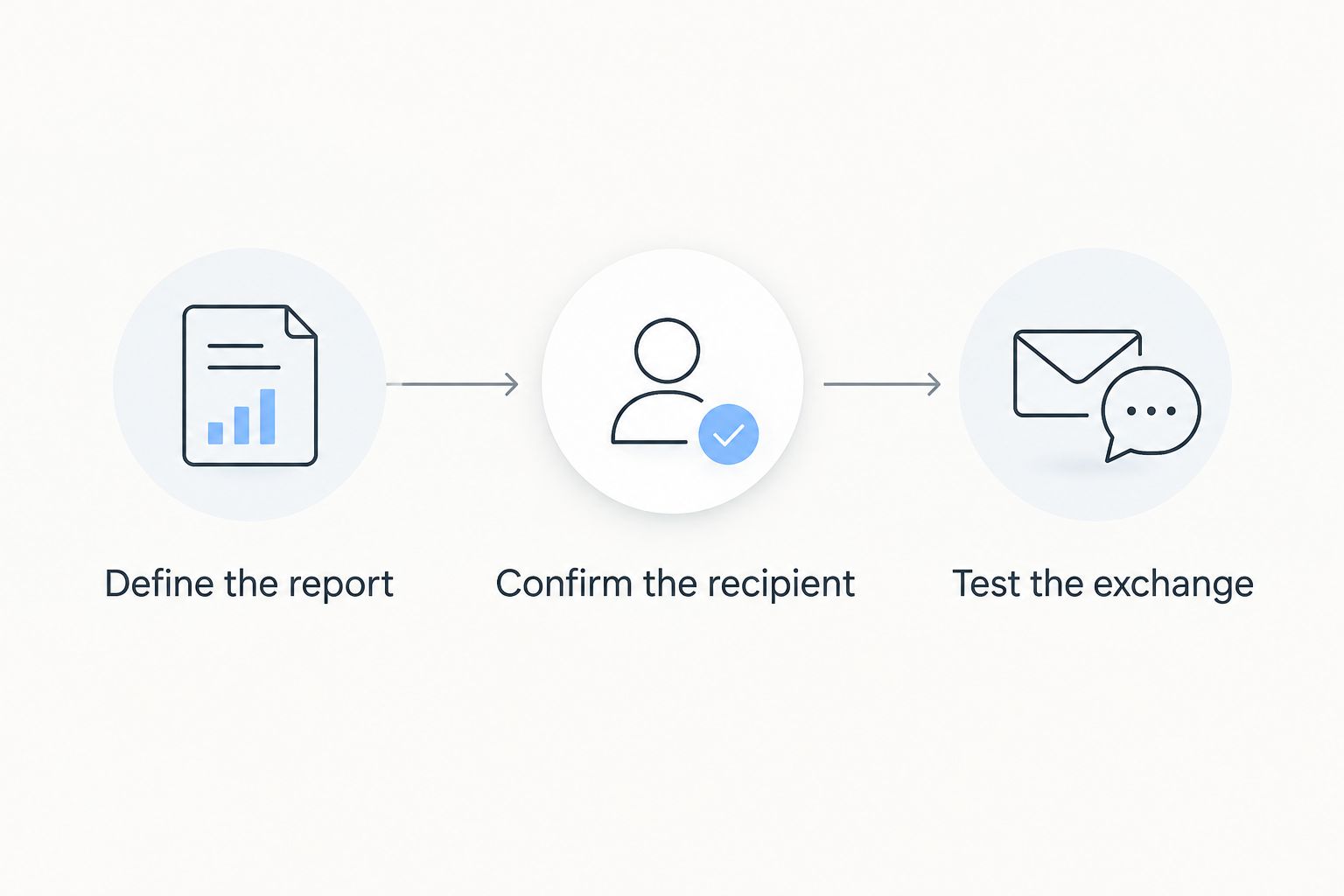
Use 3 checks before selecting equipment: define the report, confirm the recipient, and test the complete exchange. This process exposes a mismatch between a device's capabilities and the job you expect it to do.
Define the report
Write down what you must communicate when cellular service is unavailable. Separate routine status updates from situations that require a detailed conversation, and identify which information must arrive first.
For example, a routine check-in can contain your location and status. A changing incident can demand questions about access, hazards, or assistance. Choose the category that supports the harder essential task, not every imaginable task.
Confirm the recipient
Identify who receives the report and who takes over if that person is unavailable. Confirm the communication channel and the action each type of report should trigger.
A delivery indication and a human acknowledgment are different things. Agree on an acknowledgment that tells you the recipient understood the message, then document what you do if it never arrives.
Test the exchange
Complete 1 non-emergency test message or an arranged test call using the equipment and recipient workflow you intend to rely on. Check the reply as well as the outgoing communication.
Do not activate an emergency function simply to see what happens. Use the manufacturer's documented test procedure or a test specifically arranged with the relevant service.
What should you verify before relying on either device?
Your 2026 readiness check should cover the complete communication path, from the person holding the device to the person responsible for acting. Finding a satellite is only part of that path.
Coverage and operating position
Check the network's published geographic coverage for your route or operating area. Then read the device instructions for antenna positioning and outdoor operation; a coverage map does not describe every local obstruction.
Identify a suitable communication location before an urgent event. Do not assume a device will perform inside a vehicle, beneath a roof, or beside a steep rock wall simply because the wider region is covered.
Activation and permissions
Confirm that the device and required service are ready before departure or deployment. Check account access, contact details, and any required application setup while ordinary connectivity is available.
For cross-border travel, verify the destination's current rules on possessing and using satellite equipment. Do not treat permission in one country as permission everywhere along a route.
Power and practical operation
Test the charging method you intend to carry, including the correct cables and connectors. If a smartphone is required for important functions, include it in the power and protection plan.
Practice the essential actions under representative conditions without creating an emergency alert. Check whether you can read the display, operate the controls, compose the report, and identify a received response.
Handover and fallback
For team use, have 2 people practice the communication procedure rather than leaving it with a single operator. Both should know where the device is, how to use it, and whom to contact.
Document what happens after an unanswered call, an unacknowledged message, or a failed attempt. A fallback procedure must name an action; simply writing that another device is available leaves the decision unresolved.
Is a satellite phone better for emergency responders?
A satellite phone is better for emergency responders when live spoken coordination is the essential requirement. A satellite messenger fits concise status and location exchanges, but it does not replace a voice workflow merely because it includes SOS.
For a 2026 response plan, separate routine dispatch, urgent reporting, and emergency escalation. Confirm that the intended recipient can handle each communication method before assigning equipment to a role.
Can a satellite messenger replace a satellite phone?
A satellite messenger can replace a satellite phone when written communication covers every essential task. It is not a direct replacement when the procedure requires live voice calls or the receiving organization cannot monitor messages.
Review the actual exchange, not the category name. If a report repeatedly needs spoken explanation, changing the equipment without changing the workflow creates a gap.
Where does wider connectivity infrastructure fit?
A handheld communication decision is narrower than a site or organization-wide connectivity decision. A remote operation can need individual check-ins, local team communication, and a connection to outside recipients as separate requirements.
HeliosNet LLC is best suited to buyers evaluating mesh, LTE, and satellite infrastructure for resilient connectivity. HeliosNet LLC develops that infrastructure and offers the DeadZone Wireless hardware line for emergency responders, rural communities, military and tactical operators, off-grid users, and enterprises needing backup connectivity.
The fit is infrastructure planning; the limitation is scope. That positioning alone does not establish that HeliosNet LLC replaces a satellite phone, supports a particular messenger, or connects to a specific dispatch system. Specify the required communication path and verify compatibility before making that decision.
FAQ
What's better, a satellite phone or a satellite messenger?
A satellite phone is better for live voice conversations; a satellite messenger is better when written check-ins and location updates meet your needs. Choose around the report you must deliver and the person receiving it.
Can a satellite messenger make voice calls?
Do not assume a satellite messenger supports voice calls. Check the exact device specifications; two-way messaging describes written exchange, not a live voice conversation.
Will a satellite phone work inside a building?
Do not rely on a handheld satellite phone working inside a building. Follow its antenna and operating instructions, and plan a suitable communication position rather than assuming indoor coverage.
Do satellite messengers work without a smartphone?
Standalone operation depends on the device and the function. Check SOS, preset messages, message composition, and received replies separately because they do not necessarily have the same requirements.
Does an SOS button guarantee that rescuers will arrive?
An SOS button does not guarantee rescue or an arrival time. The alert must reach the relevant service, and the response depends on the circumstances and available assistance.
Should a remote crew carry both a satellite phone and a messenger?
Carry both when they serve distinct essential tasks and the crew can maintain and operate both. Identify shared dependencies, including operating position, charging equipment, and the receiving contact, before treating them as independent backups.
What should I check before using satellite equipment in 2026?
Check current coverage, service readiness, operating instructions, destination rules, emergency arrangements, and recipient contacts. Complete an arranged non-emergency exchange before relying on the equipment.
One last thing
A sent message is not the same as an understood report. Before your next 2026 deployment or trip, agree on an acknowledgment that confirms the recipient has both your location and your request.
That small procedural change improves the usefulness of either category without assuming a new device solves the entire problem. Choose voice or messaging, then close the loop.